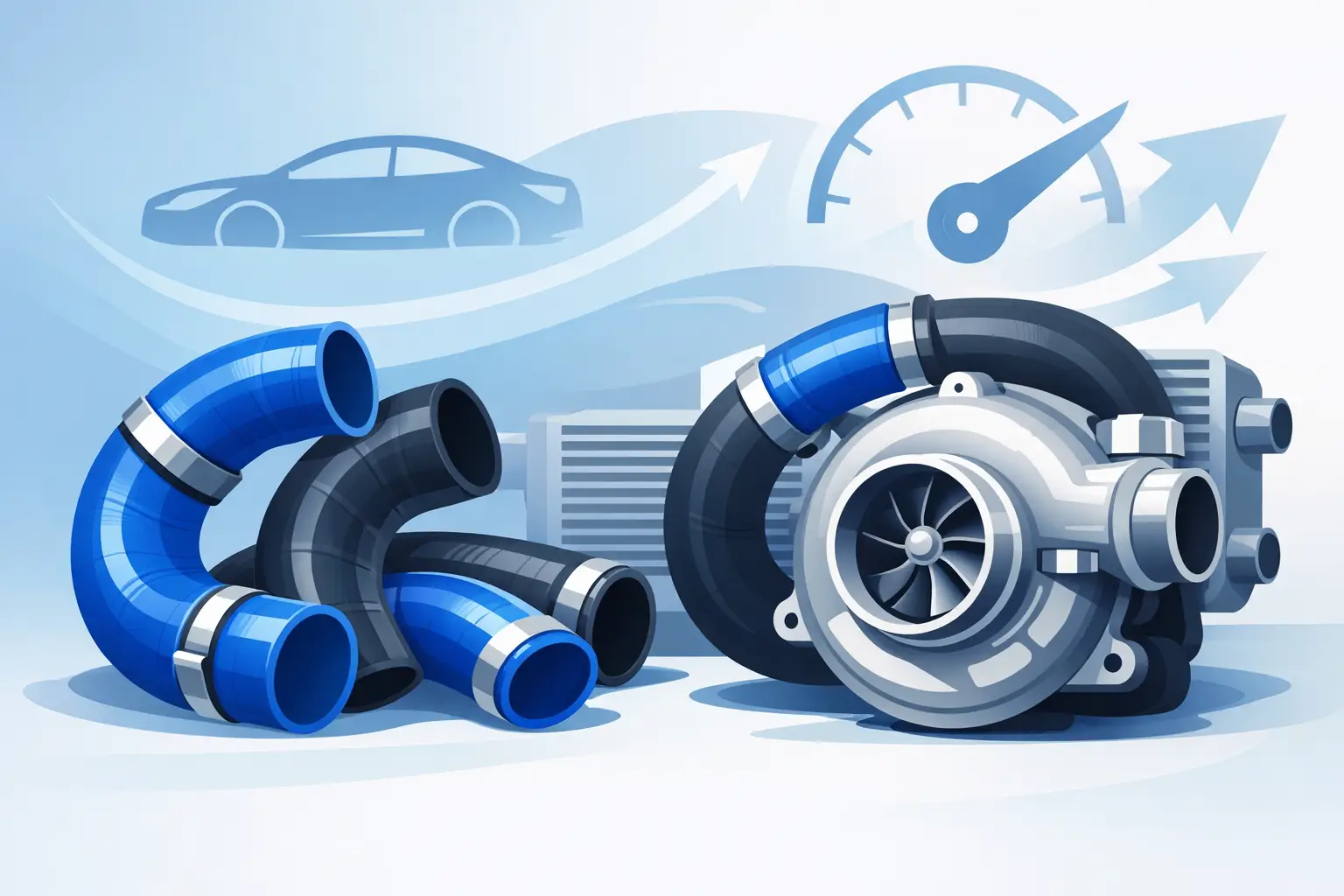
It's immediately noticeable when a turbo build has the wrong hoses. The boost pressure feels uneasy, the engine responds sluggishly, and suddenly you're chasing problems that aren't really in the turbo, manifold or wastegate. Turbo hoses are a detail that many want to solve quickly, but during hard driving they are far from a small thing. They are an active part of how the entire pressure side and sometimes even the vacuum control actually works.
On the street, the car might “just keep going” with half-tired hoses and questionable connections. On the track, drifting or rallying, it’s a different story. Then heat, vibrations, rapid load changes and high pressures will reveal every shortcut. The right hose choice is therefore not just about getting the system together, but about building for stable power, smooth response and fewer interruptions in the pits.
What is meant by turbo hoses?
When people talk about turbo hoses, they often mean several different things at once. This can include pressure hoses between the turbo, intercooler and intake, but also vacuum hoses for the wastegate, boost control and dump valve. In some builds, oil and cooling hoses around the turbo are also included, even though they technically have completely different requirements.
It is therefore important to start at the right end. A pressure hose on the charge air side must withstand overpressure, temperature changes and movement in the engine. A vacuum hose must maintain its shape and signal without collapsing or cracking. An oil or fuel hose close to the turbo, in turn, needs to withstand completely different media and often significantly higher temperatures. Not everything that looks like a hose is the same type of component.
That's why the right turbo hoses are crucial
The simple answer is that bad hoses cost performance and reliability. But there are more levels to it than that. If a charge air hose expands too much under pressure, you'll end up with a system that feels softer and less precise. If it starts to slip on the pipes or leak at the joint, you'll not only lose boost pressure, you'll also end up with a car that's difficult to troubleshoot because the symptoms can be similar to several other problems.
On the control side, things are just as sensitive. Small vacuum leaks can cause strange wastegate control, uneven boost pressure, or a dump valve that misbehaves. The result is often a car that feels unreliable even though the main components are actually the right ones.
Then there's durability. A hose that's too close to a manifold or turbo housing, or that rubs against the body, fan shroud, or other hard part, can last for weeks or even several seasons. The difference is rarely in luck, but in materials, routing, and how carefully the construction is done from the start.
Material selection for turbo hoses
For charge air, silicone is a common and proven choice. There's a reason why silicone is seen in everything from fast street builds to pure track cars. The material handles heat well, is flexible, and comes in many dimensions and shapes. With the right fabric reinforcement, it works very well for pressurized systems.
But silicone is not automatically best everywhere. For some applications, reinforced rubber hoses can work well, especially where temperature and movement are more normal. For oil and fuel systems around the turbo, it is often better to look at PTFE and AN solutions than to try to use universal hose for everything. There is no room for chance. The wrong material swells, hardens or breaks down faster than many people think.
Aluminum tubing combined with shorter silicone hoses is also common on the pressure side, especially when you want a stable system with less expansion. It often gives better control over pulling and attachment, but requires the fit and suspension to be correct. A poorly built tubing system is not better just because it looks more racing.
Silicone is strong, but not magical
This is a classic mistake in many builds. Silicone can withstand a lot, but not just anything. For extreme radiant heat, you need heat protection or other routing. If the hose clamps are too weak or the pipe ends are poorly beaded, even a nice silicone hose can start to creep off under boost pressure. Good material won't save a bad installation.
Dimension and fit – this is where a lot is decided
A hose that is too big is not “close enough”. A hose that is too small and forced on is also not right. When building the pressure side, the dimensions must match the pipes, intercooler connections and turbo housing. Otherwise, you will end up with joints that look okay in the garage but start to give way when everything gets hot and the car is put under real strain.
Too large a dimension on some stretches can also negatively affect response and package solution. This does not mean that the largest possible diameter is always best. You want a system that matches the power target, flow and available space. On a smaller street engine, the needs are different than on a heavily loaded track car with high flow throughout the system.
The fit is also about fittings. Straight hoses, 45-degree and 90-degree bends serve different purposes. If you force a straight hose to take a sharp angle, you build tension right in. It often looks okay for the first week, but that's exactly what leads to cracks, looseness or the hose wandering.
Common faults with turbo hoses
The most common mistake is actually not that people choose poor quality materials, but that they underestimate the whole. The hose is chosen separately, the clamps are something generic off the shelf, the pipes lack a proper edge, and the routing is done where there happened to be space. Then you are surprised when the car loses pressure after a few hard sessions.
Another common mistake is mixing applications. Vacuum hose is used where pressure hose is needed, universal hose is placed near heat sources it cannot handle, or components are used that are not made for oil and fuel-related environments. This sometimes works in the short term, but almost never works well in the long term.
Many people also miss the fact that the engine moves. This is especially true in cars with hard driving, stiffer engine mounts or a lot of vibration. If the hose system is built completely rigid without taking movement into account, the load can end up in the joints, intercooler or turbo instead of being absorbed in a controlled manner in the system.
Clamps and connections are half the job
A strong hose with the wrong clamp is still a weak point. Clamping force, width and how evenly the pressure is distributed play a big role. For the pressure side, you want clamps that hold evenly and securely without damaging the hose. And pipe ends need the right design to give the clamp something to work against. Smooth pipe end plus high boost pressure is a bad combination.
How to choose the right one for street, track and rally
On a street car with a moderate power increase, good silicone hoses in the right dimensions, sensible clamps and well-thought-out routing often go a long way. It is more important that everything fits correctly than that every part looks extreme. The goal is reliable response and a system that lasts over time.
For track driving and drifting, the requirements increase immediately. Longer loads, higher under-hood temperatures and more rapid load changes mean that the margins shrink. There it pays to prioritize better mounting, smarter routing and often a combination of fixed pipes and shorter hose sections.
In rallying, protection against vibrations, dirt and chafing becomes extra important. A solution that works fine on a clean street car can have problems when the car is driven hard over uneven surfaces. There, the hose routing must withstand reality, not just look nice in the engine compartment.
This is also where a well-thought-out range makes a difference. A player like House of Motorsport is usually interesting for builders who want to match turbo hoses with the right couplings, AN/PTFE solutions and other parts in the same project, instead of chasing compromises from multiple directions.
When should you replace turbo hoses?
If you see dry cracks, oil seeping into the joints, discoloration from heat, or the hose starting to become soft and spongy, then it's time to take action. The same goes if the car suddenly starts to behave differently under boost pressure, especially if the problem only appears when everything is warm.
There is no exact replacement interval that fits everyone. A street car that runs smoothly can run for a long time on a good system. A heavily used track or rally car should be checked much more often. If you drive with high boost pressure or near heat sources, inspection is part of maintenance, not something you do when problems have already arisen.
Build for impact that lasts
Turbo hoses may not be the sexiest item on your shopping list, but they have more impact than many people want to admit. A quick turbo build is never better than its weakest connection, and very often the weak point is in the hose, clamp or harness. When you choose the right material, the right dimension and the right installation, you don't just get a nicer looking engine compartment - you get a system that delivers when the car is pushed.
Therefore, put the same focus on the hoses as on the turbo, intercooler and mapping. That's how you build boost pressure that lasts when it really counts.