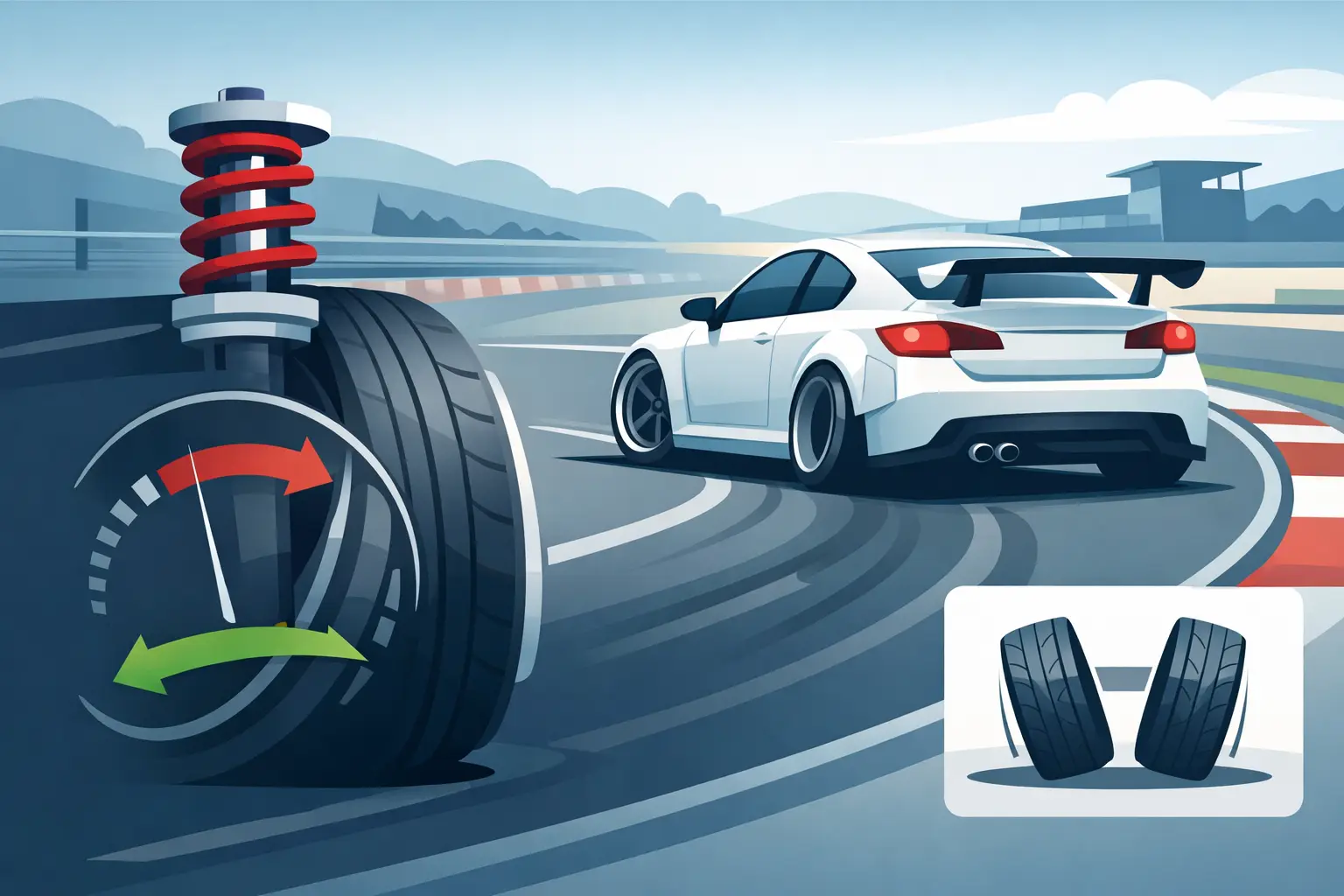
When the car feels strong going into a corner but still gives up on the outside wheel after a few laps, it's rarely a lack of power. More often it's geometry. Setting camber for track is one of the most effective adjustments you can make to get better grip, more even temperature across the tire, and a car that responds harder when you start to charge.
This is not a magic number that fits everyone. Camber is about how the tire sits against the asphalt when the car brakes, rolls and takes load through the corner. Too little negative camber and you wear the outside of the tire while the car starts to understeer. Too much and you lose braking stability, traction out of slow sections and, worst of all, contact patch when you really need it. On the track, there is speed to be gained, but only if the rest of the package keeps up.
What camber actually does on the track
Camber is the angle of the wheel when viewed from the front or rear. Negative camber means that the top of the wheel leans inward towards the car. On a street car, it is often set quite conservatively to work in everything from highways to potholes and low tire wear. On the track, different rules apply.
When the car enters a curve, the chassis leans. The outer tire then wants to be as flat against the asphalt as possible under load. That's where negative camber comes in. With the right angle, you get a better contact patch as the car works, which gives you more grip in the middle and end of the turn. This often feels like sharper turn-in, better support on the front end, and a car that holds its line longer without starting to stick out its nose.
But camber never works alone. Springs, anti-roll bars, damper settings , tire type, air pressure and toe all affect how much camber you actually need. That's why figures from forums are often pretty useless if you copy them straight.
Setting camber for the track – start with the right goal
The most common misconception is that more negative camber is always better. It's not. You're not chasing the highest possible number, you're chasing the best possible working surface on the tire during your particular ride.
If you drive a front-wheel drive car with a heavy nose, semi-slicks and an aggressive driving style, the front will almost always want more negative camber than a rear-wheel drive street-ready car on regular UUHP tires. A light car with stiff suspension and good camber gain in the front can work with less static camber than a heavier car that rolls more. Same thing at the rear – there it is often more about stability and drive out of the corner than about maximum initial turn-in.
A good goal is for the car to use the tire evenly across the tread during a really hard session. Not after a quiet transport route. Not after a lap behind traffic. After load.
Typical ranges to start from
As a rough starting point, many trackday cars are somewhere around -2,0 to -3,5 degrees up front and about -1,5 to -2,5 degrees at the rear. But those are just starting points. A McPherson front suspension often needs more negative camber up front than a double A-arm solution to get the same cornering behavior. A car that is used on both the street and track also needs a compromise that doesn't eat tires on the way to work.
The important thing is not to hit a number that looks tough on a setup sheet. The important thing is how the car carries the tire when you drive hard.
How do you know the camber is wrong?
Too little negative camber at the front is often felt immediately. The car starts to turn in okay but soon starts to slide on the outside edge of the front tire. The steering wheel needs more angle, the temperature builds on the outside of the tread and the tire looks punished after the session. You may also notice that the car gets worse the harder you push, even though the brakes and tires actually have more to give.
Too much negative camber at the front gives a different feel. Turn-in may feel snappy, but the car becomes nervous under braking, has poorer straight-line stability and is less confident when you unload from slow turns. The tire can wear more on the inside and you sometimes get worse grip when the speed is lower and the chassis doesn't have time to work fully.
At the rear, the wrong camber is more noticeable in the balance. Too little negative camber at the rear can provide less support in the middle of a turn and a rear end that doesn't feel as planted. Too much can make the car sluggish out of a corner or less predictable when the grip starts to lose.
How to set camber for track in practice
Start by making sure the rest of the chassis is in order. Loose bushings, worn top bearings or uneven height will make the entire adjustment pointless. Wheel alignment should be done with the correct ride height, the correct tire pressure as a starting position and preferably with the weight the car is actually being driven with.
If the car has camber plates, adjustable top mounts or control arms, use them. If it doesn't, you sometimes need to rebuild it to achieve reasonable track performance. This is often where the difference between street trim and actual track prep begins to show.
First set a reasonable base level and drive. After a hard session, check the tire wear and preferably the temperature over the inner edge, center and outer edge. If the outside is clearly warmer than the front, you often have too little negative camber or too high pressure, sometimes both. If the inside is clearly warmer and the car feels nervous, you may have gone too far.
The fastest way to learn is to change a little at a time. Not a whole degree at once. Make small steps, preferably 0,2 to 0,4 degrees, and feel what happens in the same type of driving. Then you will also see the difference between real improvement and placebo from the pit.
Don't forget toe
Camber and toe are closely related. Changing camber often affects toe, especially at the front. A car with good camber but the wrong toe can feel worse than before the adjustment. A little toe out at the front can give faster steering on the track, but too much makes the car anxious and wears out the tires. Many people want stability at the rear, but even there it depends on the type of car, drivetrain and use.
So you can't talk about setting camber for the track as if it were a single knob to turn. Geometry is a package.
Tires, chassis and driving style determine more than you think
Semi-slicks with a stiff carcass can withstand and often require a different setup than regular street tires. Soft street tires roll more on the shoulder and can trick you into chasing more camber than is actually optimal. At the same time, a really stiff coilover kit can reduce the need for extreme static camber because the car rolls less in the corner.
Driving style also plays a role. A driver who brakes late, carries high speed and works the car hard over the front tires usually has to think differently than someone who drives more smoothly and prioritizes stability and drifting out of turns. The same car can therefore end up with different setups depending on who is behind the wheel.
This is also why a track with fast long corners may require something different than a technical track with lots of hairpins. There is nothing wrong with having a street setup, a mixed setup and a pure track configuration if the car is used a lot.
Common mistakes when chasing more grip
A classic mistake is to read the tires too early. After a half-hearted session, everything often looks better than it does under full load. Another is to only look at wear and not the feel of the car. If the car has become faster on one lap but harder to trust over an entire session, the setup may not be better, just sharper in a narrow window.
Many people also confuse symptoms. Understeer does not always need to be solved with more camber at the front. It could just as easily be too high front tire pressure, too soft front suspension, wrong toe or a rear suspension that does not help. The same thing at the rear – a nervous rear end does not automatically mean too little camber.
The third mistake is forgetting to use it between the bank corners. If you drive your car on the road to and from the track, you need to accept a compromise. Very negative camber can work perfectly on laps but be tiring on the street, especially on rutted asphalt and with uneven wear over time.
When hardware becomes the limitation
If you can't get the car where you want it to go with the adjustments available, it's often not you who's wrong. It's the hardware that's holding you back. Original equipment upper bearings, fixed control arms or soft bushings limit how precisely you can work. Here, the right components can make a bigger difference than fine-tuning another tenth of a degree in an already compromised geometry.
For a serious banker, it's worth building a front and rear suspension that can actually be adjusted and that holds its value under load. This is especially true for cars that are starting to gain enough grip, braking ability and speed to really expose weaknesses in the chassis. That's exactly where a supplier like House of Motorsport becomes relevant - when you want parts that don't just look good on paper but last when the car is used the way it's supposed to.
Good camber isn't the most glamorous upgrade in the garage. It's barely noticeable. But on the track, it's felt in every braking, every apex, and every lap where the tires are still working instead of giving up. Start with a sensible foundation, measure after real laps, and let the car do the talking. That's how you find a setup that not only looks fast in the pits but actually delivers when the helmet is on.