When the brake pedal feels long after a few hard stops, it's easy to start chasing bigger discs, more aggressive pads and more pistons. But sometimes part of the feeling is in a much smaller component. The question of steel-braided brake hoses or rubber is not just about appearance in the wheel well. It's about pedal response, heat resistance, assembly and whether the car is actually used on the street, track, rally track or in the pits.
For a regular street car with fresh original parts, a rubber hose can work perfectly fine. For the car that is braked late lap after lap, gets intense heat from the brakes and chassis, or is built with a focus on precise control, the choice is more loaded. Here we go through what actually makes the difference – without marketing hype and without pretending that the same solution is best for every build.
What happens in the brake hose when you pedal?
The brake fluid is supposed to transfer the force from the master cylinder to the caliper. Ideally, all the pressure from your foot should become piston movement in the caliper. In reality, a hose can move a little when the system is pressurized. The more the hose expands, the more pedal travel you can experience before the pads fully bite.
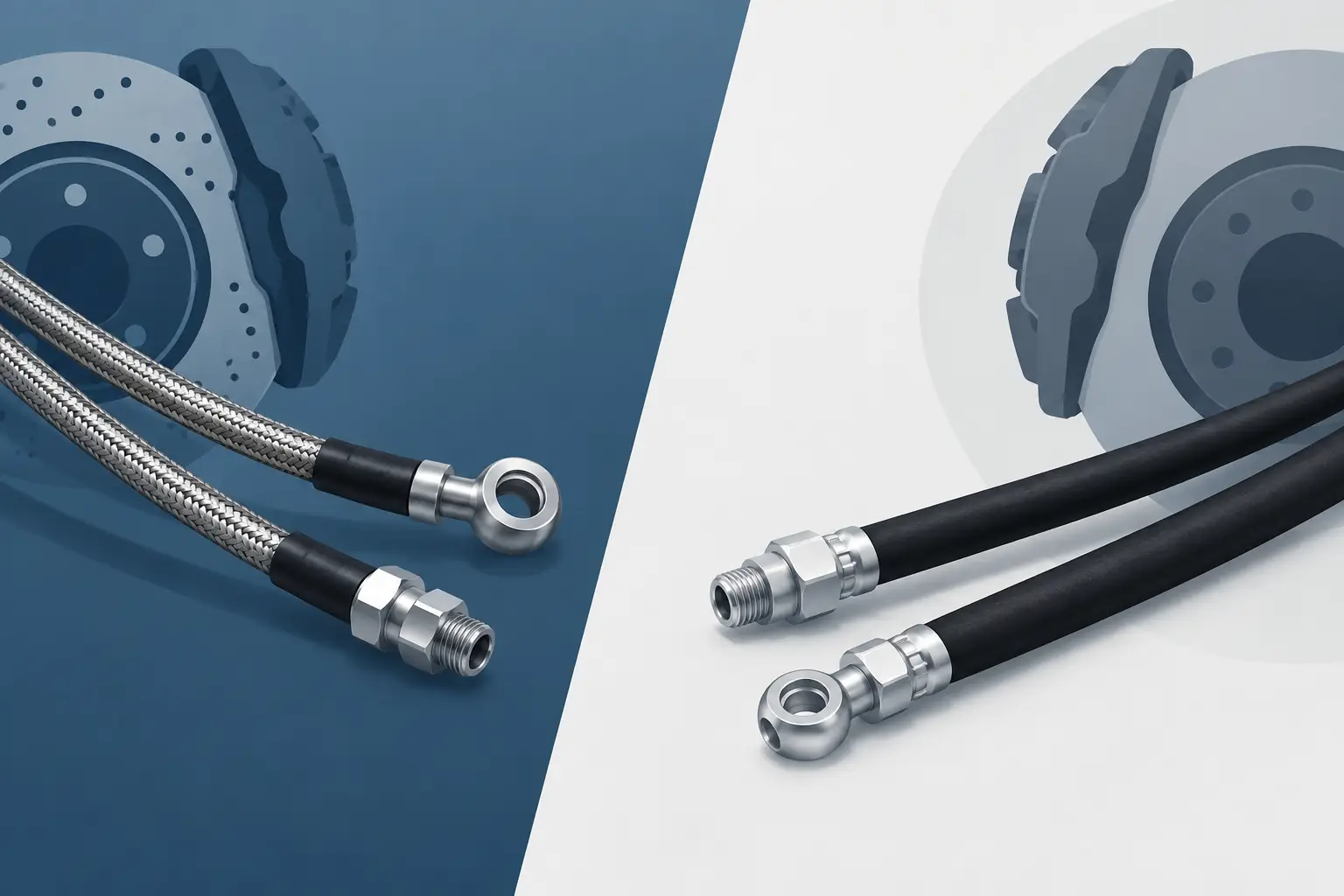
An original rubber hose is built to be flexible, withstand movement between the body and suspension, and last a long time in normal use. It has several layers and is not just a simple piece of rubber. But rubber ages with time, heat, dirt, ozone, and brake fluid. On an older enthusiast car, the condition of the hoses can therefore play a bigger role than many people think.
A steel braided brake hose typically has an inner PTFE hose, a stainless steel braided layer, and often an outer plastic cover. The design limits the hose's expansion under pressure. The result can be a firmer, more direct pedal, especially when the brake system is exposed to high temperatures and repeated hard braking.
The word can be honest here. A new hose does not automatically make the brakes brutal. If you have air in the system, old fluids, bad pads, flexing calipers or worn discs, steel reinforcement will not solve the basic problem. However, it can remove a source of sponginess and provide more consistent pedal pressure.
Steel-braided brake hoses or rubber: the actual difference
The most noticeable difference is usually the feel of the pedal. Steel-braided hoses often give less compliance and thus a more defined response. On the track this is valuable because you are braking close to the limit, often with the same reference point lap after lap. A pedal that behaves the same way when you enter the third heat is easier to trust.
On the street, the difference is sometimes subtle. A modern car with short, fresh original hoses and a well-maintained brake system can feel very good with rubber. However, if you replace 20-year-old original hoses with quality steel-braided hoses, bleed the system properly and choose the right brake fluid, many people experience a more noticeable improvement. Then it is difficult to determine how much of the part is hose, fluid and correct bleeding – but the whole is what counts.
The rubber hose also has an advantage that is rarely brought up in the discussion: it is forgiving of movement and incorrect pulling. A high-quality original type is designed for the car's suspension travel, attachments and everyday environment. This makes it a sensible choice when the car is to be restored, kept original or used as a pure utility car.
The steel braid requires more precision. A braided hose must never rub against the rim, tire, strut or control arm. It must not be twisted during assembly, stretched in a fully sprung position or have a bend radius that is too tight. If installed incorrectly, an expensive motorsport part can become a weak point. The right length, the right banjo coupling, the right attachment and control throughout the entire steering and suspension movement are not details – it is the job.
Outer casing is more than cosmetics
Many steel braided hoses have a PVC or plastic coating on the outside of the steel braid. This protects against dirt and reduces the risk of the braid rubbing against surrounding components. It can also make it easier to detect if a hose has been damaged.
A completely unprotected steel hose looks raw, but can collect dirt and be less kind to nearby parts if the traction is not perfect. For a street and track car, a quality hose with a protective outer casing is often a smarter choice than choosing the most race-ready look.
When is steel wrap the right upgrade?
For track driving, time attack, drifting and active rally driving, steel braided brake hoses are a logical part of a brake package. Especially if you already drive with pads that work at higher temperatures, better brake fluid and brakes that have to work hard. The hose then contributes to the consistency you want when the braking points are moved later and the speed increases.
On rally cars, durability and proper routing are just as important as pedal response. Hoses must withstand movement, vibration, stone chips and service in real-world conditions. So choose a solution that is designed for the application and the car, not just a universal hose that happens to be the right length on the workbench.
For the street car with a sportier ride, it depends on the goal. If you want to freshen up old wear parts and at the same time get a more precise feel, a model-specific steel braided kit is a good move. If you only want to replace a cracked original hose on a commuter car, a quality rubber hose is often both economically and functionally reasonable.
There are also builds where brakes, suspension and engine are far from original. In these cases, AN and PTFE-based solutions may be the way to go, but they place higher demands on component selection and assembly. Custom brake lines are no place for guesswork. Coupling types, seals, mobility and working pressure must be right from the start.
Don't forget the street car rules
A brake hose is a safety-critical part. On a car that is to be driven on public roads, the component must be approved for the purpose and fit the car in question. Choose model-specific hose kits from established manufacturers, with the right connections and documentation, instead of taking chances with generic motorsport parts.
Inspection and regulations can be affected by car model, year, and how the modification is performed. If you are building for both street and track use, it is wise to check the requirements before installing the parts. It is much more fun to spend your time on the next track session than to redo a system that does not meet the requirements.
A hose change requires more than two wrenches
When replacing, treat the system as the safety job it is. Use the correct brake fluid for the vehicle and application, protect the paint from spills, and install connections according to the manufacturer's instructions. Avoid pulling on a brake hose to make it fit. If it doesn't fit properly, it's the wrong hose, the wrong routing, or the wrong mount.
After installation, check that the hose has sufficient freedom with the wheels fully in both directions and through the suspension movement. Look for contact points, kinks, twisting and stretching. Then bleed the brakes thoroughly and test the brakes carefully before the car is allowed to work hard. If the pedal still feels spongy, troubleshoot – do not drive faster to see if it goes away.
Also take the opportunity to inspect the caliper sliding pins, the condition of the discs, the thickness of the pads and the age of the fluid. The feel of the brake pedal is the result of the entire system. Combining the right hose with fresh fluid, good pads and proper service often has a greater effect than upgrading a single part and hoping for magic.
Choose according to how the car is braked
The steel-wrapped tire is for the driver who demands clarity, repeatability and a component that is suitable for a serious sports, rally or race build. Rubber is not automatically budget or bad – a new, original quality type is right for many street cars and works great when the car is used as it was intended.
The key is to match the part to the load, the car and the level of ambition. If you are building for late braking points and hard sessions, choose a model-specific quality solution and install it as if the next braking really matters. Because it does.