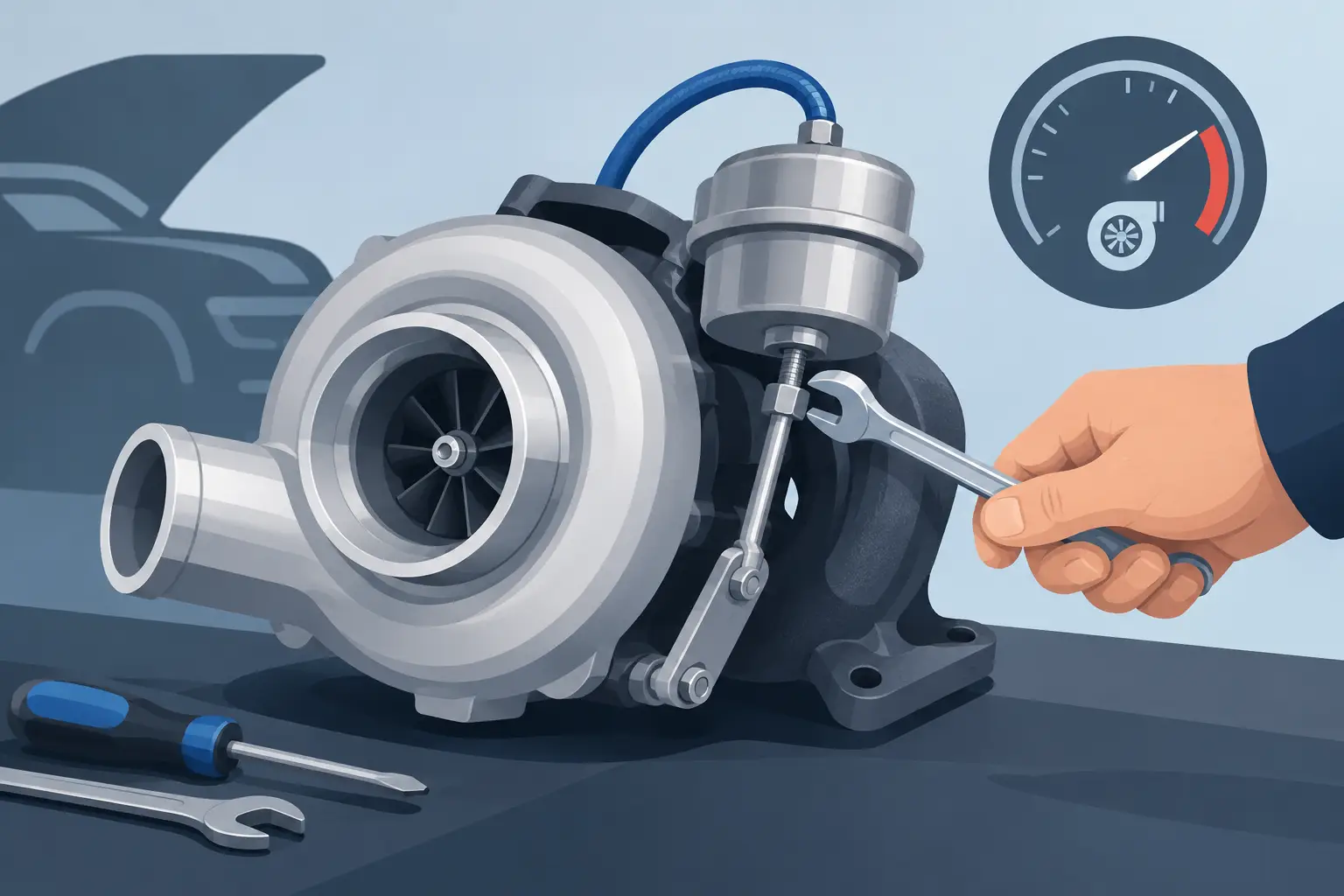
Half a turn on the wastegate rod can be the difference between a boost pressure that lasts the whole race and an engine that nails itself to pieces before the next braking point. Adjusting the wastegate on a turbocharged engine is not about chasing the highest possible number on the boost gauge. It's about getting the turbo, control system, fuel and ignition to work as a package – regardless of whether the car is built for street, track, rally or drifting.
The wastegate is the turbo system's pressure regulator. When it opens, some of the exhaust gases are directed past the turbine wheel, which slows down the turbo and limits the boost pressure. The adjustment therefore affects both how early the boost arrives, how stable it is and how much margin the engine's other components have under full load.
What the wastegate adjustment actually controls
On a turbo with an internal wastegate, there is usually a pressure bell with a rod attached to the wastegate arm. The preload of the rod determines how much force is required before the valve starts to open. More preload usually increases the mechanical base pressure, while less preload usually lowers it. On an external wastegate, the spring in the bell controls the base pressure instead.
Base pressure is not the same as the car's final boost pressure. If you have an electronic or manual boost pressure control, the system can build higher pressure than the wastegate spring or clock is specified for. However, the wastegate sets the foundation. If the base pressure is wrong, an advanced boost controller, a well-written folder or a larger turbocharger will be difficult to get in order.
Too low a preload can result in sluggish response, poor boost and a wastegate that opens too early. Too high a preload can cause the valve to not open enough, which causes boost creep – the boost pressure continues to rise even though the control tries to hold back. This is especially common when the exhaust system is open, the turbo is small or the engine flows significantly better than original.
Before adjusting the wastegate on a turbocharged engine
Never start at the throttle body unless you know what the car's actual boost pressure is. A clean boost gauge or logging from a reliable MAP sensor is the minimum. For a tuned turbo engine, you should also be able to see lambda or AFR, intake temperature and preferably knock values. It's not enough for the car to feel fast in third gear.
Also check the hose routing to the wastegate and boost pressure control. A cracked vacuum hose, incorrectly connected solenoid valve or leak in the pressure pipe can cause the same symptoms as a incorrectly adjusted wastegate. It is advisable to test the system with pressure before you screw. Look for leaks at the compressor housing, dump valve, intake, injector seats and all connections that have been exposed to heat and vibration.
The basic health of the engine determines how much boost it can handle. The capacity of the fuel pump , the duty cycle of the injectors, the heat index of the spark plugs, the function of the intercooler, exhaust pressure and mapping need to be included in the calculation. A boost pressure that works on a cold evening may be completely wrong after five laps on the track on a hot day. The same applies to different fuels – a mapping for 98 octane is not automatically ready for more boost just because you have fitted better pipes or a freer exhaust system.
How to adjust the wastegate methodically
Work in small increments and change one thing at a time. On an internal wastegate, this usually means one to two full turns of the rod, then another check under load. Write down the initial position before you touch anything. Feel free to measure how many visible threads there are, or mark the rod and fork with a paint pen. That way you can always return to a position that worked.
Set the base pressure first
Disconnect or bypass the boost pressure control according to how your installation is built, so that the wastegate operates at its mechanical base pressure. Then do a controlled load test on a suitable road, brake dyno or track. Look at the boost curve throughout the entire rev range, not just at the highest note.
If the base pressure is too low, you can increase the preload carefully. On many internal wastegates, the rod is shortened to increase the preload, but designs vary. Always check how your particular watch and arm work before assuming the direction. The rod should normally need to be pulled a little to reach the mount, but it should not be so tight that the wastegate arm can barely move.
On an external wastegate, the correct method is usually to choose a spring that matches the desired base pressure. Trying to solve everything with electronic control when the spring is far from the target often results in poorer control. For example, if you want to run a moderate street charge with stable response, a reasonable base spring is better than asking the solenoid to do all the work.
Add steering afterwards
When the base pressure is stable, you can engage the manual or electronic boost pressure control again. Then raise the boost gradually and follow the logs. Be especially vigilant for pressure spikes at start-up and if the boost pressure pulls away at high revs. A spike may feel brutal from the driver's seat but often costs more than it tastes, especially on original pistons, standard rods or an engine with limited knock margin.
Electronic control often provides the best opportunity to control boost pressure gear by gear, against rpm and based on intake temperature. It is worth its weight in gold on a car that needs to get traction out of hairpins or be driven hard on the track. But it cannot compensate for a wastegate that is too small, a poorly ported turbine housing solution or a mechanical that seizes.
Verify under real load
A short test run is rarely enough. Load through at least one gear where the engine is under heavy load for a while and check both the load curve and engine values. Also make sure the car is properly warmed up. Cold oil, low intake temperature and a quick test can hide problems that only become apparent when everything has reached temperature.
If you change boost pressure, the mapping must follow suit. More air requires the right amount of fuel and often an adapted ignition. A broadband lambda that looks good at a single speed does not exonerate the map over the entire register. If you do not have the opportunity to log and calibrate safely, it is wiser to keep the boost conservative until the car can be mapped properly.
Common errors when boost pressure is not behaving
If the car doesn't reach the target boost even though you increase the preload, the wastegate may be leaking, the pressure bell may be tired or the turbo may be too small for the engine's flow. Even a leak after the turbo steals response and power. Start with a pressure test before ordering parts on a whim.
If boost pressure rises uncontrollably at high rpm, boost creep is more likely. Then the solution is rarely to screw on the wastegate rod further. A larger or better positioned external wastegate, porting of the internal wastegate channel or a turbine housing that fits the power target may be needed. It is a hardware issue, not a setting that can be magicked away.
A boost pressure that fluctuates can be caused by too aggressive steering, the wrong restrictor, too long hoses or a solenoid valve that is incorrectly connected. Short and clear hose routing, correct connections and a calmer steering strategy often do more than raise the setpoint. In a race car, stability through an entire heat is always more useful than a top note that only appears in the log for half a second.
Build for the impact goal, not the margin
Wastegate and boost pressure control should be sized according to the turbo, engine and use. A street car with an original bottom normally needs a much more cautious strategy than a built engine with the right fuel system, temperature control and mapping. A rally car needs response and repeatability over changing loads, while a drifter may prioritize a boost register that can be held on the gas without the car becoming difficult to control.
Choose components that can handle the temperature and use. Heat-protected hoses, the right AN or vacuum fittings, a stable wastegate and a quality solenoid valve are small details compared to the engine build, but they often determine whether the car delivers lap after lap. House of Motorsport targets precisely the type of builds where brakes, driveline , fuel system and turbo setup must work together under load.
The fastest car is rarely the one that runs the most boost on paper. It's the car that maintains the right boost, the right lambda and the right temperature when you're still on the gas after several hard minutes. Adjust calmly, log carefully and let each change earn its place in the build.