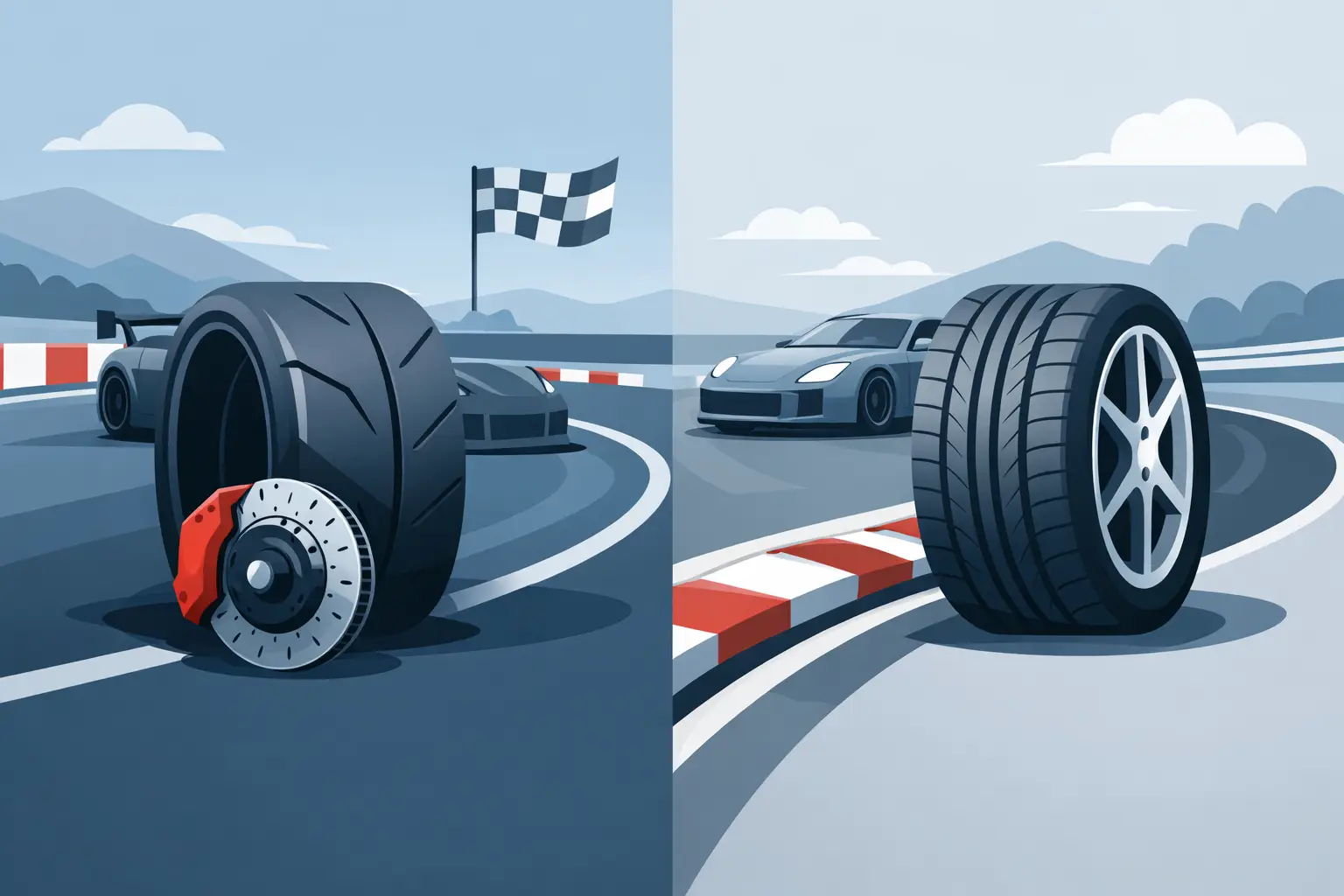
The first track run often feels great until the tires start to give out after three laps. Then the question comes right back in the pits – R-tyres or street tires for the track? The answer is not always what people want to hear, because it depends less on what is “best” and more on how you drive, how much the car weighs, how the chassis is set up and what you actually want to get out of the day.
The simple answer is that road tires almost always provide better grip and better lap times when everything works. The less simple answer is that street tires are in many cases smarter, cheaper and actually better for building speed, routine and a more consistent driving style. If you run the wrong tires for your level or setup, the car will feel worse, not faster.
R-tire or street tire on track – what's the difference?
R-tire are built to work closely with track driving and club motorsport. The rubber compound is softer, the carcasses are often stiffer and the pattern is more sparing. The result is faster response, higher lateral grip and better braking grip when the tire is in the right temperature window.
Street tires are a compromise for reality. They have to work in rain, cold, highway speeds, rutting, everyday wear and tear, and sometimes even low noise. A good UHP tire or max performance tire can absolutely work on the track, but it's not made to be fed lap after lap of high heat.
That doesn't mean street tires are bad. It means they have a wider job. An R tire has a narrower job, but does that job harder.
When r-tyres are the right choice
If you chase lap times, drive regular track days and already have a handle on air pressure, temperature and basic chassis balance, then R-tyres start to make sense. You'll notice a clear difference in braking, entry speed and how long the car stays stable through long, loaded corners.
An R-tire can also handle more lateral load before it feels spongy. On a car with good coilovers, sensible camber and order on the brakes, there is often a completely different precision. Turn-in is sharper, the car rolls less on the tire side and you can work closer to the limit without the feeling disappearing immediately.
But here comes the downside. R-tire sets higher demands on setup. If you have too little negative camber, the wrong pressure or a car that overheats the front tires, an expensive R-tire will quickly look ruined. Then you have paid more for a shorter lifespan and uneven performance. On a heavy front-wheel drive car without chassis work, an R-tire can also mask problems at first and then fall off hard when the temperature rises.
When street tires on track are the smarter choice
If you're new to the track, driving the car to and from the event, and want a package that works without drama, then street tires are often the right choice. Especially if you're still practicing braking points, line selection, and how the car reacts when the grip loses traction.
Street tires often communicate more gradually near the limit. They don't always release as abruptly, they cost less per mile driven, and they can provide more learning per dollar. For many drivers, that's worth a lot more than the final seconds of lap time.
There is also a practical side. With street tires, you often avoid trailers, extra wheels and more weather stress. If it rains in the middle of the day, many street tires are significantly more forgiving than r-tires. For those who drive mixed use – street, track and maybe a little active country road – a good performance street tire is often the most sensible overall choice.
Grip is only half the truth
It's easy to focus on maximum grip, but grip without control is not automatically faster. An R-tire can increase capacity so much that weaknesses in brakes, suspension and driving style become more apparent. The braking points are moved forward, cornering speed increases and suddenly the rest of the car is working at a level it wasn't really built for.
It is often noticeable in brake temperature, outer edges of the tires and how the car behaves after a few laps. Many people experience that the car first feels brutal on R tires and then strange when the temperatures rise. In that case, it is rarely the tire itself that is the problem. It is the whole.
With street tires, the limit is lower, but often more manageable. You get more movement in the car, more tire noise, and clearer signals of what's happening. For a driver who wants to get really fast, it can be a better tool than maximum grip right away.
Economy per lap matters more than you think
R-tire costs more to buy and can cost even more if you use them incorrectly. If you run them too cold you won't get the grip you paid for. If you run them too hot you'll tear up the surface. If you have the wrong wheel angles you'll eat up the shoulders quickly. Then the cost per trackday becomes pretty brutal.
Street tires often survive more miles and more types of driving, although they can of course also overheat and crumble under hard use. For those who drive a few track days per season, it is often smarter to put the difference in brake pads, brake fluid, better cooling or a sensible wheel alignment. There is often more lap time and more reliability there than in jumping straight to R-tires.
R-tire or street tire track depending on the car type
The layout of the car plays a big role. A light rear-wheel drive car with good weight distribution will often get a lot out of R-tire fairly early on. A heavy front-wheel drive car with a lot of power on the front axle, on the other hand, can be brutal on the front tires and require more chassis work before R-tire really becomes worthwhile.
On four-wheel drive cars, the grip from R-tire can provide enormous traction out of corners, but also higher loads on the drivetrain , diffs and brakes. Here it is important to think a step further than just tire choice. More grip almost always means more load in the rest of the system.
If you're drifting, the question is also different. There it's not always about maximum grip around the entire lap, but about balance, temperature control and economy, especially at the rear. For many drift builds, a good street tire is a more realistic solution on the right axle depending on level.
The weather determines more than forum threads do
A dry summer day with warm asphalt is the home turf for many R-tyres. There you get the precision and bite that makes the car feel connected to the track. But the same tire can be a real gamble in cold weather or standing water.
Street tires tend to have a wider operating window. This makes them more consistent when the day starts cold, warms up mid-lunch, and then ends with rain. Unless you want to spend all day chasing temperature and pressure, this is an advantage that is easy to underestimate.
How to choose the right one for your level
If you're still building a routine, want to do a lot of laps, and appreciate a tire that speaks to you, choose a really good street tire. You'll likely progress faster and keep costs in check.
If you already drive actively, keep track of your air pressure after each session, know how the car behaves when you change camber and can actually use the extra grip, then R-tyres are a sensible step. Especially if the car no longer feels limited by the engine or brakes, but by the tires themselves.
And if you're somewhere in between? Then it's often wise to start with a sharp street tire and optimize the rest. Good pads, fresh fluid, sensible alignment and the right tire pressure do more than many people think. When you then switch to r-tires, you also get a lot more out of them.
The most common mistake
The most common mistake isn't choosing the wrong brand. It's choosing too many tires for the rest of the package. An R tire on a car with tired suspension, incorrect wheel alignment, and too-hot brake fluid isn't an upgrade, it's just a more expensive path to frustration.
Build the car in the right order. Tires are a key part, but they also reveal everything else. That's why the best solution is rarely the most aggressive on paper, but the one that matches the car, the driver and how you actually drive.
To get the most out of your next track day, start where you can be consistent throughout the session – not just fastest for two laps. That's where the speed becomes real, and that's where the right tire choice really makes a difference.