You usually notice it on the first real pull out of the corner. One wheel starts to lose power, the car feels anxious or just sluggish, and suddenly the question becomes very concrete – limited slip diff or Torsen diff? For those who build for faster lap times, better drive out of corners or more predictable behavior on gravel and asphalt, the diff choice is not a detail. It is one of those upgrades that is actually felt behind the wheel.
There is no universal answer here. The right diff depends on the car, drivetrain, tires, power, surface and above all how you drive. A diff that feels perfect on the street and trackday may be the wrong choice for drifting or rallying. Therefore, it is better to start with function than with forum opinions.
Multi-disc diff or Torsen diff – what's the difference?
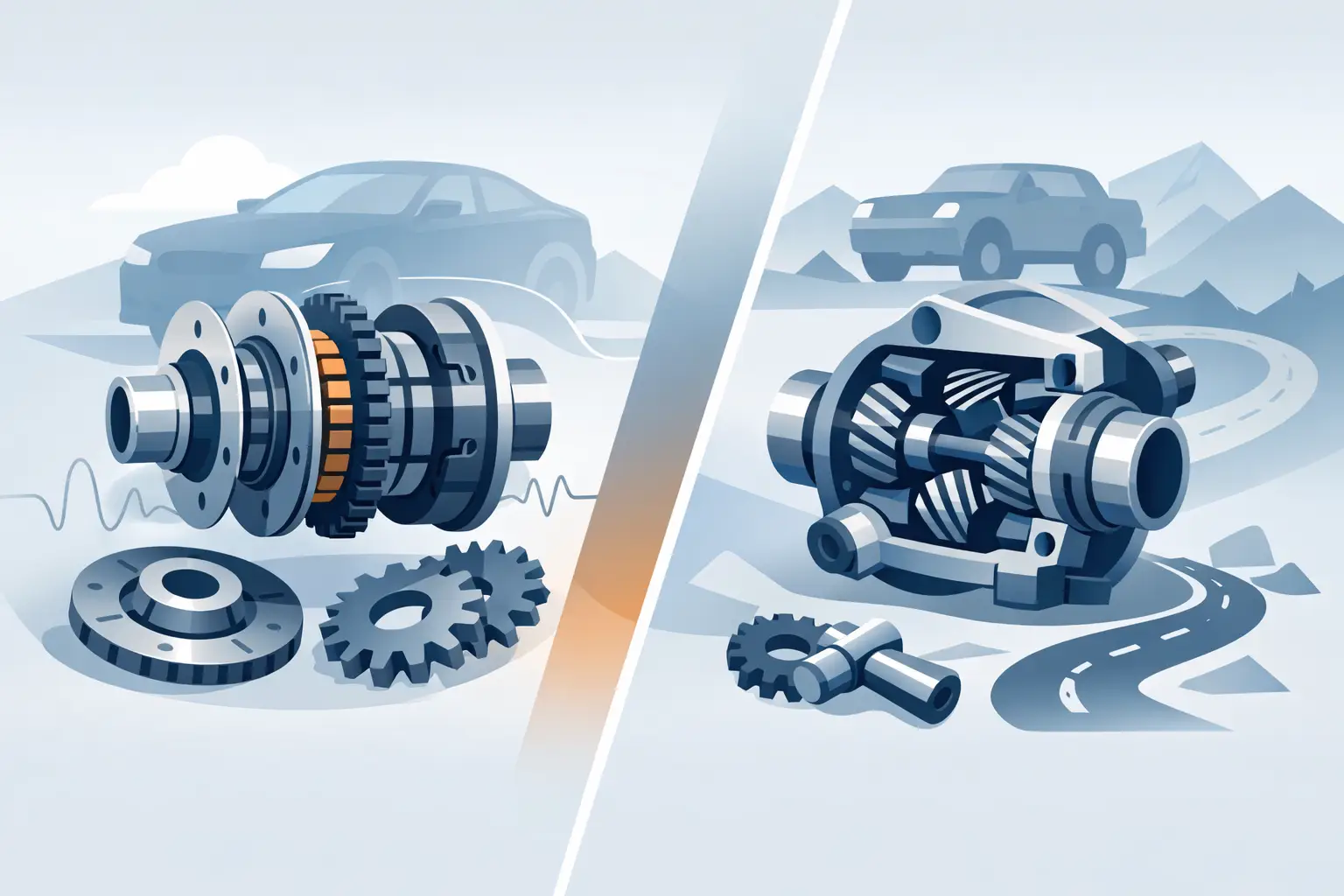
Both solutions address the same basic problem – distributing drive force better between the wheels than an open differential does. The difference lies in how they create the locking effect.
A limited slip differential uses friction plates and mechanical load to lock the wheels together to a greater or lesser extent depending on the design and setting. This is why it often feels more aggressive, more direct and more “racing” in its way of working. It can be built for different degrees of lock, preload and ramp angles, making it very adaptable.
A Torsen diff instead uses helical gears to distribute torque to the wheel with the best grip. It works smoother, more progressive and typically requires less maintenance. Many appreciate it because it behaves civilized on the street but still provides significantly better traction than an open diff.
It sounds simple on paper, but in practice the choice is about how much lock you want, when you want it, and how the car should react when grip varies rapidly.
When a limited slip differential is the right choice
If you are building a car for hard driving where you really want to control how the rear or front axle behaves under throttle and engine braking, then the limited slip differential is often the first choice. This is especially true for drifting, rally, time attack and track cars where consistent locking action is very important.
Its great strength is that it continues to provide locking even when a wheel has very little load. This is important in situations where the car is unloading an inside wheel on corner exit, jumping over bumps or working on surfaces with large differences in grip. Where a Torsen diff can lose efficiency when a wheel becomes too light, a limited slip differential continues to drive.
That's also why many drivers like it in rally and drifting. You get more clear rotation into the corner, better ability to keep the car on the gas and a more consistent response when things get messy. A good limited slip differential can make the car faster, but also significantly more lively.
The downside is that it is rarely as discreet. It can chop a little at low speeds, make more noise in tight turns and requires the right oil and sometimes service or renovation of the slats depending on use. If you drive a lot on the street it may be okay. If you drive mostly commuting and quiet country roads, the compromise is more noticeable.
Another thing is that a limited slip differential must match the car and the use. The wrong preload or the wrong ramp angles can make the car understeer on entry, nervous on braking or unnecessarily heavy on the street. This is not a disadvantage of the design itself, but it is an area where the right spec plays a big role.
When Torsen diff is the right choice
A Torsen diff is often perfect for fast street cars, trackday cars and many builds where you want better grip without losing the car's everyday usability. It works smoother, more naturally and without the same mechanical "on and off" feeling that some limited slip differentials can give.
On dry asphalt with even grip it is often really nice. The car feels more responsive, the steering can be perceived as cleaner and you get better traction out of corners without the rear or front feeling as locked. For many enthusiasts who want a fast, fun and useful car, it is exactly the right character.
The maintenance requirement is also usually lower. You don't have plates that wear out in the same way, and for those who want to build a durable street and track car without having to unscrew the diff at regular intervals, this is a strong argument.
But a Torsen diff has its limitations. It needs resistance in both wheels to be able to distribute torque effectively. If a wheel lifts, is on ice, gravel or receives very low load, the function can be worse than many expect. On some cars and on some surfaces it makes little difference. On others it is immediately noticeable.
This means that the Torsen is not always the first choice for pure drifting or tough rally driving where the grip level changes quickly and wheel unloading is part of everyday life.
Multi-disc diff or Torsen diff for different types of driving
For drifting, the choice is pretty straightforward. If you want consistent lock, clear response, and a rear end that you can rely on when you throw the car in and hold on to the gas, then the limited slip differential is the normal choice. The Torsen can work in some setups, but it rarely gives the same predictable behavior when things get aggressive.
For rallying, the limited-slip differential is also strong. On gravel, uneven asphalt and during hard weight shifts, there is a big point in the fact that the differential continues to work even when one wheel is unloaded. Here it is not just a question of grip, but of control and drivability throughout the entire sequence.
For trackday and track driving on asphalt, it depends more on the car's setup and your level. A Torsen diff can provide a very nice balance in a street-based track car, especially if you want something that works just as well on the way home from the track. A limited slip differential can be faster and more consistent when you're chasing lap times, but it also requires more understanding and sometimes more compromise in everyday driving.
For fast street driving, a Torsen diff is often the easiest answer. It feels more refined, less noisy and still gives a clear performance gain. However, if you have high power, aggressive wheel angle, stiffer chassis or drive very actively even on the street, a milder limited slip diff may be just right.
How the diff affects the feel of the car
This is the part many underestimate. The differential doesn't just affect grip – it affects how the car communicates.
A limited slip differential often feels more mechanical. You notice how the car “settles” into drive, how it wants to push with both wheels and how it reacts more clearly to throttle and deceleration. In the right car it’s fantastic. In the wrong car it can feel nervous or sluggish.
A Torsen diff often feels more transparent. It helps the car find traction without the whole character becoming as raw. For some drivers, it's exactly what they want. For others, it feels too nice.
This is also why the same differential choice can be judged completely differently by two drivers. One wants maximum control through a more active chassis. The other wants speed without the car requiring constant correction. Both can be right.
What you need to consider before choosing
It's easy to get caught up in which diff is "best", but the better question is what the rest of the car requires. Tires, wheel angles, bushings, suspension , power output and driving style all affect how the diff is experienced. A really good diff in a poorly balanced car won't save the whole.
Also consider serviceability and usage. If the car is driven a lot on the street, perhaps even in the rain and at low speeds in an urban environment, then comfort and noise level matter more than many people admit. If the car is mostly driven on the track, special stages or active driving, it matters less as long as the function is where it should be.
For front-wheel drive cars, the choice of differential is extra sensitive because it affects both drive and steering at the same time. There, a Torsen differential can provide very nice drivability in a fast street or track car, while a limited-slip differential can provide more bite but also more steering input depending on the setup. For rear-wheel drive, the differences are often more apparent in how the car rotates and exits corners.
At House of Motorsport, it's exactly that kind of choice that makes a real difference – not parts for the sake of it, but the right parts for how the car will actually be used.
How to choose the right one: limited slip differential or Torsen differential
If you want maximum control, consistent locking under heavy load and a car that will deliver in drifting, rallying or really active track driving, then a limited slip differential is the way to go. If you instead want a fast, efficient and more street-friendly solution for asphalt driving and track days, then a Torsen differential is often a very smart choice.
The important thing is to choose a diff based on reality, not what sounds the hardest in theory. The best upgrade is the one that matches the car, the driver and the use all the way.
Start where the car is losing time or grip today – and the differential choice will be much easier.