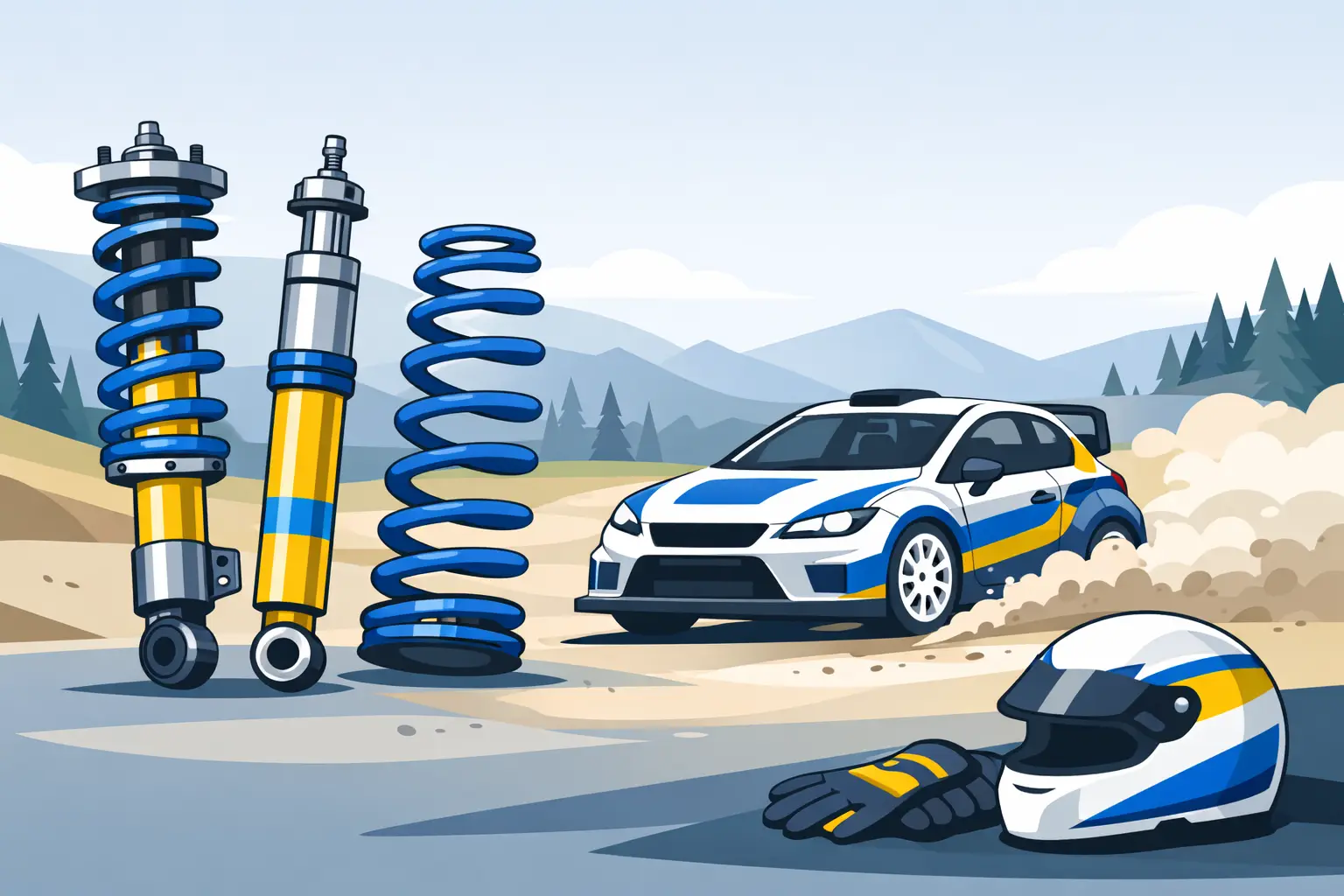
Gravel rallying immediately reveals whether the chassis is built correctly or just feels good on the workshop floor. A car that is safe over crests, holds its line in loose gravel and doesn't blow through every pothole requires more than "harder is better". If you are looking for an example Bilstein setup for gravel rallying, it is smart to start at the right end - the weight of the car, speed level, tires, surface and how aggressively you actually drive.
What a Bilstein setup for gravel rallying must be able to do
On tarmac you can get away with a chassis that is very tight and direct. On gravel it's a different game. The car has to be able to move, absorb impacts, build grip and still provide support when you throw it into a fast corner or land after a lift.
That's why Bilstein is so common in rally builds. The right dampers don't just provide control in the first corner. They hold the car together as the temperature rises, the road gets broken up and the pace picks up. For a gravel setup, it's less about making the car feel stiff in the pits and more about making the wheels work against the ground the whole way.
There is also no universal recipe. A front-wheel drive light car requires a completely different approach than a rear-wheel drive Volvo or a four-wheel drive turbo platform. But it is possible to talk about a sensible basic level that can then be fine-tuned to suit the car and driver.
Example Bilstein setup for gravel rally
If we take a typical club or national gravel rally build as a starting point – say a light to medium-weight car of 1100 to 1350 kilos, real roll cage, rally seats, skid plate and gravel tires – then a healthy setup often looks like this in broad outline.
The Bilstein shock absorbers should have enough travel to allow the car to work over bumps without bottoming out too easily. At the same time, the car should not be so soft that it rocks completely after each compression. Many people end up with a relatively firm low-speed damping to support body movements, but with more compliance in the high-speed range so that impacts from stones, washboards and edges do not make the car nervous.
Springs are often softer than many people think. On gravel you want mechanical grip, not just quick reactions. A front-wheel drive car often benefits from a front end with good support under braking but still enough movement to be able to pull in looser sections. The rear needs to be free enough for rotation, but not so lively that the car becomes difficult over fast crests.
Ground clearance is also key. A car that is too low looks fast until the chassis starts to buckle and the car loses composure. A car that is too high gives more movement, a higher center of gravity and less precision. A sensible rally height on gravel is often higher than street and track people first think, especially if the roads are rough. It is better to give the chassis room to work than to build an asphalt patch for a forest road.
Anti-roll bars play a big role, but many people make the mistake of chasing too much stiffness. On gravel, too-hard anti-roll bars can reduce wheel contact when the road is uneven. You often gain more from good damping, the right springs and a well-thought-out wheel alignment than from locking the car with coarse anti-roll bars.
A reasonable basic level to start from
A useful example of a Bilstein setup for gravel rallying is a chassis with medium to medium-soft spring rates, slightly firmer rebound than compression, and enough height to handle real special stages without hitting every edge. At the front, you may want a little more shock support to keep the nose calm under braking and initial turn-in. At the rear, it often works better with good rebound control than pure hardness, so that the car settles quickly after impacts but doesn't bounce further.
For a front-wheel drive car, this often means that you build for traction out of corners and stability under braking. For a rear-wheel drive car, you instead have to focus more on ensuring that the rear end doesn't lose ground contact when things get messy, as this directly costs you driveability and confidence.
Damping – where time is available
It's easy to get caught up in spring rates, but on gravel, the damper character is often what determines whether the car feels fast or just dumb. Bilstein is strong here, as a good monotube solution tends to give consistent response even under heavy load.
Compression damping controls a lot of how the car absorbs impacts and how quickly it settles under load. If it is too stiff, the car becomes bumpy and starts to skip over looser sections. If it is too soft, the car sinks too far and loses support when changing direction.
Rebound damping is just as important. Too much rebound means the wheel doesn't have time to settle back down after a bump, which can cause poor grip on broken roads. Too little rebound makes the car bouncy and uneasy. What you want is control without locking up the suspension's work.
This is also the reason why two cars with the “same setup” rarely feel the same. Weight distribution, unsprung weight, tire casing and driving style change everything. One driver brakes late and aggressively, the other drives faster. Then the chassis has to support different things.
Springs, height and bump stop – the whole thing matters
On gravel, a chassis that is too stiff can feel impressive on the transport and be slow on the road. The wheel needs to follow the ground, and the car needs to be able to use its full suspension travel. Therefore, bump stops and available travel are at least as important as the spring itself.
If you hit the bump stop too early, the car suddenly becomes extremely stiff in the middle of the movement. This may work briefly on smooth asphalt, but on gravel it often becomes unpredictable. A better approach is to let the car work freely for most of the stroke and use the bump stop as a support near the end position, not as the main spring.
Camber and toe also need to follow the setup. Too much negative camber that works on track rarely does any good on gravel where the car moves more and the surface is alive. More moderate angles often work better, focusing on stability and contact rather than maximum bite in a perfect apex.
How to test yourself without getting carried away
The fastest way to ruin a rally setup is to change five things at once. Work methodically. Start with a basic setup that is safe and only make one adjustment at a time – tire pressure, height, front or rear suspension, or camber.
If the car feels nervous over fast bumps, it is not automatically too soft. Often it is too hard in the wrong part of the movement, or the wheel does not have time to return to the ground. If it feels lazy into a bend, it is not always too soft either. It could be height, weight transfer or too little support at the front during the first load.
Take notes after each test. No novels, just what matters: braking stability, turn-in, pull-out, behavior over crests, bottoming and confidence at high speed. That's how you really build speed.
Common mistakes in gravel setup
A classic mistake is to build too much asphalt. A low car, springs that are too stiff and too much anti-roll bar give a car that feels “race” but becomes slow when the road gets loose and broken. Another mistake is to chase rotation at the back with a rear suspension that is too stiff. Sure, the car turns in – until it starts to throw in fast sections where you need calm and drive.
A third mistake is to underestimate the role of the tires. The same Bilstein chassis can feel completely different depending on the frame, pattern and pressure. Therefore, shock absorbers, springs and tires should always be seen as a package.
When to choose the setup
If you go from fine gravel to really rough and rutted roads, your car almost always needs more room to work. That could mean a little more height, a little softer overall balance, or a less aggressive anti-roll bar. If you're driving on faster, smoother roads, you might want more support to keep the car flatter and quicker in changes of direction.
The same goes for when you pick up the pace. A setup that feels perfect in training can start to bottom out or become too mobile when you really push it. Then it’s tempting to stiffen everything up. In many cases, it’s enough to adjust the part that’s actually failing – maybe more support in the front in compression, maybe better control in the rear in rebound, maybe just more travel or a different ride height.
If you need parts for the entire build, from Bilstein shocks to rally-ready peripherals, House of Motorsport has plenty of the right stuff. But no matter where you shop, the same thing applies: don't just buy hard parts, buy parts that work together.
The best gravel setup isn't the one that feels the toughest in the pits. It's the one that lets you stay on the gas when the road gets rough, the car starts moving and others are forced to lift off.