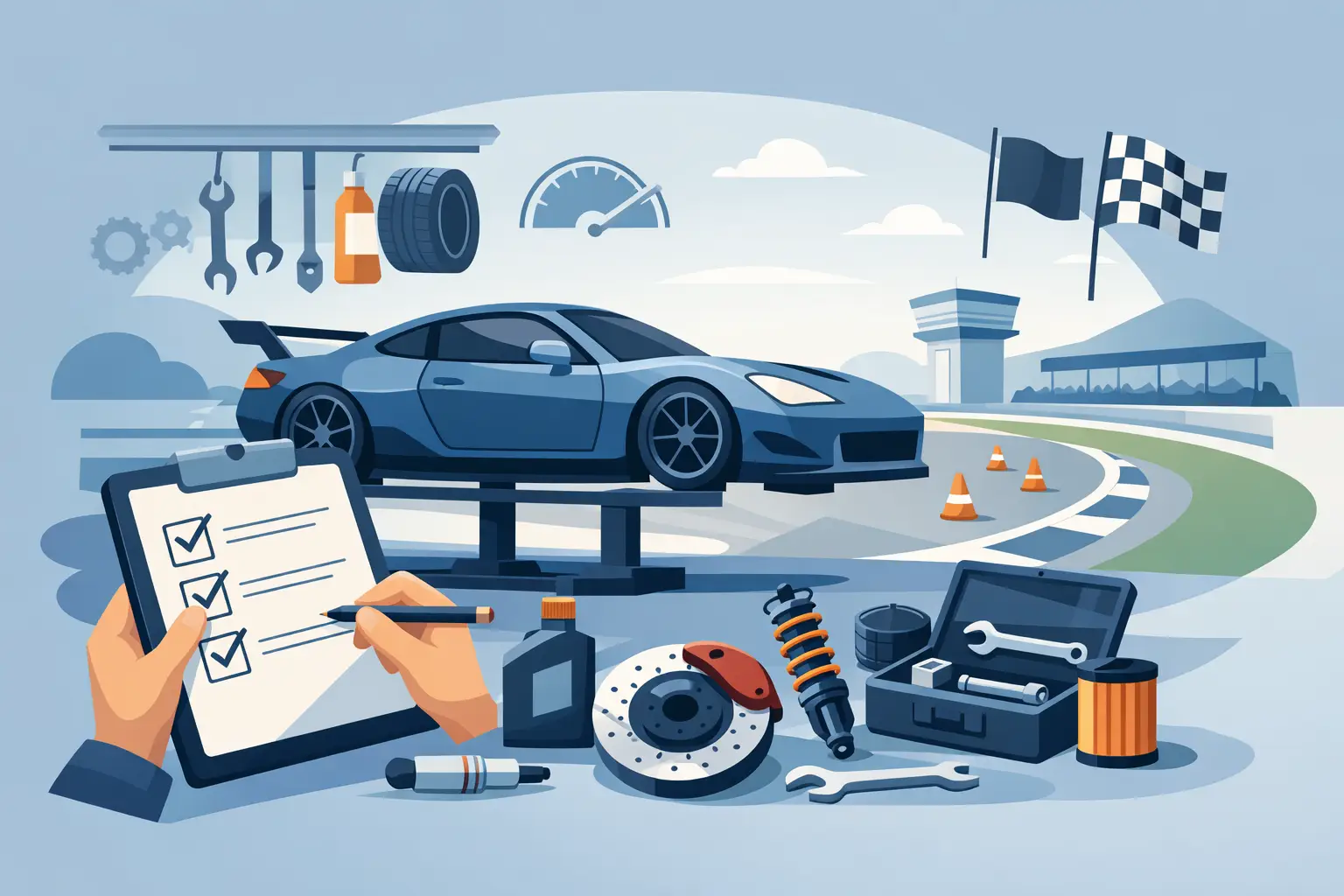
The first pass reveals everything. A car that feels lively on the road can start to boil brake fluid after a few hard laps, the tires can overheat and small gaps in the chassis suddenly become big problems. That's why it's not enough that "it runs fine". A real checklist for trackday service and parts is about building out weaknesses before you stand in the pits with the hood up and miss out on driving time.
This is not a list for polishing and parking. It is for those who want their car to last when the load increases, the lap times decrease and the temperature rises. Some cars can handle a track day almost in standard configuration. Others need brakes, cooling and service right away to avoid expensive tuition fees. It depends on weight, power, tires, driving style and how hard you intend to drive.
Checklist for trackday service and parts that actually matter
First things first – brakes , fluids, tires and chassis. That’s where most trackday problems start. Engine power is great, but a car that doesn’t brake consistently or loses grip after three laps is never going to be really fast.
Start by being honest about the level of the car. Is it a street car that will be testing the track for the first time, or an already upgraded car that will be driven hard all day? For a beginner car, good brake fluid, fresh pads and the right tire pressure can go a long way. For a more serious setup, you need to look at temperature resistance, wear parts and how the whole package works under repeated load.
Brakes – the most common weak link
If there's one area where you shouldn't take chances, it's the braking system. Standard pads may work on the road, but on the track they quickly run into problems with fading, uneven pedaling and heat cracks in the worst case. Trackday has completely different demands on temperature and recovery.
Check the thickness of the pads before you ride. If they are already half worn and you know the track is heavy braking, then this is the wrong place to save money. The discs should be free of severe cracks, rough play or obvious overheating. Also feel how the pedal feels. A spongy pedal is a warning flag even before you roll out.
Brake fluid is often the most underrated upgrade. Fresh high-temperature fluid makes a huge difference on the track. If the fluid has been in the car for a long time or if you don't know when it was last changed, change it. Period. The same goes for hoses if they are old and tired. A firm and consistent pedal gives confidence, and confidence saves both time and materials.
Tires and wheels – where lap times live
Many people chase power before they have grip. It's the other way around. Tires are one of the best investments for both feel and speed. But even the right tires can perform poorly if the pressure, temperature and wheel alignment are not right.
Check tread depth, age, and uneven wear. A tire that looks “okay” may be hard, heat-tired, or wrong for the type of riding you’re doing. For a lighter beginner track day, a good street performance tire can work just fine. If you’re driving a heavier car, at a higher pace, or for longer sessions, you often want something that can handle heat better.
Don't forget the wheel bolts or wheel nuts. The correct torque is fundamental, but it is still missed. Retighten when the car has warmed up. Also check that the rims have no cracks, run-outs or previous damage. On the track, small margins are suddenly not small anymore.
Service before trackday – do the job before the car gives up
Trackday doesn't just wear out wearing parts. It exposes neglected service. Engine oil, cooling system and driveline must be in good condition if the car is to last a full day.
The engine oil should be fresh and suitable for the application. If the oil already has many miles on it, change it before driving. On the track, the oil temperature rises faster and stays high longer. In this case, it is not enough that the oil is “not old”. It must also withstand the load. Check the level carefully, and preferably again when you get to the track.
The cooling system is the next item. Hoses, clamps, expansion tanks and radiators should be tight and in good condition. If you see the slightest hint of a leak or old plastic starting to give out, fix it before track day. Overheating doesn't just cost you driving time. It can quickly become an engine problem.
The gearbox and differential are often forgotten. If the car has started to make noise, feel sluggish in gear or has gained more power than before, then it is time to check the oils and general condition. Especially front-wheel drive cars that are driven hard on the track can reveal worn driveshafts, tired engine mounts and diff problems faster than you think.
Chassis and steering – precision beats drama
A car that feels nervous or floats in the corners is rarely fast, even if it feels “exciting.” Before the track, the chassis should be tight. No strange noises, no looseness, no worn bushings that make the wheel angles a guess under load.
Check the control arms, ball joints, steering joints, top bearings and bushings. The slightest play is felt more on the track than on the street. Leaking shock absorbers or springs that are set incorrectly also directly affect the balance. If you have coilovers or an adjustable chassis , check the height, lock rings and basic adjustment so that nothing has moved.
Wheel alignment does more than many people think. A little more negative camber at the front can give better grip and more even tire wear on the track, but it's not a universal solution. If you also drive the car a lot on the street, you need to weigh up tire wear, track sensitivity and how the car will behave in everyday life. It's always a compromise.
Parts to have at home or in the depot
There's a clear difference between essential parts and "nice to haves." You don't have to build a pit car to drive track day, but a few things often save the day.
Brake pads, brake fluid, engine oil and an extra set of wheels are smart if you drive hard or far to the track. If you have a car with known weaknesses, such as ignition coils, vacuum hoses or specific cooling components, then it makes sense to think before instead of after. The same goes for simple consumables like cable ties, tape and hose clamps. It's not glamorous, but it keeps you on the track.
Tools should be adapted to the car, not to the garage box at home. Sockets for the wheels, torque wrench, jack, air pressure gauge and preferably the ability to fill air are the basics. If you drive more regularly, it quickly becomes obvious that pit discipline is part of the lap time.
For those who want to shop everything in one place and avoid hunting for compatible parts between different stores, it is an advantage to choose a player that is built for performance cars. At https://houseofmotorsport.com you will find a lot of what actually makes a difference before the track – brakes, hoses, driveline, chassis and engine-related upgrades without unnecessary detours.
Common mistakes in a trackday service and parts checklist
The classic mistake is to focus on power before durability. More boost, better map or bigger turbo sounds tempting, but if the brakes are boiling and the cooling is not keeping up, you still won't get anything out of the build. The track punishes imbalance immediately.
Another mistake is not testing after service or assembly. If you change pads, fluids, hoses or chassis parts the night before without testing, you are taking a chance. A small leak, a noise or a faulty moment on the wheels is better to find at home than after the first session.
It is also common to underestimate the role of the driver. If you are new to the track, the car does not need to be extreme. Put your money where it gives you safety and consistency first. A well-maintained car with good brakes and the right tires will often beat a more modified car that is not fully built.
How to prioritize if your budget is limited
If you're not going to do it all at once, start with fresh brake fluid, good pads, fresh engine oil and a proper check of the tires and chassis. That's the foundation. After that comes wheel alignment and possibly better tires. Only when the car brakes, turns and keeps the temperature stable does it make sense to move on to bigger upgrades.
If you already have the basic package in place, the next step could be better dampers, steel brake hoses, more temperature-resistant wear parts or improved cooling. But again – it depends on the car. A light rear-wheel drive trackday car and a heavy turbo car with front-wheel drive rarely need the same solution.
Trackday is at its best when the car feels sharp right from the start and holds together just as well in the last lap as it did in the first. Spend time in the garage before you put your right foot on the floor, and you'll get more driving, better feel and fewer unnecessary interruptions when it matters.