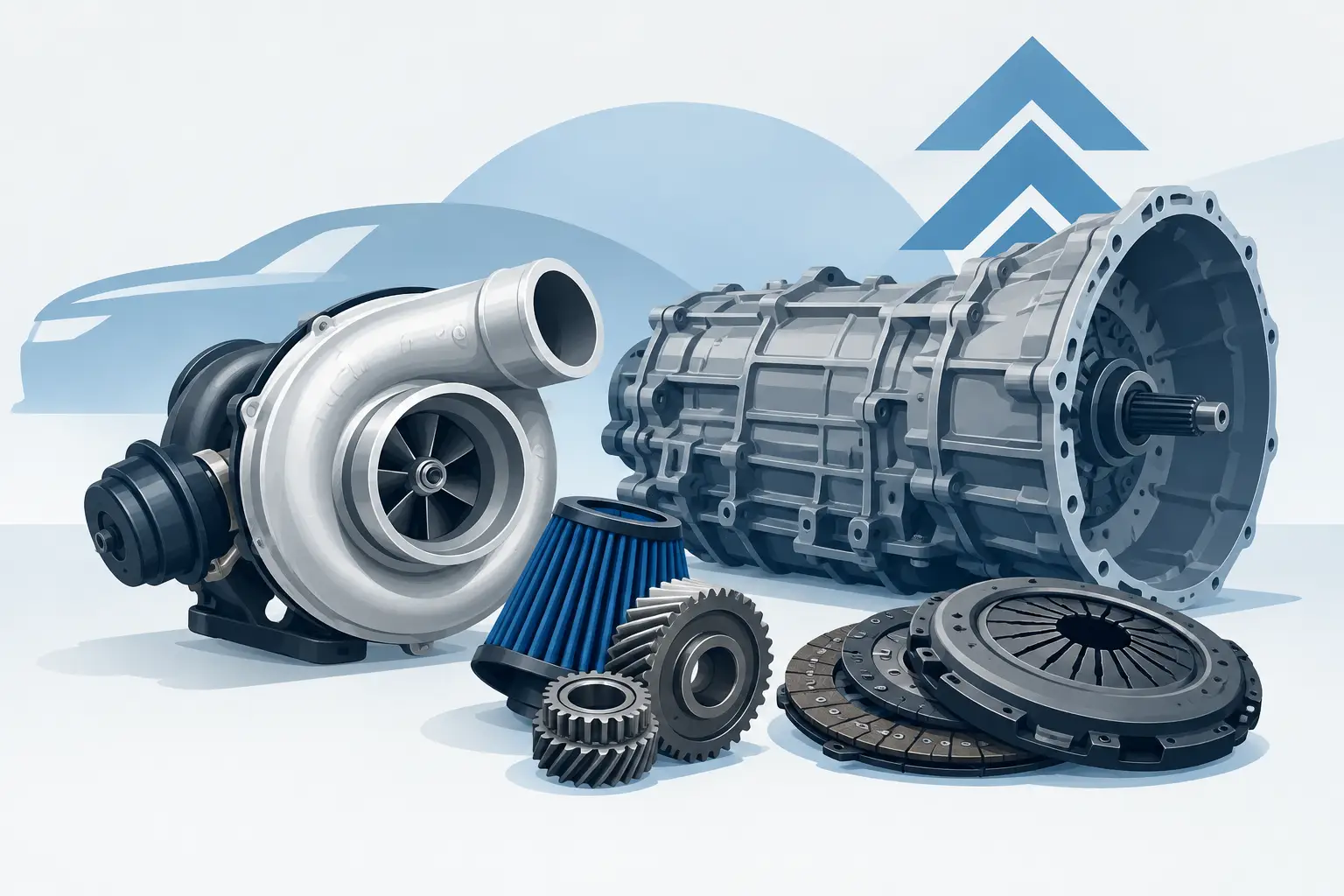
More boost, a bigger turbo and a sharper map are fun – until the gearbox starts to protest. The best turbo gearbox upgrades are therefore not about throwing in the strongest possible parts right away. It's about building a drivetrain where the clutch, diff, axles, gearbox and software can handle the same level of torque. Then the build will hold up when the grip comes, the temperature rises and the start from the pit or the red light becomes hard.
On a turbocharged car, torque is often the real gearbox killer. An engine that delivers a lot of torque early on can hit the gears and synchromesh harder than an engine with higher peak power but a smoother torque curve. So you need to choose parts based on how the car is used – street driving, track driving, rallying, drifting or towing – and which gearbox housing is actually in the car.
Start with the moment goal, not the catalog
Before you order a reinforced clutch or a diff, you need to know what the engine delivers in practice. Don't just look at an optimistic power figure. The torque, where in the register it comes and how the car gets grip determine the load. A front-wheel drive turbo car on regular street tires can spin away some of the impact. The same car with sticky tires, harder bushings and good asphalt sends significantly more load into the box.
Also find out which gearbox you have, what weak points it is known for and whether there are multiple versions. On many platforms there are many differences between model years, gear ratios, splines and diff housings. Some gearboxes are limited by the original diff, others by the input shaft, third gear or poor oil supply during long-term track driving.
If the gearbox is already making noise, jumping out of gear or scraping when shifting, the first upgrade is a check and renovation. More power on top of worn bearings and tired synchronizers is an expensive way to push the problem forward.
The clutch should hold – and be driveable
The clutch is often the first component to give up after a turbo upgrade. A slipping clutch is not always visible as a dramatic failure. The engine speed can creep away in high gear under full boost pressure, especially when the car is warm. By then, the margin is already gone.
An organic performance disc with a reinforced pressure plate is suitable for many fast street and bank cars. The pedal will be normally manageable and the engagement soft enough for queues, parking and everyday driving. When the torque increases further, a sinter disc, often with four or six pads, may be the way to go. It can withstand harder grip but usually causes more jerking, more noise and higher load on the drivetrain.
A stiff sinter plate is not automatically the best. For a rally car or pure drag racing car, it may be just right. For a street car with an original gearbox, the hard impact can instead shift the load to the gears, joints and axles. Therefore, choose the clutch that suits the car's torque target and driving, not the one with the most aggressive product text.
Don't forget the release bearing, slave cylinder, pilot bearing where present and clutch hydraulics. The small parts are cheap compared to tearing the box apart again.
Differential brake provides grip and protects the ride
An open differential means that power tends to take the easiest path when a wheel loosens or loses grip. The result is a spinning inner wheel, poorer acceleration out of corners, and a car that feels less consistent when you push it.
A limited-slip differential, Torsen differential or other type of differential brake can be one of the most noticeable upgrades on a turbo car. Which design is suitable depends on the discipline. A Torsen-based solution often provides predictable and smooth behavior for street and track driving. A limited-slip differential can provide more locking and clearer drive out of corners, which is appreciated in rally, racing and drifting – but requires the right oil, correct setup and more understanding of how the car reacts.
The differential lock does not make the gearbox immortal. On the contrary, better grip can increase the load because the power actually reaches the ground. But it makes the car faster, more controllable and less dependent on the driver waiting for grip. It is an upgrade that provides power every time you step on the gas.
Best upgrades for gearbox turbo under load
When the power target exceeds what the original parts can reasonably handle, the clutch and differential are not always enough. Then it's time to focus on the strength of the box itself and the temperature in the system.
Reinforced gear sets and axles are relevant when the car is driven hard with high torque, frequent launchers or a lot of grip. Straight-cut gears can withstand more and provide fast, clear power transfer, but they are loud. It's a real racing feeling, not something everyone wants on their way to work. Helical-cut performance gears are often a better choice for a fast street or trackday car where noise level and usability still matter.
Some transmissions feature proven enhancements such as better shifters, upgraded bushings, reinforced gearbox mounts or oil control solutions. A firmer mount reduces the amount of drivetrain movement when shifting and loading, which can provide better feel and reduce the risk of missed gears. The downside is more vibration and noise in the cabin. On a street car, a moderately stiff solution can be smarter than a rigid one everywhere.
For long track runs, rally distances or hard drifting, oil temperature and lubrication are crucial. The right gearbox oil according to the gearbox's requirements is the basic level. An oil that feels good cold but loses its properties when it gets hot can cost you synchronizations and bearings. For particularly exposed builds, an external pump, cooler or modified oil supply can be a sensible investment, if the gearbox design supports it.
Gearbox technology and engine control also count
Many broken transmissions haven't been broken by a single peak in the engine. They've been hit repeatedly. Hard clutch releases, wheel hop, shifts without proper torque release, and aggressive starts are brutal on gears, axles, and diffs.
Wheel hop should be taken seriously. When the wheels alternately grip and release, strong shocks occur that can break parts even in an otherwise well-built package. Check the engine mounts, gearbox mounts, bushings, shock absorbers and suspension before you just go up to heavier driveshafts.
A well-calibrated engine management can also make a big difference. Torque limiting in lower gears, smoother boost pressure build-up and the right torque reduction when shifting can save the drivetrain without the car feeling slow. On a front-wheel drive street car, it often becomes faster in real life when it can get the power down without wheelspin and jerking.
Sequential gearbox or dogbox is the next level for those who build without compromise for competition. The shifts are fast and the box is built for hard use, but the cost, service requirements and noise level are significantly higher. It is the right solution when timing dictates the build, not when the car should function comfortably every weekend.
Build the drivetrain as a package
The smartest order is often to ensure the function first: fresh gearbox, correct oil and tight hydraulics. Then you choose a clutch with a reasonable margin, improve grip with a differential lock and check the mounts and chassis so that the car does not wheel jump. Only when the power and usage level requires it is it time for reinforced gears, axles or a completely different gearbox.
This is also where the right parts and the right support save both money and garage time. House of Motorsport can help project builders match driveline parts to car model, power goals and driving style, instead of the build getting stuck on a misordered plate or incompatible splines.
Put your money where the load is. A turbo car that shifts cleanly, gets the power down and holds the entire session is more fun than a car with a high power figure that is on jack stands after the third hard start.