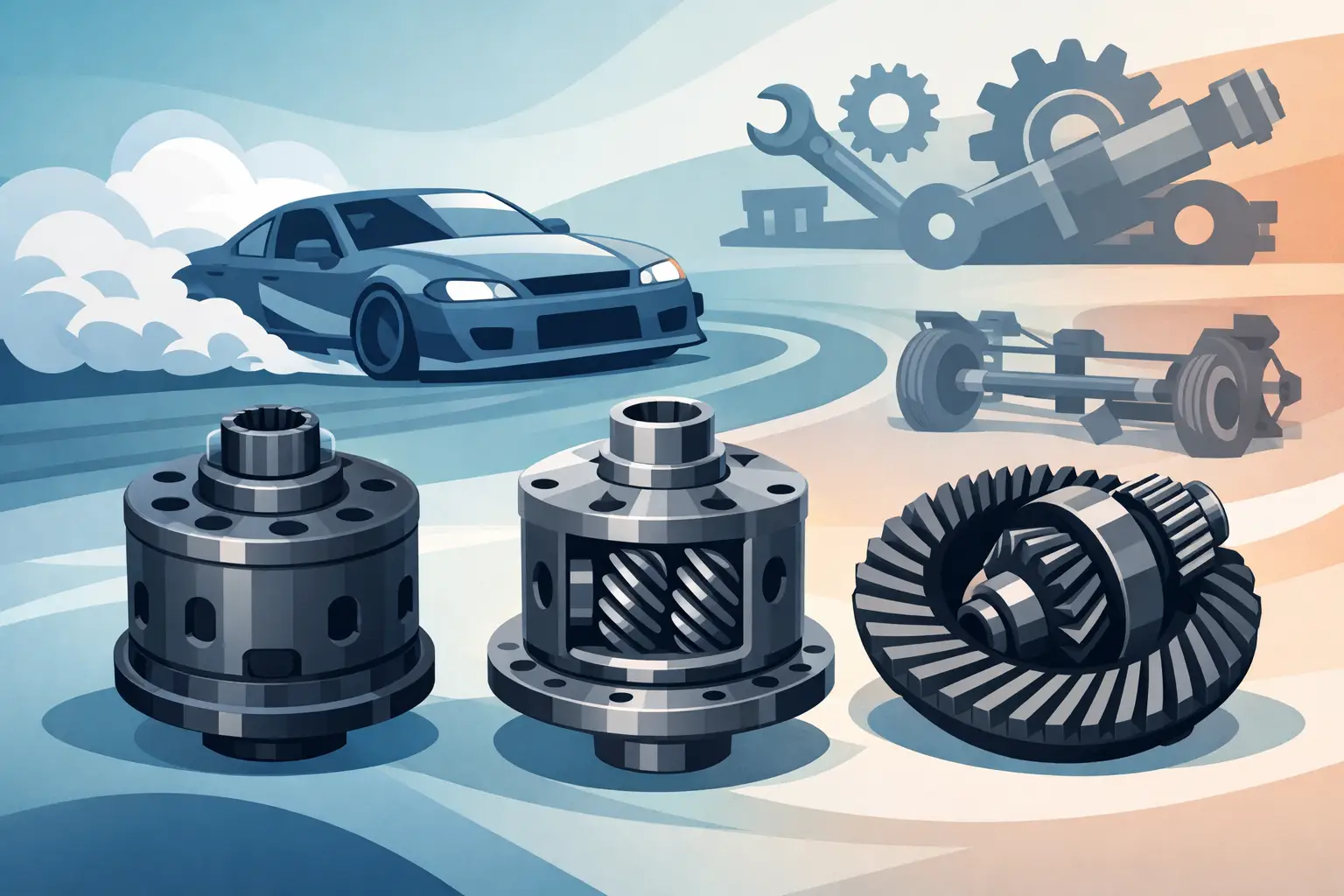
If the car goes into the curve nicely but dies as soon as you ask for more angle, then it is often not the handbrake or the power that is the problem. It is the drive. The question of which diff for drifting is right for your particular build determines how the car unlocks, drifts out and behaves when you change load in the middle of the curve.
This is one of the most important parts of a drift build, and yet one of the most misunderstood. Many people blindly believe that “locked is locked,” but the reality is more nuanced. The choice of differential affects not only how easy the car is to skid, but also how predictable it feels, how much powertrain power takes, and how the car performs on the street, track, and in transport.
Which diff for drifting is best?
The short answer is that it depends on how you drive, how much the car weighs, how much rear grip you have, and how uncompromising the build can be. For pure drifting, a fully locked solution works best for many drivers because both wheels always have equal traction. But for a car that will also be on the street, a good multi-plate LSD may be the smarter choice.
There are basically three common paths to take. Welded diff, multi-plate LSD and spool or full lock solution. Each has its place. What sets them apart is how they transfer power, how they react when you let off the throttle and how much compromise you are willing to accept off the track.
Welded diff – cheap, simple, brutal
Welded diffs are often the first step into drifting. They are cheap, direct and do exactly what you ask them to do – both wheels rotate together at all times. For those on a budget or looking to get out there and drive fast, this is still a relevant solution.
On the track it gives a clear behavior. The car becomes easy to initiate, easy to hold on the gas and more consistent than a worn original diff. That's why so many people start here. You get a rear end that drives every time, not just when the diff happens to feel like it.
But there are disadvantages. A welded diff is hard on the drivetrain, difficult on the street and less forgiving in some situations. Parking, roundabouts and low speed become more jerky. The load on the driveshafts, joints and tires also increases. If the welding job is poorly done, you have also built a weak point into the entire rear axle.
For a purely budget build or a car that mostly goes on the track, a welded diff is still hard to beat for the price. For a street-registered car that will be used a lot, the compromise becomes greater.
Lamell-LSD – the right choice for many serious builds
A true multi-disc LSD is often the best balance between performance and usability. It doesn't lock 100% all the time like a welded diff, but can provide very strong locking when properly specced and shimmed for the application.
The beauty of this is the control. A good 1.5 or 2-way LSD can provide a lot of drive out of a corner while also behaving better under braking and in everyday driving. For drifting, 2-way diffs are especially popular because they lock on both throttle and engine braking. This gives more consistent behavior when you throw the car in and off the throttle in fast transitions.
The difference between a tired standard LSD and a motorsport-adapted limited slip differential is huge. Many stock differentials feel good on paper but can't hold the lock when the temperature and load increase. The result is uneven behavior - exactly what you don't want when you're leaning on the door handles.
The downside is the price. A good LSD costs more than welding, and it requires the right oil, the right assembly, and sometimes maintenance. But if you want to build something that actually lasts and delivers lap after lap, then this is often the money that really counts.
What difference does drifting make if the car also drives on the street?
Then a multi-plate LSD is usually the sensible answer. A welded diff works, but it quickly becomes tiring in everyday use and can make the car messy on wet surfaces or during normal maneuvering. If you have a car that should be able to be driven to the meet, to the track and back home without feeling like a truck at every intersection, then a good LSD almost always wins.
This doesn't mean that all street cars have to have LSD. Some accept the compromise of a welded diff to get maximum function on a low budget. But if you're already spending money on chassis, steering angle , cooling and drivetrain, it's hard to justify a diff as the crude emergency solution.
Spool – for those who want zero hesitation
A spool replaces the differential function completely. There are no satellites, no locking mechanism and no lamellae that can give up. Axle to axle it is silent. For pure competition this is the most consistent solution, and that is also why it is seen in more uncompromising builds.
On the track, it means total predictability. What you feed into the drivetrain goes straight to both wheels. No hesitation, no variation, no “almost locked” feeling. For drivers who want the exact same behavior every lap, it’s a strong advantage.
On the street, however, it is in practice the wrong choice for most people. It wears out tires, stresses components and makes the car uncomfortable at low speeds. If you haven't built your car to be tough, loud and uncompromising, there are better ways.
What actually determines the difference
Many people ask for a universal solution, but the diff has to match the rest of the package. A light car with modest power and narrow rear tires can work well with a simpler locked solution. A heavier car with lots of grip, turbo power and aggressive driving demands more from both the diff and the drivetrain.
The gear ratio also plays a role. A diff that feels perfect in one car with the right final drive may feel wrong in another. If the car drops out of power range in the middle of a race, it doesn't help that the diff locks nicely. The same goes if the suspension and rear axle geometry don't work for you. The diff is central, but it never works alone.
Driving style is the next big factor. If you are new to drifting, you often benefit most from something consistent and easy to read. Then a welded diff can be a good learning tool. If you drive faster tracks, higher speeds and work more with weight transfer than just throttle, then the quality of the locking becomes more important. That's where a good 2-way LSD often comes into its own.
Common mistakes when choosing a diff for drifting
The most common belief is that all LSD solutions are drifting diffs. This is not true. Many viscous diffs and worn original LSDs provide too poor and uneven locking to work well when you really put the car under load. They may feel okay in a roundabout but completely collapse when the temperature rises.
The second mistake is to only look at the purchase price. A cheap solution that ruins drivability, eats tires and stresses the drivetrain can still be expensive. Especially if the car is used frequently.
The third is that the diff is installed without checking the rest. Bearings, backlash, oil and condition of the crown wheel and pinion all play a role. A good diff in a bad housing is not a good solution. Here it pays to do the right thing right away.
This is how you should think about your building
If the goal is to get out and drive now, with a small budget and a car that will primarily be skidded on the track, then a welded diff is still a reasonable choice. It is simple, clear and has an immediate effect.
If you are building a car with higher ambitions, wanting more precision while still maintaining some roadability, then a real multi-plate LSD is often the best investment. You get a more well-crafted package and a car that feels more professional in how it delivers grip and lockup.
If the car is a pure competition build where compromises are uninteresting, then a spool or equivalent full lock is an option to take seriously. But then the rest of the car should also be built for the same level.
The logic of the House of Motorsport job fits quite well here – choose parts that make a measurable difference, not just cheap shortcuts. The diff is one such component. It is noticeable in every initiation, every transition and every release of the throttle.
The right diff doesn't just make the car easier to drive. It makes it easier to trust. And when the car responds the same way every time, you can put your focus where it belongs – on line, speed and angle.