When the pedal becomes long after a few hard laps, the question is no longer theoretical – which brake fluid can withstand high temperatures enough for your particular driving style? For street use, standard fluid often goes a long way. For track driving, drifting and rallying, however, the wrong fluid can cost you both brake feel, consistency and confidence behind the wheel.
Which brake fluid can withstand high temperatures in practice?
The short answer is that racing-oriented DOT 4 fluid with high dry and wet boiling points is often the best choice for performance driving. But it depends on how the car is used, how often the fluid is changed, and how hot the brake system actually gets. Someone who chases lap times needs something completely different than someone who mostly drives on the street with occasional inspired passes on their favorite road.
This is also where many people go wrong. You look at a high dry boiling point number, fill the system and think that's it. In reality, brake fluid loses performance over time because it absorbs moisture. Therefore, wet boiling point is at least as important if the car is used regularly and the fluid is not changed before every event.
What actually determines heat resistance
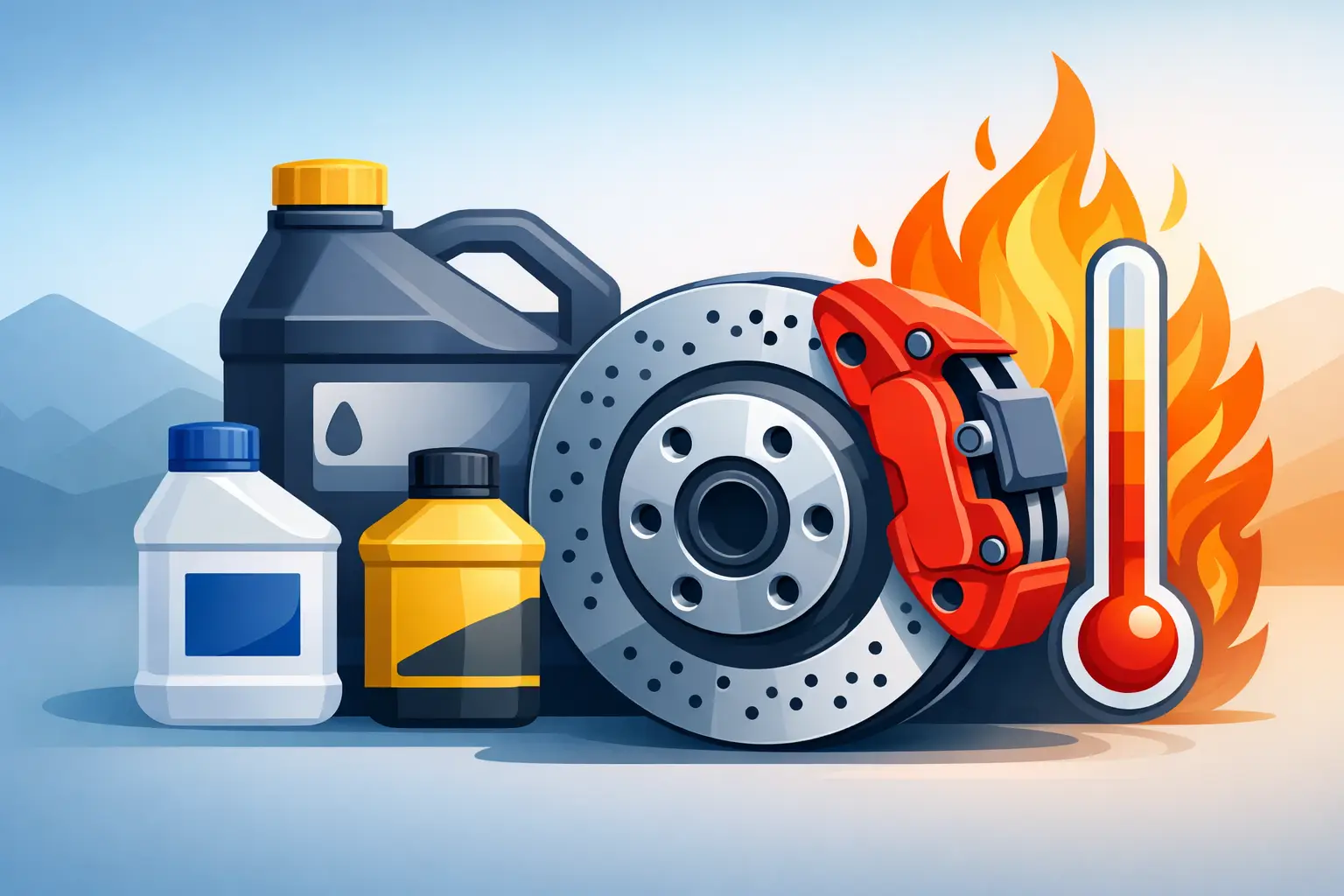
Brake fluid works in an environment where temperatures rise rapidly. During hard braking, heat is conducted from the pads and discs to the calipers, pistons and ultimately the fluid. When the fluid starts to boil, gas bubbles form, and gas can be compressed. The result is immediately noticeable in the pedal – a spongy feeling, longer pedal travel or, in the worst case, brake failure.
That is why two values must always be read together: dry boiling point and wet boiling point. Dry boiling point applies to new fluid straight from the package. Wet boiling point shows how the fluid performs after it has absorbed a certain amount of moisture. For a car that goes on the track a few times a season but is also driven on the street, wet boiling point is often the more relevant measurement.
Viscosity can also play a role, especially in cars with modern ABS and ESP. Some racing fluids are built for extreme temperatures but are not always the first choice in systems where low viscosity in cold weather is a priority. However, for most enthusiast builds, it is the boiling point that determines whether the brakes hold together when the pace increases.
The difference between DOT 3, DOT 4, DOT 5 and DOT 5.1
This is where things get a little confusing, as a higher number doesn't always mean better for your particular build.
DOT 3 is practically uninteresting for hard driving. It works in simpler applications, but for performance and heat the margins are too small.
DOT 4 is the class that dominates among enthusiasts, trackday drivers and many race cars. Within DOT 4 there is a wide range, from regular street fluid to really sharp racing products with a very high boiling point. This is often where you will find the best balance between price, compatibility and temperature resistance.
DOT 5 should not be confused with 5.1. DOT 5 is silicone based and is not used as standard in regular performance car or motorsports systems. It does not mix with glycol based fluids and is the wrong way to go for most people building for street, track or rally.
DOT 5.1 is glycol-based, much like DOT 4, and can perform well. But that doesn't automatically mean it can handle more heat than a good racing DOT 4. In fact, many high-performance DOT 4 fluids rank higher where it really counts.
Different requirements apply for street, track and rally
If the car is mainly used on the street and only has to work a little harder sometimes, the most extreme fluid on the market is rarely needed. A quality DOT 4 with good margins often goes a long way, especially if the brake system is otherwise healthy and the pads and cooling match the use.
For track days, the situation changes quickly. If you drive a heavy car, semi-slicks and slow braking, the temperature will rise quickly. Then a motorsport-oriented DOT 4 with a high dry boiling point is a clearly better choice. Here the difference is noticeable not only in pure safety, but in the consistency of the pedal, session after session.
In rallying and drifting, the load is different but at least equally demanding. Rallying often involves changing temperatures, dirt and hard use over a long period of time. Drifting can create a lot of local heat and repeated loads. Then you want a fluid that can withstand high temperatures but also functions stably between changes.
Which brake fluid withstands high temperatures best for track driving?
For pure track driving, the answer is usually a high-performance racing DOT 4 from an established manufacturer. It is the type of fluid that has proven time and time again to work best in real-world conditions, as it combines a high boiling point with compatibility in standard brake systems.
But best is not always the most extreme on the label. If you drive a few track days a year and change fluids before the season, a good premium DOT 4 can be a smarter choice than a pure racing fluid with shorter service intervals and higher costs. However, if you drive often, late on the brakes and with a heavily loaded car, then there are good reasons to go straight for a fluid with a clear racing profile.
A common mistake is to try to solve all brake fade with just fluid. Brake fluid is part of the chain, not the whole solution. Pads, discs , cooling, tire grip and driving style affect heat generation at least as much.
How to choose the right one without guessing
Start by being honest about how you use the car. Is it mostly highway driving with spirited driving, or are you chasing consistent lap times? A car that brakes from 200 km/h lap after lap has completely different requirements than a street car with a sportier feel.
Then look at three things: boiling points, change intervals and compatibility. High dry boiling point is good, but if you don't change often, the wet boiling point also needs to be strong. If the car has ABS and is used in varying temperatures, it may also be wise to choose a fluid from a brand that clearly specifies the range of use, not just the maximum value.
The price issue is also easy to put into perspective. Brake fluid is cheap compared to what a lost brake position costs in pads, discs, skidding or missed driving. Don't skimp on the right product, but don't buy excessively extreme fluid if the rest of the car and driving don't require it.
Replacement and maintenance – where much is decided
Even the best brake fluid will deteriorate if left sitting for too long. For street cars, regular replacement is important. For track driving, it is almost even more important to see the fluid as a consumable. Many experienced drivers change it before the season, and even more often during heavy use.
Air in the system, old fluid or careless bleeding can ruin the feel even with the right specification in the bottle. If you have experienced a spongy pedal after upgrading to a better fluid, the problem is not always the fluid itself. It could just as easily be residual air, boiled dust seals or a system that needs to be checked from the master cylinder to the caliper.
Also, don't mix products at random. Some fluids are compatible within the same type, but if you're still aiming for better performance, it's wise to flush the system thoroughly and start with clean, new fluid. This will give more consistent results and reduce the risk of old residue dragging the system down.
Common mistakes when brakes get too hot
Many people point directly to the brake fluid when the pedal feels bad. Sometimes that's true, sometimes not. If you have too aggressive tires and too weak brakes, heat will build up regardless of the fluid. If you have the wrong temperature window, you'll still have problems. And if brake cooling is missing on a heavy or fast car, everything in the system will have to work beyond its comfort zone.
It is also common to choose based on forum rumors instead of usage profile. What works in a light front-wheel drive trackday car may not be right in a four-wheel drive rally car or a rear-wheel drive drifting car with a different weight, speed and heat balance.
For those who build with a focus on braking performance and durability under load, it's smart to see the fluid as part of a well-thought-out whole. At https://houseofmotorsport.com you can find the components for builds where brakes should actually deliver when it matters, not just look good in the garage.
The simple answer is that a racing-oriented DOT 4 is often the right choice if you are wondering which brake fluid can withstand high temperatures best. The right answer only comes when you consider how the car is driven, how often you change it, and how the rest of the brake package is specced. Start there – then you will have a pedal that will last even when the pace does the same.