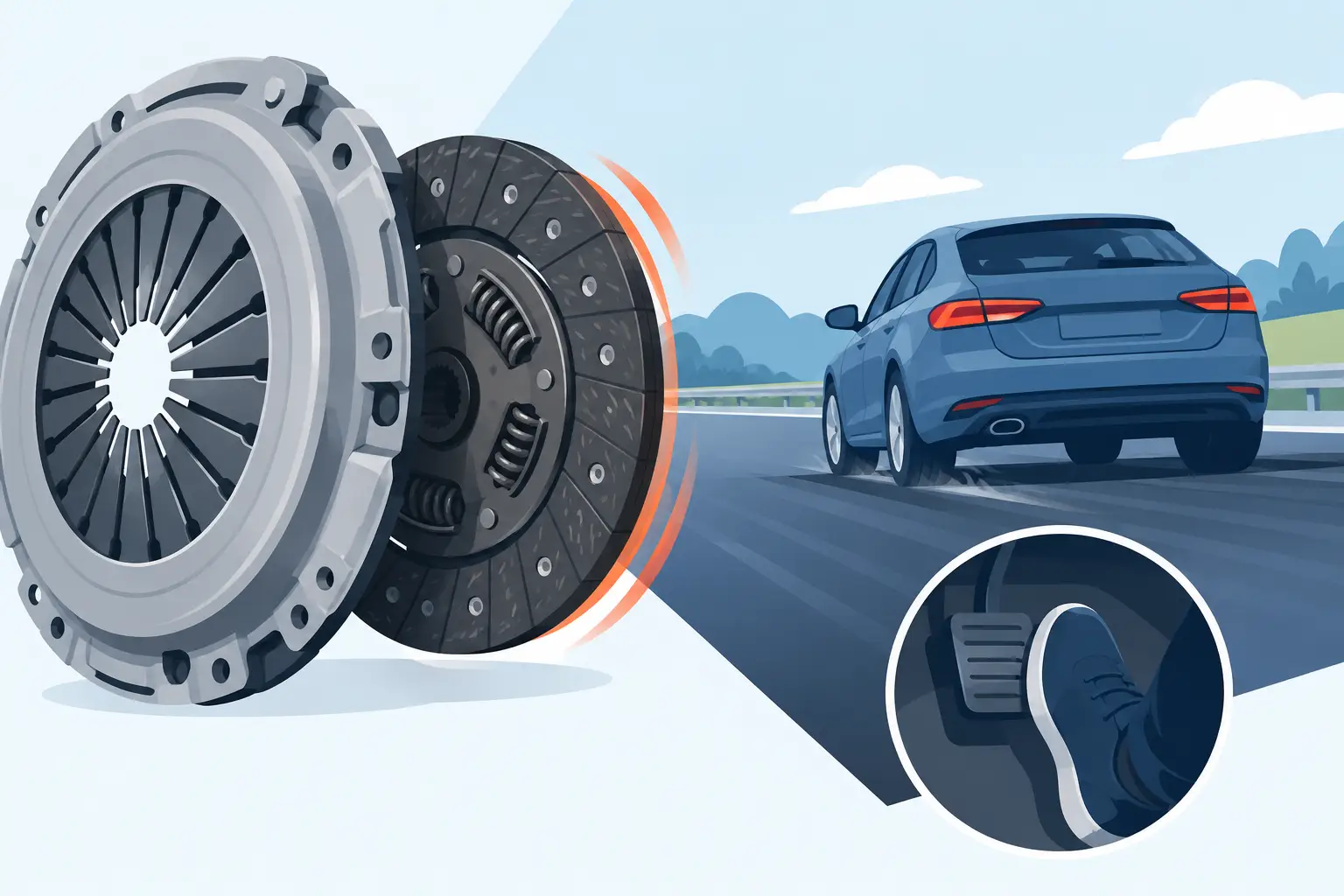
It is often noticeable just when the car is about to deliver. You shift into a higher gear, the boost pressure builds, the torque comes – and the revs drop without the speed following suit. Why does the clutch slip under load? Because the clutch can no longer hold the engine's torque, but the root cause is not always a worn disc. On a tuned street car, rally car or track car, the wrong component choice, poor assembly or heating problems can cause exactly the same symptoms.
Continuing to drive when the clutch slips is rarely a cheap shortcut. Every full-throttle stroke builds more heat in the plate and pressure plate, glazes the lining and can damage the flywheel surface. What might have been enough with a well-thought-out upgrade can quickly become a bigger job with more parts on the bench.
This is what a slipping clutch feels like
The classic symptom is that the engine revs up under hard acceleration, especially in third, fourth or fifth gear. Higher gears put more strain on the drivetrain, which means that a clutch at the limit is often revealed there first. The car may feel completely normal in quiet city driving, but start to slip as soon as you overtake, tow a trailer or go full throttle.
Sometimes there is also a pungent, burnt smell after a hard start or a session on the track. The clutch pedal, however, does not necessarily feel different. A light or normal pedal does not mean that the clutch is healthy – it mainly says something about the design and hydraulics.
A simple road test can give a clear indication. Drive in a high gear at low to medium rpm and apply the throttle firmly. If the rpm increases rapidly while the car hesitates to accelerate at the same rate, you are likely skidding. Don't do the test over and over again. You are verifying a fault, not practicing overheating the parts.
Why does the clutch slip under load?
The clutch works by friction. The pressure plate clamps the disc against the flywheel and transfers the engine's power to the gearbox. When the torque becomes higher than the clamping force and friction the package can handle, the disc starts to move against the flywheel instead of locking together. Then power is lost as heat.
Worn or glazed slat
The most common cause is wear. The friction material becomes thinner, heat management deteriorates and the clutch eventually reaches its limit. But a plate can also be glazed. This means that the surface has become hard and shiny from overheating, which reduces grip even though there may be material left.
This is common when a stock clutch is subjected to repeated hard starts, drifting, back-to-back revs, or power it was never built for. One really bad overheating can be enough to change how the clutch behaves.
Too low engine torque capacity
Horsepower sells headlines, but the clutch lives on torque. A turbo conversion that delivers a lot of torque at low revs can be harder on the clutch than an engine with more top horsepower but a smoother torque curve. This is especially true on heavy cars and cars with sticky tires, where the drivetrain is actually gaining traction rather than relieving itself through wheelspin.
Many problems start after the engine has been mapped , the turbo has been upgraded, or the camshafts and fuel system have made the car really deliver. The original clutch may work in everyday driving, but it has no margin when the supercharger comes. Therefore, choose a clutch based on actual torque, the weight of the car, use and the desired safety margin – not just an optimistic power target.
Weak pressure plate or tired diaphragm spring
The pressure plate creates the clamping force. If the diaphragm spring has lost its elasticity due to age and heat, or if the pressure plate is simply not dimensioned for the construction, installing a new standard plate will not always help. The result will still be slippage under high load.
A stronger pressure plate will usually provide better capacity, but the trade-off may be higher pedal pressure. For a pure track or rally car, this is often acceptable. For a street car that is driven in queues every week, a solution with better friction material and a reasonable pedal may be smarter than choosing the most aggressive pressure plate outright.
Oil or grease on the coupling surfaces
A dry clutch should be dry. Oil from the rear crankshaft seal, the gearbox input shaft seal or too much grease on the splines can end up on the plate. This will dramatically reduce friction and the clutch may start to slip even if it is not particularly worn.
This is often mistaken for a capacity problem, especially if the car has recently gained more power. If you see oil in the clutch cover or on the plate, replacing the friction parts is not enough. The cause of the leak must be removed, the flywheel and pressure plate must be carefully assessed, and contaminated parts should normally not be reused.
Condition of the flywheel and pressure plate
Blue tarnish, heat cracks, grooves and uneven surfaces impair contact between the parts. A flywheel that has become too hot may have hard spots where the new plate does not get an even grip. If you install a new one on a poor mating surface, you risk the new package having a short and expensive life.
A flat and fresh flywheel is the foundation. In some cases, it is possible to re-lathe, but this depends on the flywheel's design, material and manufacturer's specifications. Dual-mass flywheels require particularly careful assessment. If the suspension or friction surface is worn out, replacement is often the reasonable course of action.
Rule out faults similar to clutch slippage
Before the gearbox breaks down, it is worth ensuring that the fault is really in the clutch. An engine that misfires under boost pressure may feel like it is losing drive, but then the rpms usually do not accelerate smoothly. Fuel or ignition problems are often accompanied by jerking, exhaust noise and uneven power.
Automatic and DSG gearboxes also have other fault patterns. Slippage can come from internal disc packs, oil pressure, mechatronics or faulty software. This troubleshooting mainly applies to manual gearboxes with a traditional friction clutch.
Also check the clutch hydraulics and release system. A master cylinder, slave cylinder or incorrectly adjusted release bearing that does not release fully can keep the clutch from disengaging easily. This is less common than wear and undersizing, but is especially relevant after a clutch replacement or transmission work.
Choose the right clutch for how the car actually drives
There is no universal clutch for 600 Nm, track driving, winter commuting and soft starts in queues. The right package depends on the entire build. Organic discs often provide fine driveability and are a strong choice for many fast street cars. Sintered or ceramic solutions can withstand more heat and torque, but can cause more jerky engagement and greater load on the drivetrain.
A sprung hub solution can help absorb shocks in a street car, while a fixed hub solution provides direct response for more pure racing. Multi-plate clutches can handle high torque with a smaller diameter and lower rotating mass, but they place higher demands on proper installation, adjustment and use. More capacity is not automatically better if the car becomes difficult to get off the starting line or uncomfortable on the way to the meet.
Also consider the rest of the drivetrain . When the clutch stops being the fuse, the next weak point may be the gearbox, driveshafts, cardan shaft or differential. A well-built package deliberately distributes the load instead of shifting the problem further.
Mounting that holds up when it gets hot
Even the right parts can fail if the details are neglected. Flywheel and pressure plate should be free of grease, bolts should be tightened to the correct torque and pattern, and the plate should be centered correctly. Check the function of the release bearing, pilot bearing where present, and that the gearbox fits together without being forced into place with the bolts.
Always follow the break-in recommendation for the clutch in question. Many organic linings require controlled running before they are fully loaded. Installing new ones and immediately starting them at full throttle is an effective way to create heat problems before the parts have even settled.
When building a car for the street, track or rally, the clutch is not a detail you choose last. It is the link between the engine's power and everything else you have spent time on in the rest of the build. Choose a package with a margin, assemble it cleanly and correctly, and let the actual use of the car dictate – then it will hold up when the gas is on the floor.