You have a nice set of rims in sight, the bolt pattern is correct and the diameter looks right – but then the question arises: what does the ET measurement on rims actually mean? This is where many project builds either get it just right or start to rub against fender edges, struts and unnecessarily poor steering feel. ET is not just a number in the product description. It is one of the measurements that determines how the car will actually perform on the street, track or in the pits.
What does ET measurement on rims mean in practice?
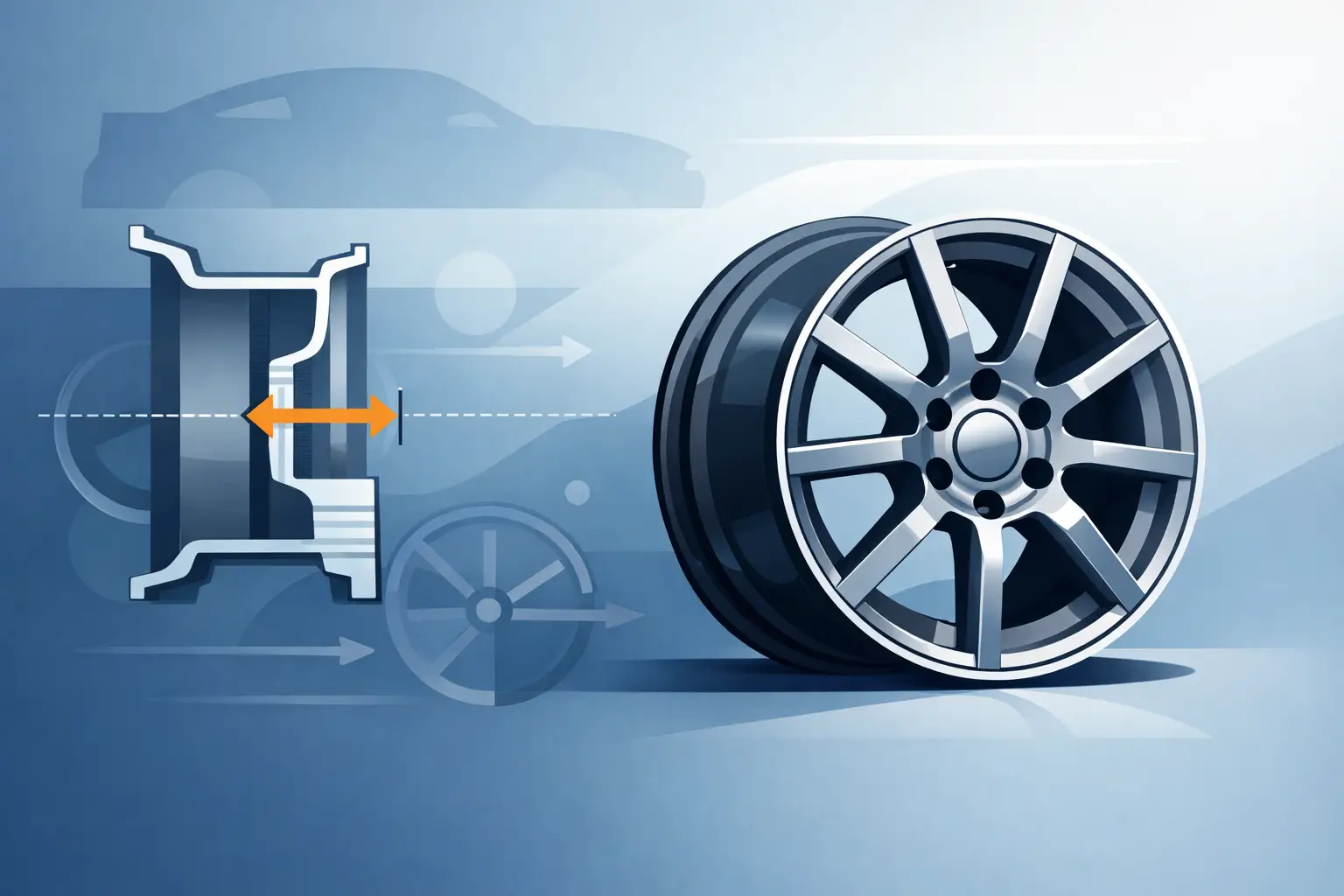
The ET measurement, often called offset, indicates the distance between the centerline of the rim and the contact surface against the hub. It is measured in millimeters. Simply put, ET tells you how far in or out the rim ends up in the wheel well when you mount it.
If a rim has a high ET, the contact surface is further out towards the outside of the rim, which means that the wheel ends up further into the wheel arch. If the rim has a lower ET, the wheel ends up further out towards the fender edge. This is why two rims with the same diameter and width can still fit completely differently on the same car.
This doesn't just affect the appearance. It affects clearance to the brakes , struts, control arms and fenders. On a street car, incorrect ET can cause scraping and vibration. On a performance car, it can also change the car's steering feel and suspension load.
How to read the ET value
For example, a rim may say ET35, ET42 or ET20. The number after ET is the offset in millimeters. The lower the number, the further out the rim will be. The higher the number, the further in it will be.
If we take a concrete example, it will be easier. An 8 inch wide rim with ET45 will sit further in than an 8 inch wide rim with ET30. The difference is 15 mm, which in practice is quite a lot. It can be the difference between a perfect flush fit and the tire catching on the fender or the strut.
It is also important to understand that ET should never be judged in isolation. Rim width plays a direct role. A wider rim with the same ET as the original will still build more inwards and outwards, because the rim itself is wider around the same hub location.
Positive, zero and negative ET
Most modern passenger cars run with positive ET. This means that the hub surface is outside the centerline of the rim and that the rim ends up relatively far in. Zero ET means that the hub surface is exactly in the center of the rim. Negative ET is more common on certain off-road builds or extreme applications where the wheel needs to extend much further.
For common performance and enthusiast builds in Sweden, it is almost always a positive ET, but within a range where a few millimeters here or there makes a big difference.
Why the ET measurement is crucial for fit
When you're chasing the right stance, it's easy to get blinded by width and diameter. But ET is often what determines whether the combination is actually ridden. Too low an offset can cause the tire to stick out too far and catch on the fender during compression or steering. Too high an offset can cause problems inwardly towards the shock absorbers, coilovers or brake calipers.
If you have larger brakes than the original, it becomes extra sensitive. A rim may have the correct ET on paper but still not provide sufficient clearance against the shape of the brake caliper. Therefore, it is not enough to simply copy an ET value from another car model or a forum. Brake package, camber, tire profile and chassis height also play a role.
On the track, it's quickly noticeable when the wheel is misaligned. You can make contact under heavy load, especially in curbs, compressions and quick changes of direction. On the street, it may only be noticeable when the car is fully loaded or when you're cornering hard with a slightly larger tire size.
How ET affects the feel of the car
Offset isn't just about wheel clearance. It also affects how the car feels. When you move the wheel out, the scrub radius changes and the load on the wheel bearings and front-end components changes. In some cases, the car can feel more aggressive and have a wider track, but there's always a downside to going too far.
Too low an ET can result in heavier steering, more kickback in the steering wheel and increased strain on bearings and joints. Too high an ET can result in too little inward clearance and mean you have to compromise on tire choice or brake setup. On a pure show car, it might be okay to be on the limit. On a car that will be going hard on the track or rally, the fit needs to be built for the load, not just for parking.
That's where a well-thought-out wheel package makes a difference. The right ET doesn't just provide good fitment – it gives a car that goes hard without protesting.
What does ET measurement mean on rims with spacers?
Spacers change the effective offset. If you install a 10 mm spacer on a rim with ET45, the effective offset will be approximately ET35. The rim will therefore be moved 10 mm outwards.
This can be a smart solution if you need clearance for brakes or want to adjust the fit a bit, but it's not always the right way to go. Too thick spacers can require longer wheel bolts or studs, and the quality of both the spacer and the attachment must be right. On a car that is driven hard, there's no point in taking chances.
Spacers are often used as a quick fix, but in a serious build, the right rim with the right ET is usually the stronger choice from the start.
Common misunderstandings about ET
A common mistake is to think that the same ET works just because the rim diameter is the same. But an 18×8 ET35 and an 18×9,5 ET35 behave very differently in the wheel well. The wider rim extends more in both directions.
Another misconception is that “lower ET is always better looking”. Sure, many people want their wheels to be longer, and that can look just right on the right car. But if you go too far, you often sacrifice functionality. On a bank cart or street car with real use, it is rarely smart to build away clearance and durability just for the sake of appearance.
There are also those who only look at whether the wheel spins freely when the car is stationary. That says very little. The car moves while driving. The suspension works, the tire flexes, the steering is loaded and the body rolls. What looks good in the garage can start to break down immediately when you start driving hard.
How to choose the right ET for your car
Always start with the car's original spec or a proven setup for your platform. Then look at the whole package: rim width, tire size, lowering, camber, brakes and application. A street car that should be trouble-free every day has different requirements than a drift car or trackday car.
If you want to go wider than stock, this is often where the math starts. A wider rim with a slightly higher ET can sometimes work better than a narrower one with a low ET, depending on where you need clearance. So you need to know if the restriction is inward or outward.
If you have coilovers with thicker struts, larger brake calipers or re-rolled fenders, the conditions change immediately. In that case, general recommendations are not enough. In that case, it is important to measure for real.
For many enthusiasts, it's worth getting help right away instead of buying on a whim. At House of Motorsport, that kind of product-related support is a big part of the whole thing – the right parts for the right build, without unnecessary detours.
A quick rule of thumb for thinking correctly
If you lower the ET, you move the wheel out. If you raise the ET, you move the wheel in. But any change must be weighed against the rim width, the actual width of the tires, and how the car is used.
There is no universal “best” ET. The right value depends on whether you prioritize brake clearance, fender clearance, steering feel, load bearing, or pure visual fit. Therefore, ET is a measurement that must be read in conjunction with the rest of the wheel package, not as a loose number in the product name.
Once you understand how ET works, it becomes much easier to choose wheels with confidence. You’ll eliminate guesswork, avoid buying the wrong ones, and build a car that not only looks fast but also performs when you put real strain on it. That’s where the difference lies – between a wheel package that only looks good on paper and one that delivers every time you turn the key.