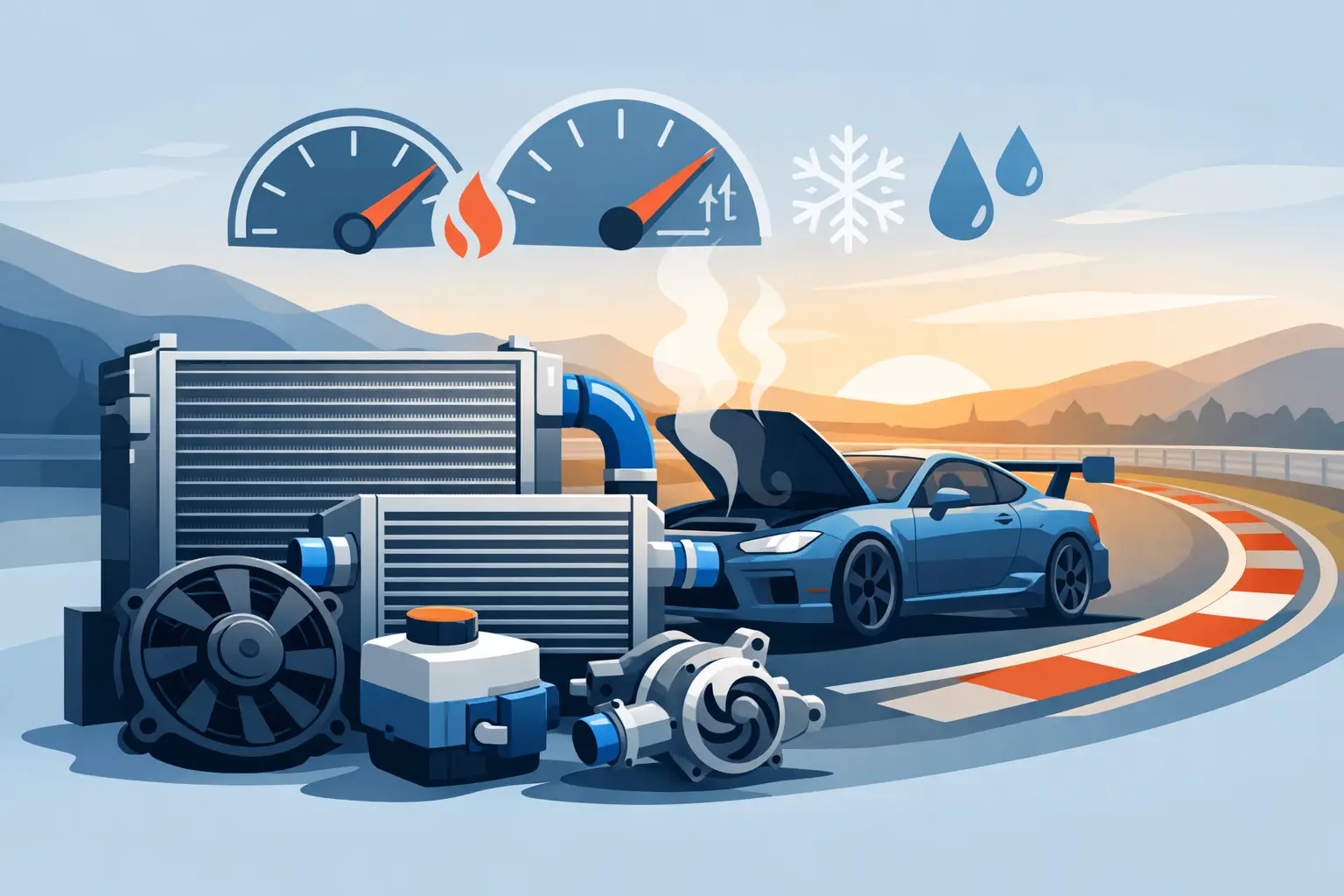
It's immediately noticeable when the cooling system is not sufficient. The oil becomes thinner, the water temperature creeps up lap after lap and the car that felt rock solid on the first lap starts to feel sluggish, hot and unreliable. If you are going to upgrade the cooling system for track driving, there is a simple truth – the original system is rarely built for repeated full throttle sessions, high ambient temperatures and late braking points.
On the street, many things can work “good enough”. On the track, that’s not enough. There, the cooling system has to maintain a consistent temperature under load, not just handle a short pull or an occasional acceleration. It’s that difference that determines whether you can focus on lane selection and braking points, or whether you’re sitting there staring at the meters after three laps.
Why original cooling often falls by the wayside
Many cars are designed for commuting, highway driving and occasional overtaking. Even sportier models often have a cooling package that balances cost, weight, noise requirements and fuel consumption. It works in everyday life, but track driving shifts the entire load picture.
You are at high load for a long time, often with higher revs than the car normally sees on the road. Under the hood, the temperature rises quickly, especially on turbo cars where both charge air and oil are heavily loaded. Add hot summer days, heavy traffic at the pit exit and maybe a little dirt in the radiator package, and the margins are gone.
It is also common to chase power before cooling. Bigger turbos , more boost pressure, sharper maps and better grip increase the temperature load everywhere. Then the cooling system becomes a bottleneck. Not the most fun upgrade on paper, but one of the most crucial if the car is actually going to last a full session.
Upgrading cooling systems for track driving – start with the big picture
The biggest mistake is to buy a bigger radiator and think the job is done. Cooling on the track is a system, not an individual part. The radiator, fans, hoses, expansion tank, thermostat, oil cooler, airflow through the front and how the air leaves the engine compartment are all interconnected.
An aluminum radiator with a larger core can make a big difference, but only if the air actually goes through the radiator and not around it. If there is no seal at the front, or if the radiator has large gaps around the sides, the air takes the easiest route. The result will be worse than many people think, even with more expensive parts.
Therefore, start by looking at how the car is used. Is it time attack with long passes and high speed wind flow? Is it drifting with a lot of wheel spin, limited speed wind and high heat at low speed? Or track days where the car should also work well on the road? The right solution depends on the scenario.
The radiator – the basis of a sustainable cooling package
For most people, the radiator is the first step, and often the right step. A better aluminum radiator provides higher capacity, better heat resistance and often more stable temperatures under longer loads. But bigger does not always equal better.
A radiator that is too thick can result in poor airflow if the rest of the package is not properly aligned. This is especially true if you already have an AC condenser, oil cooler, and intercooler up front. In that case, a smarter core design and better mounting can be more effective than just building thicker.
Fit also matters. A radiator that is mounted correctly, sits securely, and has good airflow will often beat a poorly mounted premium part. On the track, you want stability – nothing that moves, chafes hoses, or starts leaking after a few heat cycles.
Fans and control
The fans rarely make the biggest difference at high speed, but they make a big difference in the pits, queues and after cooling down. More powerful electric fans with the correct shroud help pull air through the entire surface of the radiator, not just the middle.
Here it is important not to skimp on the electrical side. Relays, fuses, wiring and control must withstand the load. A strong fan that is poorly powered will not deliver what you think. At the same time, you should not overestimate the fan's role on the straights - there, air control and front flow are more important.
Oil cooling – often as important as water temperature
Many people only look at water temperature, but the oil takes just as much abuse during track driving. When the oil gets too hot, it loses viscosity, the lubricating film deteriorates and the engine has to work in an increasingly narrow window. This is especially noticeable on turbo cars and engines that are already close to the limit from the factory.
An external oil cooler with the right thermostat plate can be the difference between a stable session and an engine that starts to feel bad after a few laps. But even here there is a balance. If you drive a lot on the street, you don't want to overcool the oil. That's why a thermostat solution is important, especially in the Swedish climate.
The placement also plays a big role. The oil cooler must get air, but not sabotage the flow to the water cooler. The front is a limited area. If you have both an intercooler, AC and several radiators in front of each other, planning is required, otherwise you just build a hot package where each part interferes with the next.
Intercooler, charge air and heating under the hood
On turbocharged cars, you can't talk about cooling systems without talking about charge air. High intake temps cost power, but they also increase the total heat load in the engine compartment. An efficient intercooler therefore helps with more than just the power curve.
At the same time, there is a classic mistake here too – installing a huge intercooler without considering pressure drop, front coverage and airflow to the rest of the cooling package. In some builds, this upgrade is one step forward and two steps back. You gain cooler charge air but lose control over water temp.
Track racing requires compromises that work together. The best looking or biggest choice is not always the fastest over an entire session.
Hoses, caps and expansion tanks – small parts that ruin the construction
It's easy to budget for the big parts and forget about the rest. But old rubber hoses, a tired radiator cap or an expansion tank that can't handle the pressure can ruin everything. On the track, weak points quickly become apparent.
Fresh silicone or motorsport-grade hoses, good hose clamps and a cap with the right pressure specification are not glamorous parts. But they are exactly what builds operational reliability. The same applies to the location and venting of the expansion tank. Air in the system causes poor circulation and uneven temperatures, and then you are chasing errors that are really about basic installation.
Airflow – where many people lose the most power
If you really want to upgrade your cooling system for track racing, you have to see air as a managed resource. The air should come in through the front, through the radiator package, and then out. If hot air remains in the engine compartment, the entire system will lose speed.
Therefore, sealing around the radiator, ducting in the front and in some cases a ventilated hood make a bigger difference than many people think. On some platforms it is almost mandatory if the car is driven hard for a long time. Especially when you have built on with an intercooler, oil cooler and a tighter front.
This is also a point where home builds can be very good if done right. A simple but well thought out air control often beats an expensive parts-on-a-pile setup. Function first.
How far do you need to go?
Not everyone needs to build a full race cooling package. A lighter street car with a naturally aspirated engine and shorter stroke might go a long way with an aluminum radiator, new hoses, better coolant and orderly airflow. A tuned turbo car on R-tire is a different story. A single upgrade is rarely enough.
If the car only warms up late in the session, the capacity is often too low. If it warms up almost immediately, it could be due to poor flow, air in the system, incorrect fan control or a blocked radiator package. If the temperature rises in the pits but stabilizes at speed, this points more to the fan and low-speed cooling than the radiator size.
That's why logging is gold. Look at water temp, oil temp and preferably intake temp over an entire session. Then you can see if the problem is constant, speed dependent or linked to certain parts of the ride.
Build for the entire session, not just the first lap
It's easy to think of power in numbers and cooling as something you solve later. But on the track, endurance is performance. A car that maintains a consistent temperature, maintains power and doesn't force you to back off is faster in real life than a car that feels brutal for two laps and then boils away its advantage.
For many builds, the right way to start is with a solid foundation: a good radiator, the right fan solution, a working oil cooler, fresh hoses and sealed airflow. Then you adjust according to platform, power goals and how hard the car is actually driven. That's how you build something that will hold up for both attack laps and the journey home.
If you want parts that match real track requirements, not just fancy product images, that's where a motorsport-focused range makes a difference. House of Motorsport is aimed squarely at builders who want their car to perform under load, not just look fast in the garage.
Proper cooling may not feel like the sexiest upgrade, but when other cars roll in with their hoods open and you can go out for your next session with a stable temp and full confidence, you'll know exactly why the work was worth it.