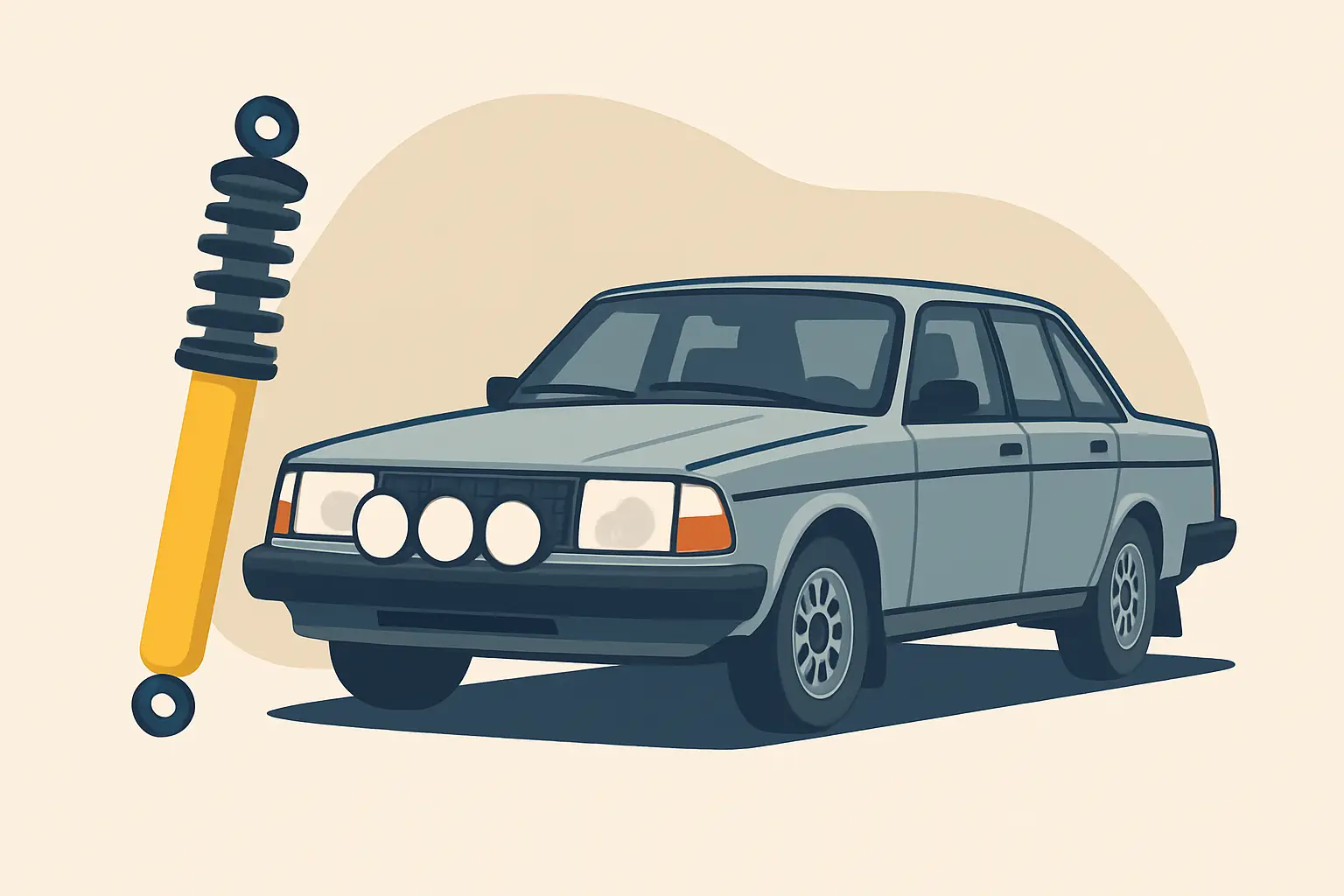
You can tell when a 240 has the wrong dampers. The nose nods under braking, the rear end takes an extra bounce over the crest, and the car requires corrections that steal both speed and confidence. With the right dampers, the same chassis suddenly becomes tight, predictable, and fast – whether you're driving sports on the street, chasing tenths on the track, or charging in a rally.
If you are looking for “shock absorber 240 sport rally racing”, you are in practice looking for one thing: control. Not just “harder” or “lowering”, but control over the contact of the wheels with the ground, over the body movements and over how the car loads and releases grip. That is where you gain time – and where you avoid unnecessary breakdowns.
What a good shock absorber does in a 240
A shock absorber is not there to make the car silent. It is there to control how fast the spring is allowed to move. On a Volvo 240, with its relatively heavy body and often upgraded drivetrain, the damping becomes extra crucial because the car likes to build energy in the chassis when you drive aggressively.
On asphalt, it’s all about keeping the tire flat and stable when you brake hard, change direction, and take curbs. On gravel, you also want to be able to let the wheels work over bumps without the car starting to bounce or “pack.” On both surfaces, the goal is the same: maximum grip over time, not a short peak that feels fun for a lap and then falls apart as the temperature and pace rise.
This is also where many people go wrong. Too hard compression damping can make the car fast in a curve with smooth asphalt – and at the same time completely hopeless on a bumpy stretch where the wheels don't have time to hit the ground. Too soft rebound can result in a car that feels nice at low speeds but becomes wobbly and imprecise when you charge.
“Shock absorber 240 sport rally racing” – three uses, three requirements
Same 240 platform, completely different conditions.
Sports and fast street
Here you often want a car that feels tight but isn't hard to live with. The shock absorbers need to handle uneven country roads and at the same time provide support when you brake into roundabouts, turn in hard and apply power out.
The key is balance. A sports shock absorber with sensible rebound control does more for the driving feel than extreme spring stiffness. If you also drive with a little more grip (better tires, wider rims), the need for damping that holds the body together becomes even more apparent.
Rally and gravel
On gravel it's easy to get speed-blind to the idea that "harder = better". But rallying is brutal on components, and the surface is constantly changing. A good rally setup is about letting the suspension and damping absorb bumps without the car losing its line.
Too little damping creates bounce and uncontrolled weight transfer. Too much damping, especially in compression, makes the car nervous and lose grip over washboards and fast bumps. You want a damper that is consistent when it gets hot and is built to take the hit—not just deliver feel in the parking lot.
Racing and track driving
On the track, repetition is everything. Same braking point, same apex, same pull – lap after lap. This is where the shock’s thermal stability and control in both compression and rebound become crucial. You also want to be able to fine-tune the balance with anti-roll bars and wheel angles without the shock stopping.
Racing often means higher spring rates and more grip, which requires dampers that can actually control the spring. Otherwise you end up with a car that looks “race” but behaves like a springboard in quick changes of direction.
How to choose the right muffler for 240 – without guessing
What determines whether your choice is a hit or miss is how you match the shock absorbers with the rest of the chassis.
1) Springs and ride height
Lowering itself is not performance, but the wrong lowering is often pure loss. Shorter springs require the damper to have the right travel and that it does not bottom out. A 240 that bottoms out under braking will feel like it is “diving” and then losing grip when it comes to a mechanical stop.
If you drive close to the original height but want better control, a sportier shock absorber will often go a long way. If you drive low with stiffer springs, the shock absorber must be built for that – otherwise it will work outside its optimal range.
2) Tires, grip and brakes
More grip reveals poor damping. When you go from street tires to more aggressive tires, the load on the chassis increases both laterally and longitudinally. The same goes for when you upgrade brakes and suddenly can brake later and harder – then the demand increases for the front end to stay stable and the rear end to not become light and messy.
The nice thing is that when the dampers are right, the car feels calm despite higher speeds. You get a window where the car communicates instead of surprising.
3) Bushings, top bearings and clearance
You can buy the best shock absorbers in the world and still get a car that feels “loose” if the bushings and top bearings are worn out. A 240 with worn rubber will eat up the precision you pay for.
This is not about everything having to be rock-solid uniball to work. But it has to be fresh and matched. For rallying, some compliance can be your friend. For track, you often want more directness. The point is that the damper shouldn't have to compensate for play.
4) Adjustable or not
Adjustable shocks sound great – and they can be clean – but they also require you to have a plan. If you’re never going to change the settings, it’s sometimes smarter to put the budget into a quality shock with a fixed, well-thought-out characteristic and spend the rest on tires, wheel angles or fresh bushings.
However, if you ride both tarmac and gravel, or switch between different tracks and tires, adjustability can be what allows you to find the right balance without constantly changing parts. Then it's important that the adjustment actually provides useful increments, not just a "hard" position that destroys grip.
Common 240-damping mistakes that cost time
The most common mistake is chasing “hard feel” instead of grip. A 240 can feel impressively stiff on the idle lap and yet be slow where it counts, because the tires never get to work optimally.
The next classic is imbalance between the front and rear. Too hard at the rear can result in a car that spins quickly but becomes difficult to drive consistently, especially in fast sections or on uneven surfaces. Too soft at the rear can cause the car to settle and lose traction out of corners. Too hard at the front often causes the car to “push” and understeer when you try to charge.
And don't forget the temperature. Track driving and rallying build up heat in the shock. A shock that feels good for three minutes but loses control after ten laps is no win, even if it was cheap or popular in a forum thread.
When the Bilstein type of damping is the right idea
There's a reason why many serious builds end up in Bilstein when the goal is sport/rally/racing. Not because it's a magic word, but because a good monotube construction often provides stable damping, good heat resistance and clear control. On a 240 that is driven hard, consistency over time becomes one of the biggest performance factors.
That doesn't mean it's always "best" regardless of use. If you ride mostly street with a focus on comfort, a different character may be a better fit. If you ride gravel and want more compliance, a different choice of camber and travel may be required. But if you're building to ride fast and long, it's a logical direction to look.
That way you get the most out of your setup
Once the shocks are in place, the fun begins – the fine-tuning. Wheel alignment is often the quickest way to better feel and lap times. A 240 with the right camber up front and a stable toe setting suddenly becomes easier to position, and you can utilize the shocks’ control instead of “saving” the car with the steering wheel.
Then comes the driving style. With a more controlled car, you can brake more progressively, release the brake earlier and carry more speed into the corner without the chassis falling apart. That's where the big win lies – in the car doing the same thing every time.
If you want to buy shock absorbers and the rest of the chassis parts in the same place, with a focus on sport/rally/racing and fast delivery, there is a wide selection at https://houseofmotorsport.com.
Choosing shock absorbers for a 240 isn’t about choosing “hard or soft.” It’s about choosing how the car will behave when you’re actually driving it. Build for grip, build for control, and let the rest of the package work with the shocks – and you’ll have a 240 that feels as sharp as it looks when you roll to the start.