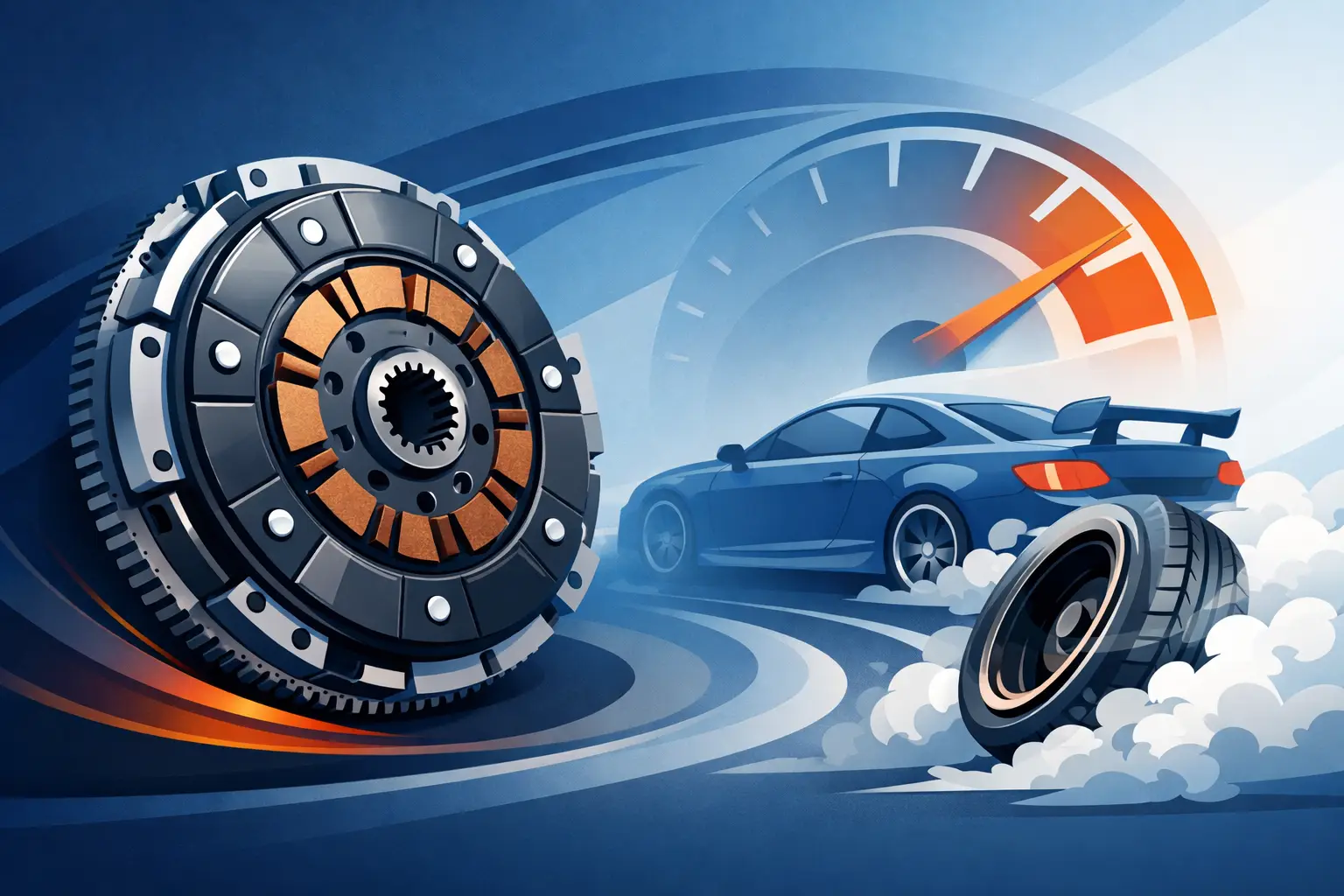
When the original clutch starts to smell burnt after a hard session on the track, or when it starts to slip as soon as boost pressure comes, then it is no longer a theory. Then a sports clutch is the next step. For those who are building for more power, harder starts or more frequent gear changes, the clutch is not a detail in the background – it is a crucial part of the entire drivetrain.
What a sports clutch actually does
A sports clutch is built to transfer more torque than a standard clutch while also withstanding higher heat loads. It sounds simple, but in practice it's all about how the car feels at every start, every gear change and every turn out of a corner.
With more clamping force in the pressure plate and friction material that is made for tougher driving, you get better grip between the engine and gearbox. The result is less risk of slippage when the power increases. On a tuned street car, it is often first noticeable in high gear and full boost pressure. On a track car or drift car, it is noticeable earlier, because the load is harder and more recurring.
The important thing is to understand that a sports clutch does not automatically mean an undriveable car or an on/off feeling. It all depends on the build. If you choose the right level for your power, weight and use, you can get a solution that both lasts and works on the street.
When the original clutch is no longer enough
There is a pretty clear point where standard parts start to give up. If you have increased the power , changed the turbo, fitted sharper cams, increased the grip in the tires or driven the car hard on the track, then the demands on the clutch also increase.
The most common signs are that the engine revs up without the car really keeping up, especially under heavy load. Another sign is that the clutch pedal feels different or that the clutch starts to engage unevenly after hard driving. Heat is often the culprit. A stock clutch can work fine on the street with a little optimization, but as you start approaching higher torque or frequent launches, the margins become small.
For rally, drifting and time attack, there's really no point in taking chances. There, the clutch is a wearing part under pressure, and the wrong choice costs both time and money.
Different types of sports clutch
Not all sports clutches are built for the same job. The use here determines more than many people think.
Organic slat
This is often the most sensible choice for a fast street car or a car that is driven both to the track and to the track. An organic disc usually provides smoother engagement, better everyday driving and less jerking at low speeds. It can often significantly outperform the original, especially in combination with an upgraded pressure plate.
The disadvantage is that it has its limits when the torque drags away or when the car is used hard for a long time. If you do a lot of track driving with a heavy car and sticky tires, it can get hot and lose power.
Sintered lamella
When the focus is more on grip than comfort, sinter comes into play. It can withstand higher temperatures and higher loads better than organic coatings. For cars with a lot of power, aggressive driving or motorsport use, it is often the way to go.
The price you pay is the feel. A sintered sports clutch is often rougher in engagement, more jerky in city traffic and less forgiving when coasting. For some, that's just right. For others, it quickly becomes tiring if the car is still used a lot on the street.
Single-disc or multi-disc
A single-disc clutch will go a long way in many builds and is often easier to live with. A multi-disc solution is used when you need very high torque capacity but still want to keep rotating mass down or fit within limited space.
Multi-disc is effective, but also more expensive and often more uncompromising. It is rarely the first choice for a regular street car, but very relevant in serious performance builds.
How to choose the right sports clutch
The most common mistake is to choose too tight right away. Many people see the highest possible torque rating as the only number that matters. But a clutch shouldn't just hold up on paper. It should work with the weight of the car, gearbox, usage and tire grip.
Start by being honest about the car. Is it a street car with a tuning program and a few track days per summer? Then an organic sports clutch with a reinforced pressure plate might be just right. Is it a turbo four with plenty of torque and recurring launch control? Then you need to look higher.
Also consider how the power comes from. A naturally aspirated engine with revs does not always require the same type of clutch as a turbo car with high torque early on. Two cars with the same horsepower can place completely different demands on the drivetrain.
Then there's the rest of the package. Flywheel, release bearing and slave cylinder affect both function and feel. If you install a new sports clutch on worn peripheral parts, you're asking for trouble. When the box is down anyway, it's often smart to do the job properly.
Sport clutch on street, track and rally
GataXNUMX
On the street, you want control without the car being a pain to operate. That's why pedal pressure, engagement and heat resistance are as important as pure torque capacity. For many performance cars, a well-matched Stage 1 or Stage 2 solution goes a long way.
Track and time attack
Here temperature and consistency become more important. The clutch should function the same lap after lap, even when the car gets hot. Fast shifts and hard downshifts place demands on both the plate and the pressure plate. For lighter track cars, low rotating mass can also play a big role in response.
Rally and drifting
Here the load is brutal and often jerky. Starting, grip changes, kicks and high temperatures wear you down. Then you need a sports clutch that is built for abuse, not just for pretty numbers in the product text. Comfort comes far down the list. Operational reliability and direct response come first.
Common mistakes when purchasing and installing
The first mistake is to only look at maximum power. The second is to ignore running-in. Many clutches need to be run-in correctly to provide full function and longevity. Skipping this can cause even good parts to behave poorly.
A third mistake is mixing parts without considering the whole. The disc, pressure plate and flywheel must fit together, both mechanically and in how they are intended to work. Add to that the fact that some cars have sensitive hydraulic systems or limited space in the clutch housing, and it becomes clear that the right specification means everything.
Assembly also plays a bigger role than many people want to admit. Incorrect centering, poor cleaning of contact surfaces or reusing worn bolts can cause vibrations, poor disengagement and short service life. A sports clutch is often less forgiving than the original.
Is harder always better?
No. Too much clutch can be almost as annoying as too little. If the car is mostly driven on the street, a very aggressive solution can make it sluggish, more tiring for the drivetrain and less fun in everyday life. High clamping force also increases the load on other parts.
That's why the best builds are rarely about the hardest part in the catalog. They're about balance. The right linkage should hold up to use, provide a clear feel, and not create unnecessary problems around it.
For those who build smartly, it is often better to choose a solution with a little margin than to go straight to pure competition spec. But if the car is actually driven as a competition car, you should not try to save yourself from the problem either. Then the right level from the start is cheaper than changing twice.
That's why the right support is worth a lot
Sport clutch is one of those parts where car model, engine platform, torque and use really decide everything. The same product can be perfect in one build and completely wrong in another. That's why you benefit from choosing parts from a range that is built for performance cars and motorsport, not just for standard service. House of Motorsport is strong right there – driveline, power and parts that will work when the car is actually used hard.
When choosing a clutch, think beyond just fit. Look at how the car is used in real life, how much power it actually delivers, and what you expect from the feel of the pedal. The best solution isn't always the most extreme, but it should withstand the use of the car for which it was built. And when your right foot is put to the test, you want to know that the clutch is doing its job every time.