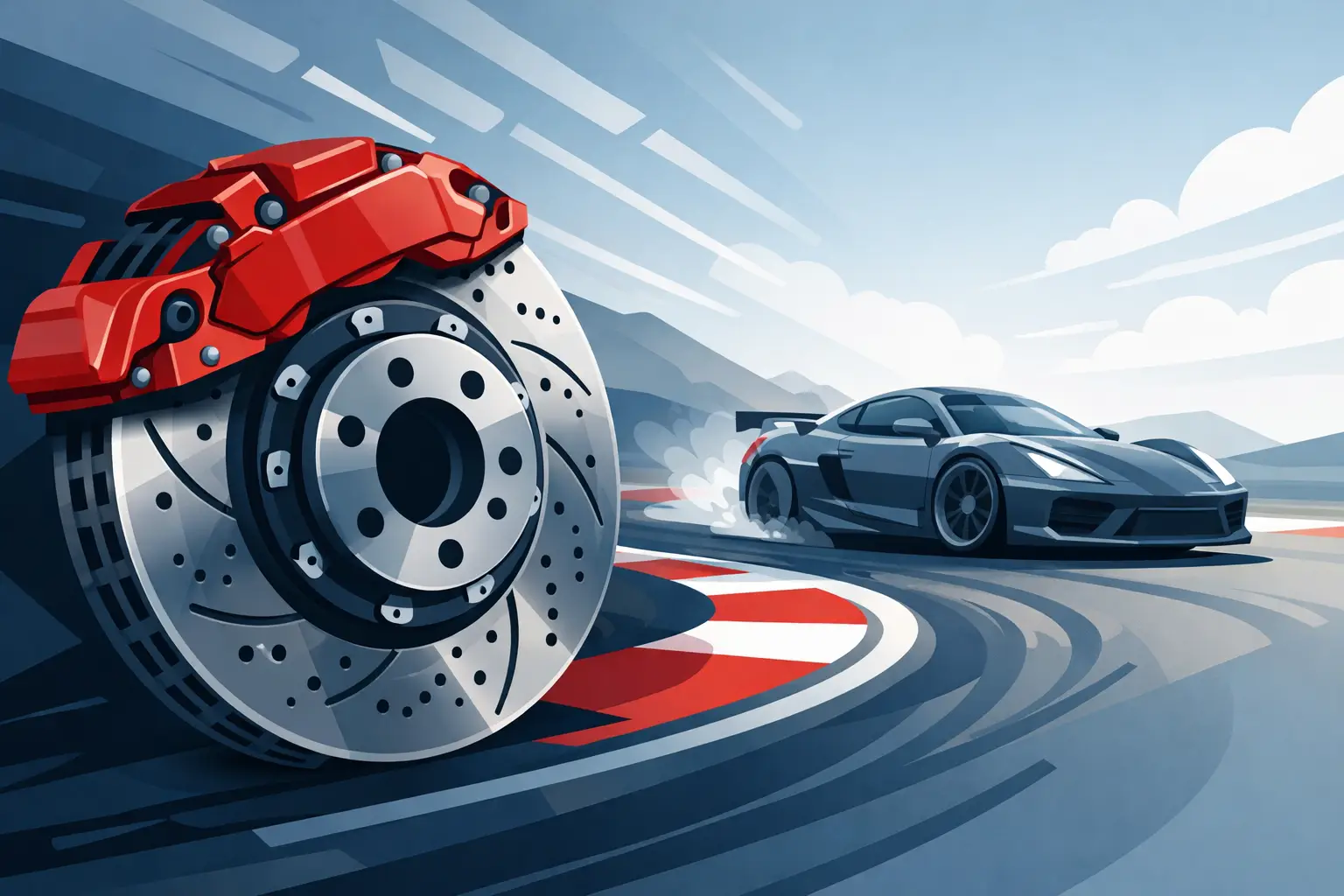
When the brakes are long after three hard laps, it doesn't matter how much power you've built. Performance brakes aren't a styling detail or a paper upgrade – they're what determines whether the car feels confident, consistent and fast when the pace picks up.
For many, the braking journey begins with a simple question: is the original enough, or is it time to upgrade? The answer depends on how the car is used. A street car that gets a more powerful engine, better tires and a stiffer chassis immediately places higher demands on the braking system. If you drive on a track, drift or rally, the margins are even smaller. Then it's not just about the car stopping, but about it doing the same thing every time.
What performance brakes actually do
The simple answer is that they handle heat better, provide clearer pedal feel, and keep performance stable under load. But this is also where many people oversimplify. Bigger brakes aren't automatically better in all situations, and the most expensive parts don't always give the best results on your particular car.
What separates performance brakes from standard components is how the whole package works together. The friction material of the pads, the construction of the disc, the stiffness of the caliper, the boiling point of the brake fluid and the expansion of the hoses all affect the same thing – how consistently the brakes feel when they get hot. A car that brakes well on the first application but worse on the fourth is not faster, just more difficult to drive.
On the street, the upgrade is often noticeable as better pedal response and safer braking at higher speeds. On the track, it is noticeable as endurance. In rally and gravel, dirt, temperature changes and tough mechanical stress are also added, making component selection even more important.
Performance brakes are about systems, not an individual part
The most common mistake is to just replace one component and expect a total difference. A pair of aggressive pads on worn original discs and old brake fluid rarely gives the effect you hope for. On the contrary, the car can feel sharp cold, but messy hot.
If you want to build correctly, start by looking at the brake system as a whole. The pads determine much of the initial bite and operating temperature. The discs affect cooling, stability and resistance to cracking. Steel-braided hoses often improve pedal feel by reducing expansion. Brake fluid is absolutely crucial when temperatures rise. Calipers affect both force distribution and feel, but also how evenly the pads work against the disc.
This doesn't mean you always have to buy a big brake kit. For many cars, the right combination of sports discs, matched pads, fresh fluid and good hoses will go a long way. Especially if the car is still on the road a lot. But when the speed increases, the weight is high or the length of the session becomes longer, then larger disc diameters and stiffer multi-piston calipers can make a real difference.
Evidence – where the feeling often begins
Brake pads are often the most noticeable upgrade per dollar. A more performance-oriented pad can provide better bite, higher temperature resistance and smoother deceleration under hard driving. At the same time, there is a clear trade-off. A pure track pad can be noisier, dustier and perform worse in the cold.
That's why the application must be decisive. A street car with occasional track days needs a tread that can handle heat without becoming unbearable in everyday traffic. A dedicated trackday car can go considerably harder in compound. Rally and drifting have their own requirements, where modulation and repeated hard braking often outweigh maximum bite in a single stop.
Discs – more than just size
Slotted, drilled or smooth discs? There is more talk than fact in many garages. Slotted discs often help keep the pad surface clean and provide even contact. Drilled discs can work well in some applications but are not always the first choice for really hard and repeated driving, where the risk of cracking can be a factor. For many performance builds, a quality slotted or smooth disc is the safer choice.
Larger diameters provide better leverage and more heat capacity, but they also increase rim clearance requirements and can affect unsprung weight. On a lightweight car, a well-tuned smaller package can feel better than an oversized system that mostly looks right behind the rim.
Fluid and hoses – small parts, big difference
A soft pedal after a few hard braking manoeuvres is often not a problem with the discs or pads, but with the fluid. Boiling brake fluid gives you a pedal you don't want to face at the end of a straight. If you drive actively, regular changes are not a detail, but a basic service.
Steel braided hoses rarely work wonders on their own, but they can provide a firmer, more predictable pedal feel, especially when you want to brake late and precisely, not just hard.
How to choose the right performance brakes
The quickest way to choose the wrong one is to buy by appearance or by what happens to be popular on a forum. The right brake upgrade always starts with three things: the weight of the car, the area of use and the tire level.
If you have a light street car with semi-slicks and a moderate increase in power, a well-thought-out OEM-plus package may be just right. If you have a heavier turbo or six-cylinder car that goes on regular track days, more thermal capacity is needed. If you drive a rally, there are additional requirements for resistance to dirt, rapid temperature changes and consistent function on varying surfaces.
Tires also play a bigger role than many people want to admit. More grip means more load on the brakes. The same car with better tires often requires better brakes to maintain the same stability during braking. That's why brakes, chassis and tires should always be thought of together.
There is also a balance in pedal feel and brake bias. Too aggressive components up front without the rest of the car following suit can result in a car that feels nervous or difficult to control. A fast car should be easy to rely on, not just brutal on the first downstroke.
Common mistakes when upgrading brakes
A classic is to install hard pads and then not embed them correctly against the discs. This will easily cause vibrations, uneven pad transfer and a worse feel than you paid for. Another mistake is to underestimate cooling. If the airflow to the brakes is poor, going up in size will only help a little.
Many people also forget that worn bushings, bad wheel bearings or incorrect wheel alignment can make brake problems feel worse than they are. The brake system does not live in isolation. If the car has play, misalignment or poor geometry, even expensive parts will not feel quite right.
Then there's the obvious but often forgotten: the rear brakes. The front takes the most work, but a car that's going to be stable under braking needs a system that works as a whole. Ignoring the rear axle rarely gives you the balance you're looking for.
When is a big brake kit worth the money?
When the original architecture starts to give out. It's usually noticeable as recurring fade, uneven temperature control or having to compromise too much with pad selection to get the car usable. A proper kit can provide better heat management, a stiffer pedal and more even power distribution. On the right car, it's a serious upgrade.
But that's not always the first step. For a car that mostly goes on the street and a few hard sessions per year, it's often smarter to start with pads, discs, hoses and fluid. You get a lot of effect per krona and can evaluate what is actually missing. House of Motorsport works precisely in this range where the right parts for the right use make a bigger difference than just buying the largest possible package outright.
For those who race, chase lap times or drive hard and for long periods under high loads, a larger brake package is often an investment in both speed and reliability. And that's where brakes go from being an upgrade to becoming a tool.
Brake feel is also confidence
This is perhaps the most important point. Good performance brakes don't just shorten stopping distances on paper. They make the car easier to read. You feel what's happening in the pedal, you know where the bite point is, and you dare to brake consistently lap after lap. It saves time, but it also saves mistakes.
There's a reason experienced drivers often talk more about brake feel than maximum braking force. Power without control is rarely fast. The real win comes when the car responds the same way every time, whether you're cruising down the street on a late summer evening, attacking curbs on trackday, or charging into the next stretch.
If you're going to build your car to withstand more than a hard scratch, start where it really counts – in a braking system that matches the pace you actually drive at.