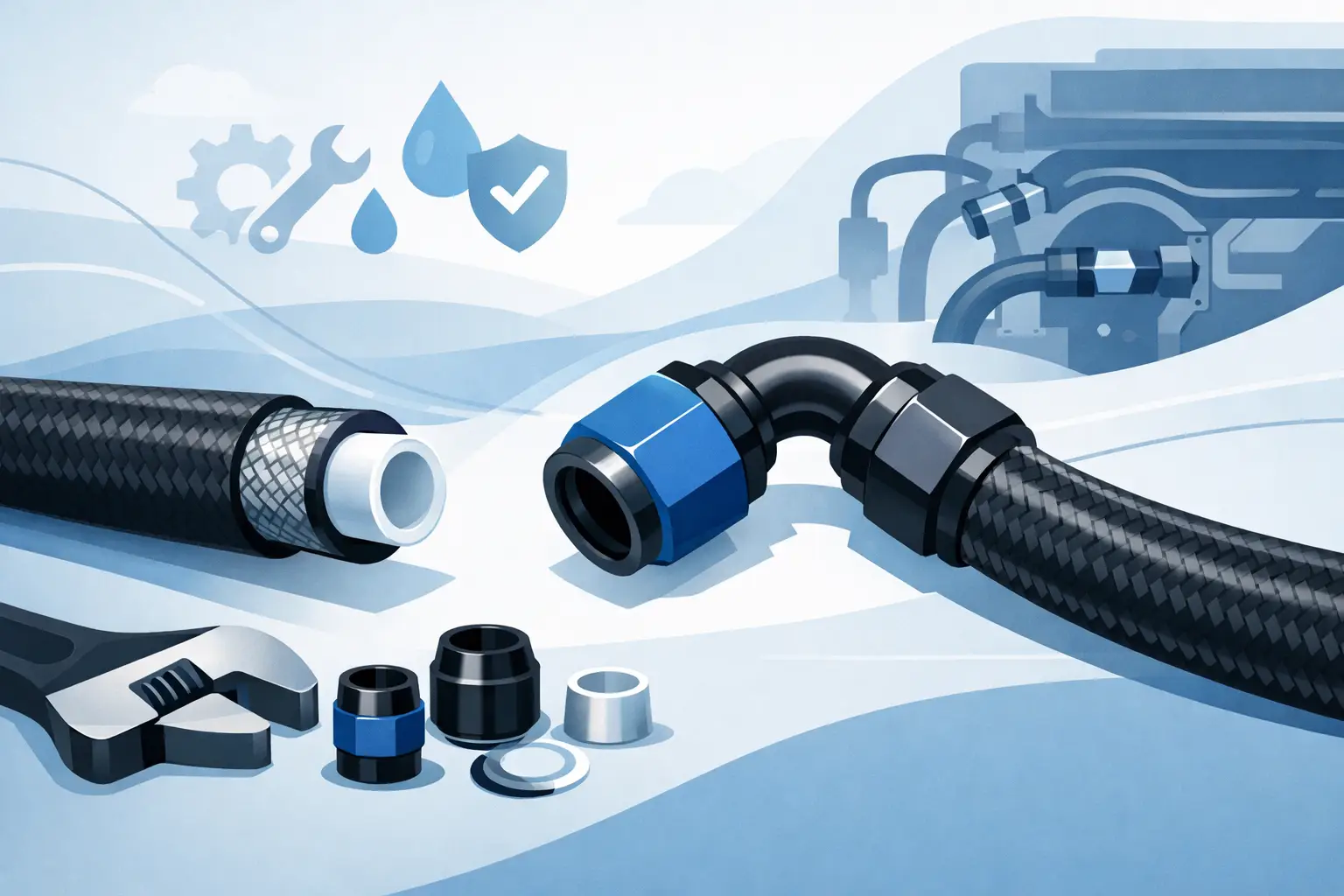
A PTFE hose that sweats fuel or starts leaking oil after a few heat cycles is almost always an assembly error, not “bad luck”. If you are going to assemble AN hose PTFE correctly, you need to be careful from the first cut. This is a detail that determines whether the construction will withstand street, track and heavy loads – or whether you have to tear it all down again.
PTFE hose is used for a reason. It can handle fuels like E85, handles chemicals better than many rubber hoses, and provides a stable solution in systems where you don't want to take any chances. But it's less forgiving when it comes to assembly than a regular rubber-braided AN hose. That's where many things go wrong. If you tighten the coupling at the wrong angle, damage the inner hose, or place the olive incorrectly, it doesn't matter how nice the parts you bought.
Therefore, you must assemble AN PTFE hose correctly
The difference between a tight PTFE installation and one that starts to leak is often in details that are barely visible. A cut that is not completely straight. A few steel wires in the braid that have bent inward. An olive that has not bottomed correctly against the PTFE liner. The result is that the connection may feel “tight” at the bench but will not hold when pressure, vibration and temperature come into play.
On a street car it is sometimes noticeable only after a while. On a track car or rally car it is noticeable faster, and then in the wrong place. Therefore, PTFE is not an area where you just “tighten it a little carefully and hope”. The assembly should be clean, straight and controlled.
The tools that make the job easier
You don't need a whole racing garage to succeed, but the right stuff will save both time and parts. A good cutting method is most important. Many people use a cutting disc, hose shears for the right type of hose, or a fine-toothed tool depending on the dimension. The point is the same - the cut should be clean without mashing the PTFE liner.
Tape around the cutting point often helps to keep the braid together before you cut. A vise with soft jaws also makes a big difference when assembling the coupling. You can do without it, but the risk increases that you will twist it wrong, scratch the anodizing or not get the control you want.
A little lubrication on threads and tapered seats can be fine, but don't overdo it. You shouldn't compensate for a poor fit with grease or force. The fit should be right from the start.
How to cut PTFE tubing without damaging it
Start by measuring properly. It sounds obvious, but AN connections often go wrong because you only measure the hose itself and forget the fitting's overall length and bend radius. A PTFE hose also doesn't want to be forced around tight bends. That puts stress on both the liner and the fitting.
Mark the cut and tape the area. Then cut as straight as you can. After cutting, check two things immediately – that the PTFE liner is not deformed and that the stainless steel braid has not frayed out more than necessary. If the end looks crooked or pinched, cut again. It costs less to redo a cut than to hunt for a leak later.
Carefully remove any loose wires. You don't want a sharp little wire that ends up misplaced when the coupling is put together. Small mistakes here will become big problems once the system is running under pressure.
Install AN PTFE hose correctly step by step
The principle itself is simple, but it requires precision. First you thread on the coupling's sleeve or nut part, depending on the design. Then the olive should be inserted between the outer braid and the PTFE liner. This step is the classic source of error.
The olive must fit evenly around the PTFE tube without cutting in incorrectly or being crooked. If the braid is compressed or unevenly under the olive, the load will be incorrect when you tighten the coupling. This can cause the inner tube to deform instead of building the seal where it should.
When the olive is correctly seated, bring the parts together and start threading by hand. If it feels stiff right away, back off. You should not force the first turns. Cross-threading or a slanted start will destroy both the coupling and the seal. When the thread is correct, tighten with controlled resistance. Hold firmly so that the hose does not twist.
A common mistake is to focus too much on how tight the coupling is and too little on how the parts were positioned before tightening. PTFE couplings are less about raw strength and more about precise positioning. Too tight can be just as bad as too loose.
Common mistakes that cause leaks
The first is a carelessly cut hose. If the end is not straight, the olive will have poor conditions to seal evenly. The second is that the PTFE liner is damaged during cutting or assembly. It may not crack immediately, but a small deformation can be enough to cause problems after a period of use.
The third is that the braid is not held back correctly when the olive is mounted. This causes material to get stuck where there shouldn't be any. The fourth is that you mix components that look compatible but aren't really built for each other. The AN world is wide, but tolerances, designs and quality vary.
Another classic mistake is testing for leaks too late. Don't build the entire car and hope everything holds up. Pressure test section by section when possible. It saves a huge amount of time.
It depends on the use – street, track or fuel system
How accurate you need to be is really the wrong question, as the answer is always very accurate. But different systems are sensitive to different things. A fuel system with E85 has different requirements than a simple crankcase ventilation. An oil feed close to high heat requires better routing than a return line further away from the manifold and turbo.
For track driving, drifting and rallying, vibrations, temperature changes and service intervals become a bigger part of the equation. It is then extra important that the hose is not in tension and that the couplings do not absorb movements that should be handled by routing and fastening. A correctly installed PTFE hose can last very well, but only if the rest of the installation is also well thought out.
There are also situations where PTFE is not always the easiest solution to work with, especially in very tight spaces with tight radii. The chemical resistance and performance are strong, but the flexibility is not always as forgiving as other hose types. So the right material choice starts before you even pick up the tools.
Check after assembly
Once the coupling is assembled, inspect it before installing it in the car. Check that the hose end is seated properly in the coupling, that nothing looks crooked, and that the hose was not twisted while tightening. Twisting builds up tension that can cause problems later.
Then pressure test if you have the opportunity. This is especially important in fuel and oil systems where a small leak quickly becomes a big problem. If everything looks tight on the bench, that's a good sign, but don't forget to also check after the first heat cycle and after the first run.
Also feel the whole thing. Is the hose properly tightened? Is there a risk of chafing? Is it too close to heat sources? Many installations are tight but still bad because the installation in the car is built incorrectly. A perfect connection will not save a hose that is against a sharp fitting or boiling next to a manifold.
When it pays to choose better components right away
Cheap fittings and hoses can work, but the variation in fit is often greater. This is immediately noticeable when you assemble. Threads feel coarser, tolerances vary, and olives do not fit as consistently. For a project where you want to screw once and then run, it is often smarter to choose parts with consistent quality from the start.
It's not that everything expensive is automatically the best. But in PTFE systems, the difference between well-thought-out components and parts that only look right in the picture is noticeable. If you are unsure about dimensions, connection type or what suits your build, it is often better to ask before ordering than to end up with the wrong parts on the bench. At houseofmotorsport.com, there are components for builds where there are actually requirements for function, not just appearance.
PTFE assembly is nothing mysterious, but it rewards precision and punishes shortcuts. If you take the time to cut straight, position the olives correctly, and build a system without tension, you'll have a solution that can handle both hard riding and long-term use. And that's exactly how a serious build should feel – tight, reliable, and ready when it's time to go all out.