You usually only notice it when the pace picks up. The pedal feels longer after a few hard braking, the car becomes anxious towards the apex or the feel is not enough when you want to brake later and harder. A good guide to brake calipers for performance is therefore not just about buying bigger parts. It is about building a brake system that can handle your driving, your car and the load you actually put it under.
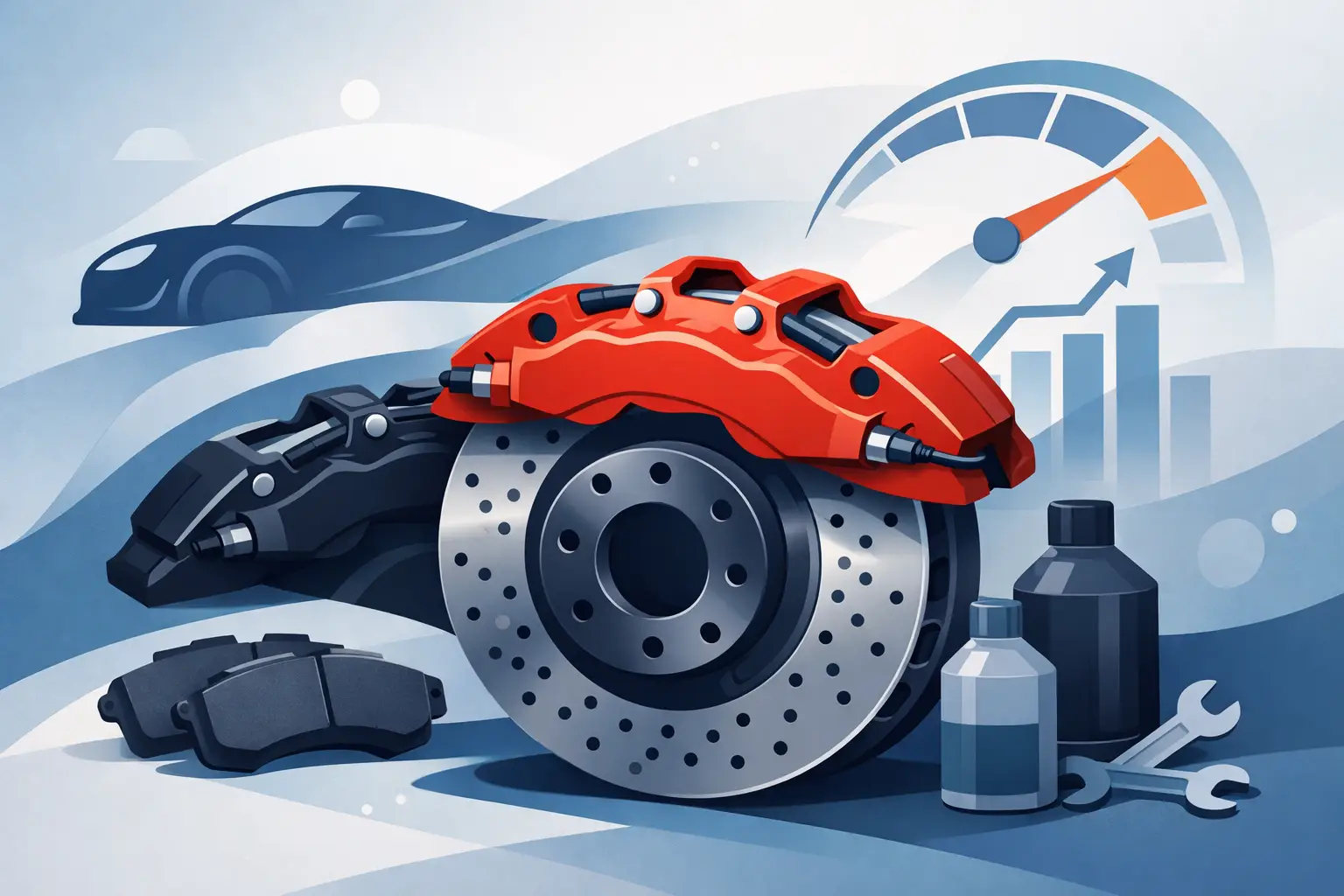
The brake caliper is the hub of the entire braking experience. It controls how the pad sits against the disc, how the pressure is distributed and how consistently the braking feels lap after lap. For street riding with a snappy setup, the original caliper can go a long way. For track riding, time attack, drifting or rallying, this is often where the limitations start to show.
What the brake caliper actually does for performance
Many people focus directly on disc diameter, but the caliper has just as much of an impact on how the car feels under braking. A stiffer caliper flexes less under pressure. This gives a firmer pedal, better modulation and more predictable braking action when you brake at the limit.
There is also a heat aspect. During hard driving, heat builds up quickly in the discs, pads and brake fluid. A performance caliper is often built to handle this better, both through material choice and design. This doesn’t mean that all multi-piston calipers are automatically the right choice, but it does mean that the right caliper can provide smoother performance when the original system starts to give out.
Fixed yoke or sliding yoke – what suits your car?
To make the right choice, you must first understand the difference between sliding calipers and fixed calipers. Sliding calipers are found on many standard cars and work well for normal driving. They are often cost-effective, easy to service, and perfectly adequate on a light street car with good pads and fluid.
Fixed calipers, often with multiple pistons, are more common in performance applications. They provide more even pressure distribution across the pad and higher stiffness. The result is often better pedal response and more consistent feel under repeated hard braking. The downside is that they cost more, require proper matching to the master cylinder, disc and pads, and sometimes involve more work with rim clearance and installation.
The simple answer is therefore not that fixed calipers are always better. On a lighter street car that is mostly driven inspiredly on the road, an upgraded sliding caliper system may be wiser than an expensive big brake kit. On a heavier car with slicks, high speed and regular track driving, fixed multi-piston calipers are significantly more relevant.
Guide to brake caliper performance after use
This is where many people build wrong. They buy too much brake for street use or too little brake for track. The right level depends on how the car is used.
For fast street driving and spirited driving, the focus is often on brake feel, reliability and reasonable running costs. You want good response cold and hot, low noise levels and parts that work in everyday life. Then a well-serviced original caliper or a moderate upgrade may be just right.
For track driving, the requirements change. Here, the brake caliper needs to withstand high heat, repeated braking and high wheel loads without the feeling collapsing. Stiffness, pad area and cooling become more important. In this case, multi-piston calipers are often a step that is really noticeable.
For drifting there is a slightly different focus. Initial bite, control and durability under repeated abuse play a big role. If you also run a hydraulic handbrake at the rear, the entire system must be thought through so that the balance and function are correct.
For rallying, durability and serviceability are almost as important as pure braking power. Dirt, heat fluctuations and a tough environment make different demands than smooth asphalt. Then it is rarely smart to just chase the biggest possible yoke. You want a solution that will last the race weekend.
Number of pistons – more is not always better
It's easy to get caught up in numbers. Four-piston calipers sound better than two-piston calipers, six-piston calipers sound even sharper. But the number of pistons is only part of the picture.
The important thing is how the piston area, pad shape and disc dimension interact. Too large a total piston area can give a long pedal if the rest of the system does not match. Too aggressive a setup at the front can create imbalance in the car, especially if the rear axle does not keep up. Too heavy a brake package also increases unsprung weight, which can negatively affect the chassis' performance.
On some builds, a light and well-tuned four-piston caliper is a better solution than a larger six-piston caliper. Especially if the car weighs moderately, has reasonable tire width and is not driven long sessions on the track. Here you gain more from balance than from max spec.
Disc, pads and fluid must play with the brake caliper
A brake caliper never works alone. If you install nice calipers but drive with the wrong pads, substandard fluid or a disc that can't handle the heat, the system will still fail where it is weakest.
The temperature window of the pad is crucial. A pad that is too race-oriented can feel sluggish and cold on the street. A street pad, on the other hand, can give up early on the track. The disc must withstand the load and have the right size, thickness and ventilation for your riding. The liquid needs to have a high enough boiling point, otherwise it won't help no matter how much you mount.
That's why the best brake upgrades are almost always well-thought-out packages. Not because everything has to be the most expensive, but because the parts have to work together under load.
Fit, rim clearance and mounting
This is where many people lose time and money. A larger caliper may require a different rim design, spacer or different disc and adapter solution. It is not enough that the caliper fits the car model on paper. You also need to know if it actually moves freely against the rim spokes and if the offset works.
Also consider hose routing, banjo bolts, air nipples and how easy the system will be to service. On a trackday car, it may not make much difference if the solution is a little more uncompromising. On a street-registered car, you often want something that is easy to live with, both when changing wheels and for ongoing maintenance.
If you're serious about building, it pays to think a step further right away. Proper assembly saves frustration later and reduces the risk of half-baked emergency solutions in the garage the night before driving.
How to choose the right brake caliper from the start
Start by being brutally honest about the use. If you say the car is a street car but you do five track races per season and brake late on R tires, then it is no longer a regular street car from a braking point of view.
Then look at weight, power, tire grip and speed. A heavy turbocharged four-wheel drive car with a lot of grip has completely different requirements than a light rear-wheel drive club race car. Also consider the running costs . Some calipers and discs are more expensive to run over time, especially if you change pads frequently.
The next step is to decide what your goals are. Do you want better pedaling, better heat resistance, or pure maximum braking? It's not always the same thing. In many cases, the smartest path is a balanced upgrade with the right pads, fluid, and cooling, rather than throwing on the biggest kit possible right away.
For those who build with a clear focus on sports, rally or racing, it is also worth choosing parts from a range where performance use is actually the core. House of Motorsport clearly works in that world, and it is noticeable when the goal is the right components for heavy duty rather than generic standard parts.
Common Mistakes in a Guide to Performance Brake Calipers
The most common mistake is to chase looks before function. Large painted yokes behind the rim look right, but if they don't suit the weight of the car, tires and use, you won't automatically get faster lap times.
Another mistake is forgetting the balance in the system. Too much front brake can make it harder for the car to get calm under braking. Too little cooling means that even expensive components lose power. And if you don't bleed the system properly or choose the wrong fluid, the feeling will still be crap.
The third is to underestimate service. Brakes are wearing parts in a performance build. Pads should be replaced, discs should be checked and calipers should be kept in good condition. If you choose a solution that is complicated to live with, there is a risk that maintenance will fall behind.
Once the caliper is right for the car, you'll notice it right away. The car will be quieter in the zone, easier to modulate and more consistent when you push. It doesn't just give you better deceleration. It gives you more confidence in every hard braking, and that's where the real tenths start to come.