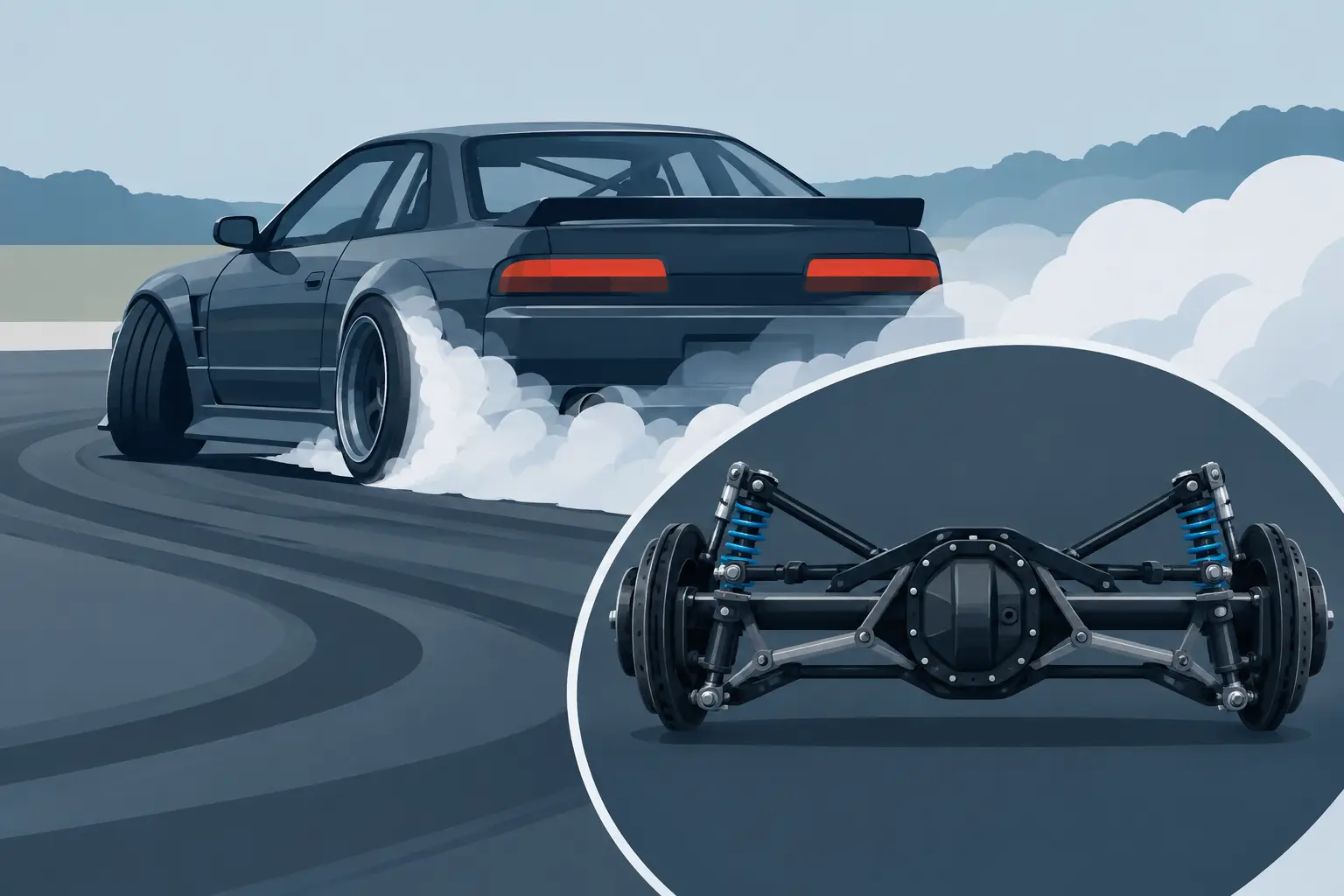
When the car grabs traction in the middle of a long bend, it's rarely the engine power that determines whether you come out with smoke from both wheels. It's the rear axle. A drift build with a reinforced rear axle is not about buying the thickest part on the shelf, but about building a driveline where the diff, driveshafts, hubs, bushings and mountings can handle the same load.
A stock rear axle can last much longer than many people think, especially in a lighter chassis with reasonable tires and a consistent driver. But as the power, grip and load increase, the weaknesses quickly become apparent. It is not enough to replace a part after every broken ride. You need to find the bottleneck and build the rear axle as a system.
When does a drift vehicle need a reinforced rear axle?
The simple answer is: when original parts limit your driving time. This can manifest itself as driveshafts that twist, splines that give out, differentials that slip unevenly, or bushings and mounts that allow the rear end to move more than intended.
The driver of a 250 horsepower street car, skinny tires, and occasional track days has completely different needs than the driver of sticky semi-slicks, aggressive clutch, and 500-plus horsepower. There's also a difference between a car that's mostly going to be driven on larger tracks and a car that gets hard clutch kicks in tight tandem runs. Grip is often as hard on the drivetrain as power.
The warning signs are clear if you know what to look for: clunking when accelerating and engine braking, noise from the diff, uneven locking action, vibrations under load or wheel angles that change when the car is put sideways. Don't wait until the differential housing is cracked or the driveshaft has broken off on the starting plate. Check the play and attachments between runs.
Start with the load, not the part
A reinforced rear axle is best chosen based on the actual use of the car. Power is a factor, but torque, weight, tires, gearing, clutch and driving style all determine how hard everything is loaded. A turbo four with a lot of torque from low revs can hit the drivetrain harder than a high-revving naturally aspirated engine with more rated horsepower.
Also consider the gear ratio. A shorter final drive gives quicker response and makes it easier to maintain the revs, but it increases the torque sent through the drivetrain. If you install larger tires or change the gearbox, you need to calculate the whole thing again. A rear axle that works with a certain combination can become a weak point when the rest of the package changes.
That's why a well-thought-out build often starts with the goal: what track, what tire size, what power, what gearbox and how many driving sessions the car will be able to complete without you having to change gears between each heat. With those answers, it becomes much easier to choose the right level of components.
The differential controls how the car behaves.
A welded diff is cheap, simple and provides consistent drive to both wheels. For many simpler drift builds it is a perfectly reasonable choice. The downside is poorer handling on the street, higher loads in certain situations and a behavior that does not suit all chassis or drivers.
A limited slip differential instead allows you to control ramp angles, preload, and how aggressively it locks on the throttle and engine brake. Properly set, it can provide a more predictable car at initial starts, transitions, and throttle inputs. However, it requires the right oil, ongoing monitoring, and a more thoughtful basic setup.
Regardless of the choice, the differential housing, crown wheel, pinion and bearings must be in order. A stronger driveshaft will not save a poorly shimmed diff or a worn bearing position. Build clean, measure backlash and check the contact pattern. It is workshop work that makes a difference when the car is driven hard.
Driveshafts, hubs and splines must match
Driveshafts are often the part that gets the most attention, and rightly so. A stronger shaft with larger splines and better materials can handle significantly more torque than an original shaft. But it has to fit the differential output flanges, wheel hubs, bearings, and the suspension travel the car actually has.
A driveshaft that is too short can bottom out when the wheel springs in. A shaft that is too long can lack margin when springing out. Both problems can damage joints, bearings and diffs. When building with adjustable control arms, lowering the car a lot or changing the track width, the working range of the shaft must be rechecked, not just measured when the car is on stands.
The hub is the next link in the chain. Stronger driveshafts and higher wheel loads place demands on bearings and hub flanges. This is especially true for heavier cars with wide wheels and high speeds. If the hub has play, the brake disc and wheel will move, which affects both braking feel and durability.
Reinforce fasteners before they become a problem
Many people focus on the parts inside the rear axle but forget the bodywork around it. Diff bushings, rear axle bridge, subframe, torque rods and control arm mounts can be the real weak link. When rubber gets soft or sheet metal starts to crack, the entire geometry shifts under throttle.
Polyurethane bushings can reduce movement and provide clearer response, while solid bushings provide maximum precision in a pure track car. The price is more vibration, more noise and higher demands on the correctness of fastenings and welds. A street car driven to events often requires a different compromise than a race car on a trailer.
Reinforcement plates at known cracking points are smart to install before problems arise. But never weld just because it looks strong. Incorrect welding, poor fit or heat in the wrong place can create new cracks. Clean, align, measure and build with a clear plan.
The geometry makes the parts survive
A rear axle holds up better when the wheels are in contact with the ground properly. Too much toe change in the suspension, bad bushings or incorrect control arm angles can create jerky loads that wear down the drivetrain. This is often noticeable as a car that feels nervous in transition or suddenly grabs and chops when you least want it.
Adjustable arms are useful, but they are not automatically an upgrade if installed without measurement. Start with a reasonable base setup and document each change. Camber, toe, ride height and anti-roll bars affect both the balance of the car and how the power reaches the ground.
Don't forget the brakes. Drifting involves high temperatures, rapid weight shifts, and frequent handbrake inputs. A rear-end package with good brakes , a fresh handbrake solution, and components that don't flex gives better control and less abuse to the drivetrain.
Build in the correct order and check often
The most cost-effective option is rarely to buy everything at once. Start by servicing and checking the original system, reinforce known weaknesses and then upgrade where the load requires it. A well-renovated original rear axle with the right diff and fresh bushings can provide more driving pleasure than a jumble of expensive parts that don't fit together.
When raising the level, be consistent. If you change to heavy-duty driveshafts but keep worn hubs or cracked mounts, you are only moving the damage further. Make sure flanges, bolts and torque are correct. Use new locks where the manufacturer requires them and check oil level, leaks and play after the first few rides.
A good way to work is to keep a log of service and parts that have been replaced. Write down diff oil, mileage, noises and any vibrations. This will help you find changes before they become an expensive day in the depot. For a project with many dependencies, personal support is also worth a lot – the right component from the start saves both time and budget.
Choose sustainability that suits your goal
House of Motorsport targets builders who want parts for the entire package, from drivetrain and brakes to chassis and engine components. It's the right mindset for drift: the rear axle is not an isolated upgrade, but a part of the car that has to function when everything else is also being pushed.
Don't just build to survive a spectacular scratch in the parking lot. Build to be able to drive all day, put in more laps, practice transitions, and drive home with the same confidence you had when you rolled out of the pits. When your rear axle is sized correctly, you can focus on the next clipping point instead of the next breakdown.