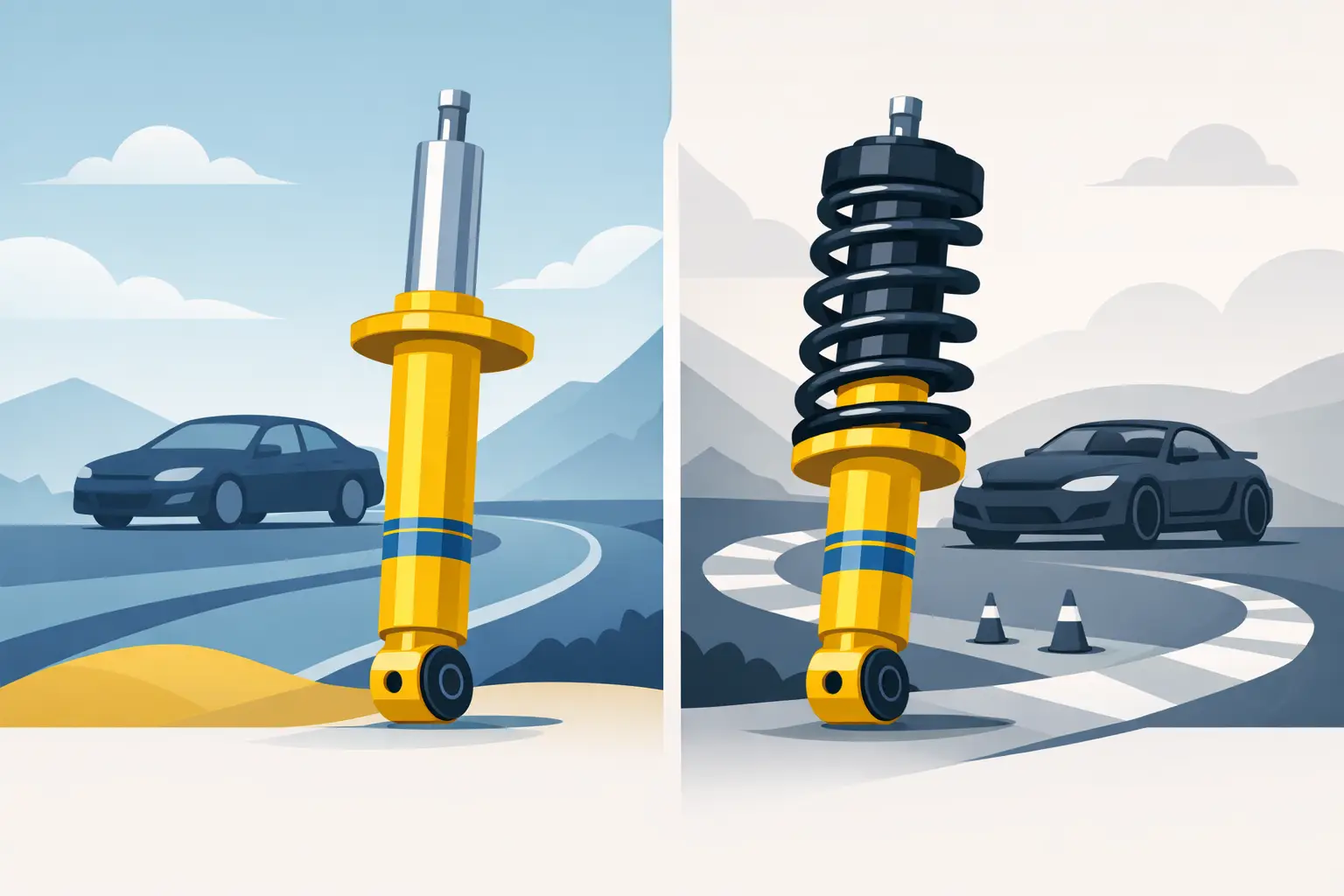
If you're standing with your finger on the buy button and weighing Bilstein B6 against B8, there's one detail that decides everything – the car's spring height. That's where the big Bilstein B6 vs B8 difference lies, and if you choose the wrong one, you could end up with a chassis that performs worse than it should, even though the shock absorber itself is a premium product.
Bilstein is an obvious name when the goal is better control, less sway and more precision in the car. But the B6 and B8 are often confused because on paper they are close in performance and both are aimed at drivers who want a sportier chassis than the original. It only makes the choice easier when you understand how they are built and what they are intended to work with.
Bilstein B6 vs B8 difference in practice
Short version first. The Bilstein B6 is basically a sports shock absorber for cars with original height or very light lowering. The Bilstein B8 is a shorter sports shock absorber for cars running with lowering springs. It's not just a question of "harder or softer", but about the right working range for the shock absorber.
Both models are typically based on Bilstein's monotube gas technology and are designed to provide a faster response than a standard shock absorber. This means you get better support when braking, better control when cornering and less bounce over bumps compared to worn original shock absorbers. But that doesn't mean they are interchangeable.
The big technical difference is that the B8 has a shorter piston rod and is adapted for a lower ride height. When the car is lowered, the working position of the shock absorber changes. A shock absorber that is too long can then end up with the wrong stroke, which affects both comfort, grip and durability. That's where the B8 comes in.
When Bilstein B6 is the right choice
B6 is best suited if you want to sharpen up the car without changing the height significantly. If you have original springs and want to get rid of the spongy, tired behavior that many street cars suffer from after a few years, B6 is often the right way to go. The same goes if you drive a slightly heavier or faster car where the original chassis feels too soft during active driving.
The great thing about the B6 is that you often get a significant boost in control without the car becoming impractical in everyday life. The steering feels more direct, the car settles into corners better and it recovers faster from bumps. For those who drive mostly on the street but still want the car to feel tight and confident, this is a strong option.
B6 can also work with some mild lowering springs, but here it is important not to take chances. If the lowering is obvious, it is almost always better to go for B8 straight away. Trying to “make it work” with the wrong type of shock absorber is rarely good in the long run.
When Bilstein B8 is the right choice
If you drive with lowering springs, the B8 is the natural choice. Period. It is built to work correctly when the car is lower, and this is noticeable both in how the car behaves and how the package lasts over time.
This is why many who build street cars with a sportier setup, or want a car that works both for everyday use and inspired driving, choose the B8. You get the right preload and the right working range in the damper even when the spring is shorter. The result is more control and less risk of the car feeling bumpy, anxious or unbalanced.
For light track driving, active road driving and quick transitions, the B8 often works very well together with quality springs. It doesn't make the car a pure coilover car, but it can take a standard chassis very far when the rest of the setup is well thought out.
Is B8 harder than B6?
This is a common question, and the answer is: not in the simple way many people think. The B8 is sometimes perceived as being harder, but that is often because it sits on a lowered car with stiffer springs. The actual feel of the car is therefore affected as much by the springs, wheel angles, tires and bushings as by the damper.
B6 and B8 are often close to each other in basic character. Both are sporty, controlled and significantly more focused than regular standard shock absorbers. The difference lies mainly in the length and the area of application, not in the fact that one is automatically “race” and the other “comfort”.
If you fit a B8 with lowering springs and compare it to a B6 with original springs, the B8 car will often feel faster and firmer. But it depends on the whole package. That's why it's more important to think of the chassis as a system than to stare blindly at a single item line.
Common mistakes when choosing between B6 and B8
The most common mistake is to choose B6 for a car that is already lowered, just because you found a “good price” or think the difference is small. It may work for a while, but you lose the point of matching the shock absorbers and springs correctly from the start.
The next classic is to believe that the B8 itself lowers the car. It doesn't. The shock absorber doesn't determine the height in the same way as the spring. The B8 is just adapted to work with a lower spring height.
A third mistake is to only think about appearance. Many people want the car to be lower and tighter, but miss the fact that geometry, wheel alignment and spring selection have at least as much of an impact as the shock absorber name on the box. A poorly matched setup can feel worse than the original, even if the parts are expensive.
So you should think based on how the car is used
If the car is a fast street car that runs all year round, with original height and a focus on better control without sacrificing too much everyday functionality, then the B6 is often right. It is especially suitable when you want to upgrade from worn original shock absorbers to something that can actually handle active driving.
However, if the car is already lowered, or is to be lowered with sport springs, then the B8 is the logical choice. This applies regardless of whether you are building for a sleeker stance, better cornering or a more aggressive feel on the street and track. The B8 is made for that environment.
For those who ride harder than average – track days, time attack training, hard country roads or rally-inspired street riding – the whole picture becomes extra important. In that case, it’s not enough to just choose between B6 and B8. Then you also need to think about spring stiffness, tires, bushings, top bearings and wheel alignment. The shock absorber is central, but never alone.
Bilstein B6 vs B8 difference for comfort and durability
Many people chase performance but don't want the car to be tiring to drive. That's entirely reasonable. A good sports shock absorber shouldn't just feel hard – it should provide control. When the shock absorber works in the right area, the car often becomes calmer over bumps even though it feels firmer.
That's why the right model choice plays such a big role in comfort. A B8 in the right lowered setup can feel more harmonious than a B6 in the wrong working position. The same goes the other way around – a B6 at original height can feel more natural than a B8 in a car that is not built for it.
Durability is also affected. When the shock absorber is allowed to work where it is designed to work, the risk of unnecessary wear and strange behavior is reduced. For an enthusiast car that is actually used, not just sitting in the parking lot, this is a strong argument.
What should you choose?
If you want it straight and without hassle, the decision is easy. Original springs or near original height – choose Bilstein B6. Lowering springs – choose Bilstein B8.
What makes the question more interesting are all the borderline cases. Some cars have slight lowering from the factory. Some aftermarket springs only lower marginally. Some drivers prioritize response over comfort, others want a chassis that works just as well for work as it does on a track day. Therefore, it is smart to start from the actual ride height, spring type and how the car is used, not just from what “usually works” on forums.
When you build a chassis, there are no free points. The right part in the right place always wins over half-baked compromises. If you need to match shock absorbers with the right setup for your car, it's better to figure it out before ordering than after the first test drive. At House of Motorsport, there are parts for builds where the chassis will really deliver – and that's exactly how you should think when you want your car to be faster, tighter and more fun to drive.
Don't choose the shock absorber that seems most popular. Choose the one that suits your height, your spring and your driving style - then you will have a chassis that works with you instead of against you.