You can have forged pistons, a bigger turbo and a brake package that bites hard – but if the oil pump loses suction in a long right-hand curve, no amount of horsepower in the world will help. If you search for the question “do you need oil pan baffles”, the answer is therefore rarely a simple yes or no. It’s about how the car is driven, how the engine is built and how much margin you want when the load becomes brutal.
For a street car that mostly rolls to hits and gets the occasional full-throttle scratch, the original solution is often sufficient. But when you brake late , run on R-tire, put the car on stands or push it on a special section, the conditions change completely. Then baffles in the oil pan are cheap insurance compared to an engine failure.
What do oil pan baffles do?
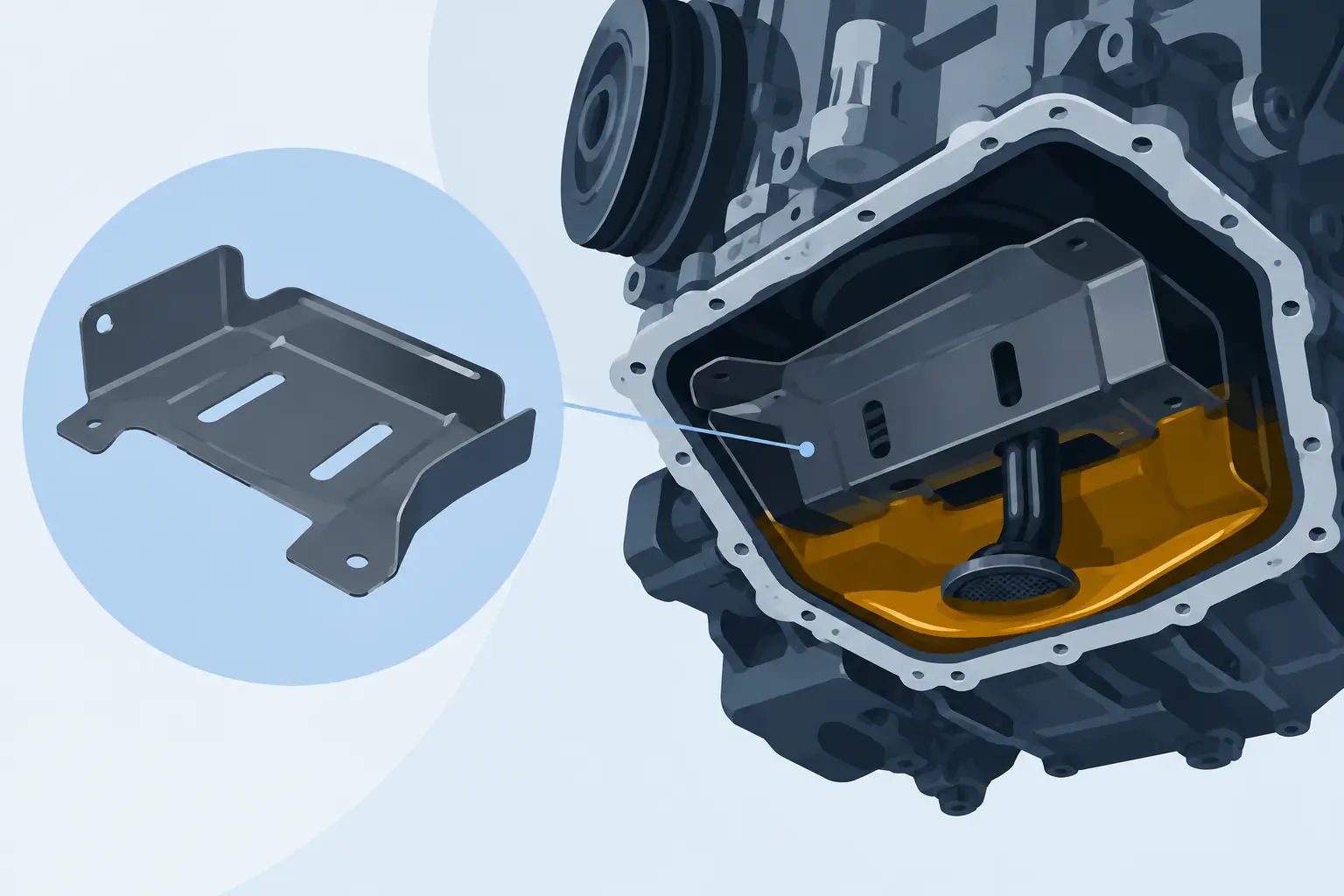
The oil pan's job is not just to collect the oil under the engine. The oil pump's suction pipe is also located down there, and for the pump to deliver stable oil pressure, the suction pipe must be covered in oil. However, when driving hard, the oil wants to move in exactly the same direction as the car.
During heavy braking, the oil is thrown forward into the sump. During acceleration, it moves backward. During fast, long curves, it is pushed to the side. If the oil leaves the area around the intake manifold, the pump can draw air instead of oil. The result is a rapid pressure drop – and bearings, crankshaft, pistons and turbo can work without the lubrication they need.
Baffles are plates, bulkheads and sometimes one-way flaps in the oil pan. They retain the oil around the intake manifold and slow down the oil's movement. The design is simple, but the function is immediately crucial when G-forces increase. A solution with trap doors, i.e. movable flaps, allows oil to enter a separate sump but limits how easily it can flow out again when the car changes direction.
Do you need oil pan baffles for your driving?
For normal street driving with a fresh original engine, you normally don't need to rebuild the oil pan just for the sake of it. The engine manufacturer has dimensioned the pan for normal driving, adequate tire grip and a driver who is not on the limit through every roundabout. The correct oil level and regular oil changes are then much more useful than an advanced baffle kit.
As soon as the use becomes more motorsport-oriented, the assessment becomes different. Track driving with sticky tires produces lateral forces that a standard car rarely experiences on the road. Drifting involves rapid changes of direction, high loads and frequent engine revs when the car is at an angle for a long time. In rallying, jumps, uneven surfaces, hard braking and corners on looser grip can create oil movements that are not always predictable.
Power also plays a role, but not in the way many people think. An engine with a lot of power does not automatically need baffles if the car is driven smoothly and has a good oil level. However, the consequences are greater when a heavily built engine loses oil pressure. If you have invested time and money in bearings, turbo, camshafts and mapping, it is rarely a good idea to take a chance on the oil check once the car is in operation.
Signs that the original tray is a weak point
Oil pressure that dips in specific curves, during hard braking or after long sweeping turns should be taken seriously. The original warning light is not sufficient as a control instrument – when it lights up, the pressure may already be too low to be safe at high rpm. A real oil pressure sensor with a gauge or logging is much better, especially on a car that is driven on a track or rally track.
Other warning flags include high-grip tires, a lowered and stiff chassis, higher rev limits, and frequent driving with the oil level close to the minimum. The faster the car can build and maintain lateral forces, the more the oil needs to be kept in the right place.
Baffles, baffle plate and accumulator are not the same thing
The terms are often confused in the garage. A swash plate or windage tray is usually located between the crankcase and the oil. It helps reduce the crankshaft from whipping up oil, which can reduce air entrainment and parasitic losses. It is good for oil control, but it does not always replace baffles around the oil pump suction pipe.
A baffled oil pan instead focuses on maintaining an oil reservoir at the pickup. In a well-thought-out solution, both functions can be present at the same time: a splash plate to calm the oil and baffles with hatches to secure the feed to the pump.
An Accusump or other external oil pressure accumulator is another step. It stores oil under pressure and can feed the engine during short pressure drops. It is a strong solution for serious racing, but it requires proper mounting, valve timing and space in the build. For many trackday and drifting builds, a good baffled sump first provides the most power per dollar and less complexity.
The right baffles must fit your engine
A universal kit is not always a shortcut. The shape of the oil pan, the location of the pickup, the return flow from the cylinder head and turbo, and the tilt of the engine in the car affect how the oil collects. A solution that works perfectly in a longitudinally mounted engine may be incorrectly designed for the same engine mounted transversely in another car.
Also check the clearance to the crankcase. On engines with longer strokes, different cranks, larger rods or aftermarket parts, the clearance in the sump may change. A baffle that catches a connecting rod at revs is not an upgrade. Test assembly and careful measurement is mandatory, not a detail you solve afterwards.
Turbocharged engines also require that the oil return to the sump flow freely and correctly. If the return oil is drained on the wrong side of the baffles or too close to a rotating crank, you can create foaming and problems that weren't there to begin with. Here, it pays to choose parts built for your specific engine platform and type of driving.
Assembly: small details that make a difference
Once the pan is off, it is time to check the pickup attachment, O-ring and suction tube. A cracked O-ring or a pickup that is not seated properly can cause the same symptoms as a poorly baffled pan. Also check that the pan is clean inside and that there are no old gasket residues, silicone or metal particles that could end up in the strainer.
Welded baffles should be clean, tight and free of welding spatter. If you build your own, you need to consider drainage back to the sump when the car is stationary, without giving the oil a free path away from the pickup while driving. If you use movable hatches, they should move easily and be oriented according to the car's most common load.
Don't forget the oil level after the modification. A larger volume pan may require more oil, while a different baffle design will affect how quickly the level stabilizes after the engine is shut off. Always follow the engine platform's recommended level as a starting point and verify with the dipstick, not just a fill amount on paper.
When are baffles not enough?
For long-term racing on slicks, extreme braking zones and high side loads, a baffled original sump may still be insufficient. Then the next level may be a deeper motorsport sump, external pump or dry sump system. Dry sumps provide superior oil control and the ability to position the engine lower, but the cost, installation and service requirements are in a completely different class.
This does not mean that all builds should go straight to the most expensive solution. Quite the opposite. The right level is the one that matches the car. A well-built baffle solution, fresh pickup, the right oil and continuous checking of the oil pressure will go a long way for many fast street and track cars.
If your car is going to be put to the test, treat the oil pan as a performance part, not an anonymous metal box at the bottom of the engine. Build for the driving you actually do, measure the oil pressure, and give the engine the oil it needs even when the braking point is moved forward and the throttle is pushed to the bottom.