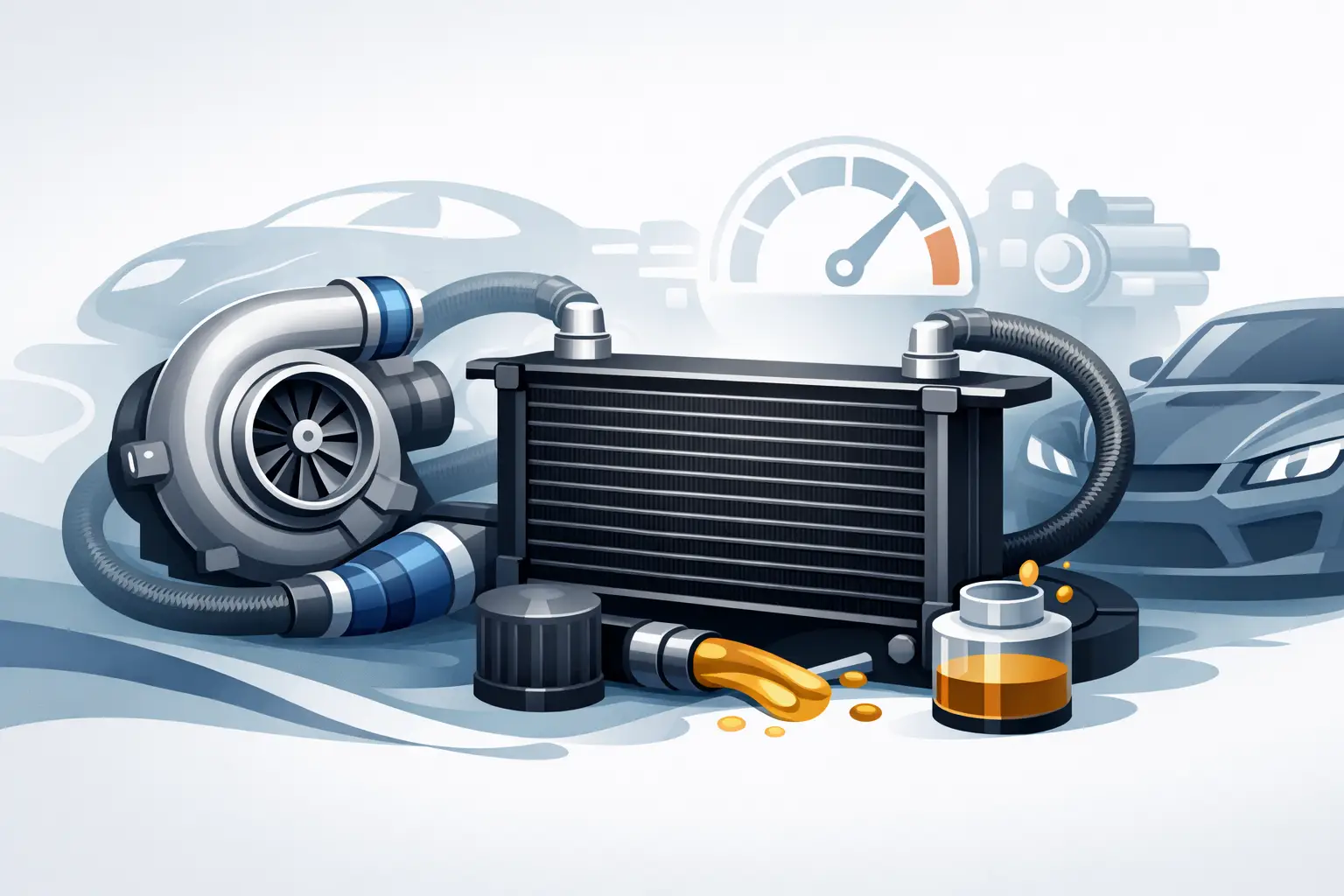
When the oil temperature rises above 120 degrees after a few hard laps, it doesn't matter how nice the turbo, map or fuel system you have. If the oil loses control, the engine loses margins. That's why the best oil cooler for a turbo car is not the biggest one you find on the shelf, but the one that actually matches the power, use and flow in your particular build.
For turbocharged cars, heat quickly becomes a limitation. More boost pressure gives more power, but also more heat in both the oil and cooling system. The oil is not only supposed to lubricate – it is also supposed to transport heat away from bearings, turbo and other heavily loaded parts. When it doesn't keep up, you get a thinner oil film, higher wear and less stability under load. On the street, it may be noticeable as rising temperatures during active driving. On the track or in drifting, it comes faster and much harder.
What determines the best oil cooler for a turbocharged car
The first thing many people look at is the size of the radiator itself. That makes sense, but it's only half the story. A larger oil cooler can lower temperatures better, but if it's misplaced, has poor airflow, or is combined with hoses that are too small, the results will still be weak. Too large a radiator on a street car can also lead to unnecessarily long warm-up times, especially in colder weather.
At least as important is the core design. A true stacked plate radiator is often the better choice for performance cars. It can withstand vibration, pressure, and harsh use better than simpler tube-and-fin solutions, and it cools more efficiently in a compact format. For a turbocharged car that is driven actively, this is usually where to start.
Then comes the flow. The oil cooler must not become a bottleneck. Too narrow a cooler, too small connections or poorly chosen adapters can cause unnecessary pressure drop. This does not mean that everything has to be enormously dimensioned, but the components must fit together. If you have built an engine with higher oil flow, external filter relocation or a larger turbo , there is even less reason to take chances.
Street, track or drifting – the use determines the choice
A street car with stage 1 or stage 2, lively driving and occasional full throttle scratches does not have the same needs as a car that goes track driving in July or sits on the stand lap after lap. This is exactly why there is no universal best oil cooler for a turbo car. The right choice depends on how the car is used when it is really pushed.
For a fast street car, a medium-sized oil cooler is often sufficient, preferably combined with a thermostatically controlled sandwich plate. This gives you better control when the car is under heavy load without the oil running too cold in everyday driving. It is a smart solution for cars that will function both for work and for a spontaneous evening drive.
For track and time attack you have to think more aggressively. Long sessions with high rpm and constant boost pressure build up heat that doesn't go away on its own. This often requires a larger cooling area, good air control and a mounting that really gets fresh air. It's not enough for the radiator to be somewhere in the front. It has to be where the air actually passes.
For drifting, the load is a little different, but at least as brutal. High revs, limited speed wind in certain situations and a lot of heat from the engine compartment place demands on both the radiator and its placement. A radiator that is too small will quickly reveal itself. At the same time, it must not be so exposed that it takes a beating from contact, gravel or vibrations.
Size, lines and connections – what to look for
When comparing oil coolers, you will often see sizes in terms of number of rows, such as 13, 16, 19 or 25 rows. More rows usually mean more capacity, but only if the rest of the system is right. A 19-row cooler is often a good starting point for many turbo builds with active driving. For harder track driving or higher-performance builds, 25 rows may be more reasonable.
But don't be fooled by the number. Different manufacturers build different cores with different efficiencies. A well-built 16-row stacked plate cooler can perform better than a cheap, larger model with poorer construction. Materials, solder quality, and interior design all matter – especially when the car is used as it should be.
The connections are the next point where many people run into problems. AN10 is common and works well in many setups. On higher-powered engines or systems with higher flow requirements, AN12 may be the way to go. Too small a hose size combined with long hose runs and multiple fittings can create restrictions that you don't want in an oil system.
Don't forget the thermostat
Many people just want to lower the temperature and think that more cooling is always better. It's not that simple. If you drive a car that is used on the street without a thermostat, there is a risk that the oil will run too cold during parts of the year. Then you will have worse lubrication properties than you should have, more condensation in the system and slower heating.
A thermostatically controlled sandwich plate means that the oil first flows internally until the correct temperature is reached. Then the flow opens towards the radiator. For most Swedish turbo cars used both on the road and in active driving, this is almost always the right choice. It gives better control and fewer compromises.
On pure track cars you can think differently, but even there it is important to build the system with an eye on working temperature, not just maximum cooling capacity. The oil should work in the right range, not just as cold as possible.
Assembly that actually works
A good oil cooler mounted incorrectly is still a bad solution. The location must provide good airflow without choking other systems. If you put it in front of the water cooler and intercooler without a plan for air management, you can win in one place and lose in another. It's a classic garage problem - you solve the oil temperature and create a higher intake temperature or a worse coolant temperature.
In the front is often best, but with a reasonable distance, free airways and a stable attachment. The radiator should not hang and hit the hoses or vibrate apart over time. Use the right brackets, the right connectors and hose that can handle both temperature and pressure. PTFE or high-quality motorsport hose is no exaggeration in a serious turbo build, it's common sense.
Also consider serviceability. Can you access clutches, filters, and nearby components without removing half the front? It sounds secondary when the car is on stands, but feels very relevant later.
Common mistakes when hunting for the best oil cooler for a turbo car
The most common mistake is to buy cheap and generic without thinking about the whole picture. A no-name cooler may look right in the picture, but material quality, tolerances and durability under pressure are what determine whether it works after a season. On a turbo car with high oil temperatures and active driving, you don't want to experiment with weak solders or questionable threads.
The second mistake is to oversize without a plan. Too large a radiator, too long a hose run and too much oil in the system can make it difficult for the car to get up to the right temperature. This is not automatically wrong, but there must be a purpose.
The third is that you skip measuring. Without a reliable oil temperature gauge, you're just guessing. Then it's hard to know if your solution actually works or if you just feel safe because you've installed more parts.
So you think right from the start
If you are building a turbocharged street car with elements of hard driving, choose a quality radiator of reasonable size, stacked plate construction, thermostat and well-thought-out hose routing. If the car is going to be on the track regularly, prioritize larger capacity, good airflow and components with documented quality. If it is a drifting or rally car , pay extra attention to durable mounting and protection against vibrations and stone chips.
The smart thing is to see the oil cooler as part of the whole package. The turbo, exhaust manifold, intercooler, radiator, oil system and airflow all affect each other. When the whole thing is in place, you not only get lower temperatures, but an engine that feels smoother, safer and more consistent when pushed.
For serious builders, it pays to choose parts that are made for sport, rally and racing – not just something that happens to fit between the headlights. House of Motorsport is strong precisely where many builds are truly decided: the right components, the right level and stuff that can withstand the load.
If you are hesitating between two sizes or two different solutions, the rule of thumb is simple. Don't buy by picture, buy by use. A good oil cooler is not recognized by how it looks race-like in the front, but by how the car holds together when you keep pumping.