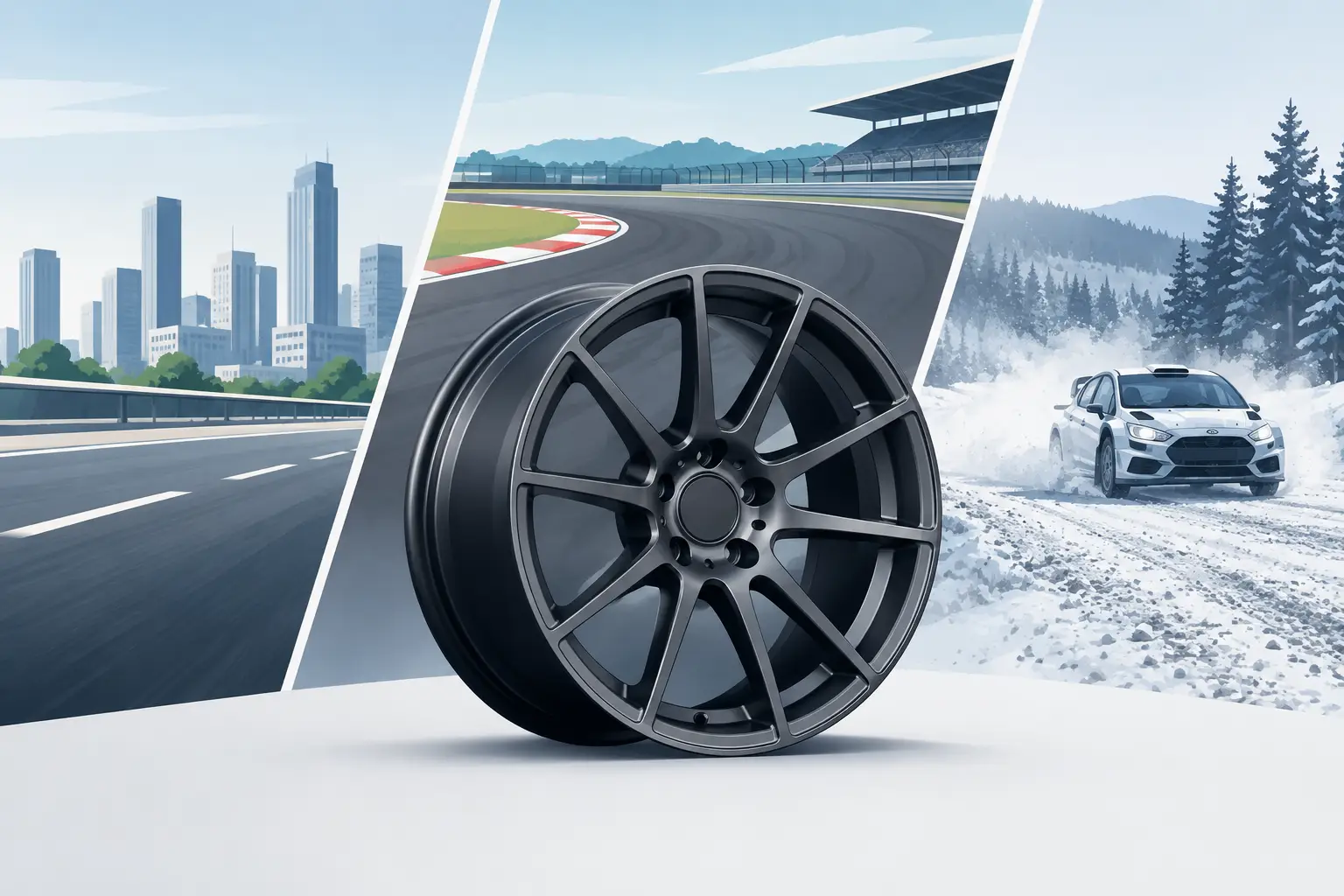
A 7×17 Polaris rim can be a perfect foundation for a build where the car will steer cleanly, withstand heat from the brakes and at the same time look right in the pits. But 7 inches wide and 17 inches in diameter only tells part of the truth. It is only when the bolt circle, ET, hub holes, brake caliper and tire size match the car that the rim becomes an upgrade instead of an expensive fit exercise.
For street, track and rally-inspired builds, choosing a rim isn’t just about style. The right combination affects steering feel, tire performance, unsprung weight and how much margin you have when the suspension bottoms out or the car loads up in a fast corner. Here we go over what to check before you decide on 7×17.
What does 7×17 mean on a Polaris rim?
The dimension 7×17 describes the width and diameter of the rim. The seven stands for 7 inches between the rim edges where the tire sits, while 17 indicates the diameter of the rim in inches. It is a relatively flexible dimension that is often suitable when you want to drive with responsive steering, reasonable tire profile and good access to sporty tires.
A 7-inch wide rim usually works well with tires around 195 to 215 millimeters, depending on the tire model and the intended use of the car. A 205-wide tire is often a balanced combination: the sidewall is supported without the tire being dragged unnecessarily, and the car maintains a compliant behavior on uneven asphalt.
There is no one size that is right for everyone. On a light front-wheel drive car, 195/45 R17 or 205/40 R17 can provide quick response and good clearance. On a heavier car, or a car that is used heavily on the track, 205/45 R17 may be more relevant if you need a little more sidewall and heat resistance. This is determined by the car's original diameter, power, wheel arches and chassis.
Start with the fit, not the design
The design, color and spokes of the Polaris rim play a role in the overall look, but the fit must always come first. A rim can have the right diameter and width but still be completely wrong for the car if the ET, bolt circle or hub holes are not correct.
Please check at least the following before ordering:
- Bolt circle, for example 4×100, 5×112 or 5×114,3.
- ET measurement, which determines how far in or out the rim ends up.
- Hub holes and need for hub rings for centered mounting.
- Brake clearance against calipers, discs and any upgraded brake components.
- The car's approved wheel and tire dimensions and practical clearance in the wheel arches.
The bolt circle is easy to understand but critical: it must match exactly. The hub hole also needs to function correctly. If the rim's hub hole is larger than the car's hub, hub rings are normally used to center the rim correctly. The wheel bolts or nuts are to hold the wheel in place, but the hub is to help position it perfectly centered.
ET, however, is the measurement that often determines whether a build will be perfect or problematic. A lower ET typically moves the wheel further out towards the fender edge, while a higher ET moves it further in towards the struts, control arms and inner fender. Just a few millimeters can be the difference between free play and contact when you turn hard or compress the suspension over curbs.
Calculate ET when changing width
If you change from, for example, an original 6,5×17 rim to a 7×17, both the inner and outer edges change depending on the ET. Half an inch of extra width corresponds to 12,7 millimeters in total. That difference is distributed in both directions, but the ET measurement then moves the entire wheel inward or outward.
This means that a 7×17 with the wrong ET may look right in the parking lot but rub when driving hard. For track driving, you shouldn't be satisfied with the wheel just rolling freely on the lift. Test with the car on the ground, full steering wheel travel and loaded suspension. If the car has coilovers, lowering springs or changed camber, you need to be even more careful.
Brake clearance is as important as rim diameter
17 inches often provides better clearance for brake upgrades than smaller sizes, but that's no guarantee. Two 17-inch rims can have completely different clearance on the inside depending on the shape of the spokes, the design of the rim tread, and how far the spokes extend into the hub.
This becomes extra important on a car with larger calipers, thicker discs or motorsport-oriented brake kits . A caliper can catch on the spoke even if there is air between the caliper and the rim track. Solving this with spacers can work, but it also changes the track width and effective ET. So it should be a well-thought-out choice, not a makeshift solution after the wheels have already arrived.
Measure the brakes, compare with the rim's brake profile if available, and get help before buying if you're using anything other than original brakes. At House of Motorsport, it's exactly the kind of detail that's worth sorting out before the project comes to a standstill due to a few millimeters of margin of error.
Choose tires based on the driving you actually do
A 7×17 Polaris rim is never better than the tire that is mounted on it. For a street car that is going to be fun on the road, many people want a tire combination with reasonable comfort, good wet grip and predictable response. For trackday, heat resistance, a stable carcass and precision under high loads are often prioritized. Rally and gravel-oriented builds instead require more tire sidewall and a solution that can handle impacts without feeling nervous.
Don't chase maximum tire width just to fill the screen. A tire that's too wide on a 7-inch rim can result in poorer lateral support, more spongy response, and more difficult temperature control when you push the car. A slightly narrower tire with the right carcass, air pressure, and wheel angle can be significantly faster and more confidence-inspiring.
Also consider the wheel circumference. Changing the outer diameter too much can affect the speedometer, gear ratio and in some cases ABS or anti-skid systems. On a pure track car it may be a conscious choice to change the gear ratio, but on a street car you normally want to stay close to the original diameter.
Weight, strength and area of application
The weight of the rim plays a big role because it is in the unsprung mass. A lighter rim can help the car follow the road better and provide a quicker feel in steering and acceleration. But the lowest possible weight is not always the smartest goal, especially not on a car that is driven on bad roads, gravel or aggressive kerbs.
For a hard-working build, strength, materials and build quality are at least as relevant as the number on the scale. A rim should be able to handle heat, repetitive loads and the bangs that come with serious driving. Also check the load capacity of the rim, especially on heavier cars or cars with a lot of grip and braking power.
A 7×17 solution is often attractive precisely because it offers a good compromise. You get room for performance brakes and modern tires, without having to go up to large and heavy wheels with an extremely low profile. On the right car, it gives a lively, functional and motorsport-like overall look.
Mounting that holds up when the pace picks up
Once the right rim and tire are selected, the details that hold it all together remain. Use the correct type of bolts or nuts for the rim seat – conical and ball-shaped are not interchangeable. Check thread length if you are running spacers or stud bolts, torque to the correct torque and always re-tighten after the first few miles or first warm-up cycle on the track.
Check the air pressure cold and hot, and look at how the tire wears across the tread. The wear pattern tells a lot about camber, toe, tire pressure, and whether the tire is actually working properly on the rim width. This is where a well-thought-out wheel choice shows its strength: not in the product photos, but when the car holds the line lap after lap.
So choose your 7×17 Polaris rim with your tape measure as close to hand as your wallet. When the fit, brake clearance and tire selection are right, you get a wheel package that can withstand hard use – from the first highway corner to the last lap when the brakes are glowing.